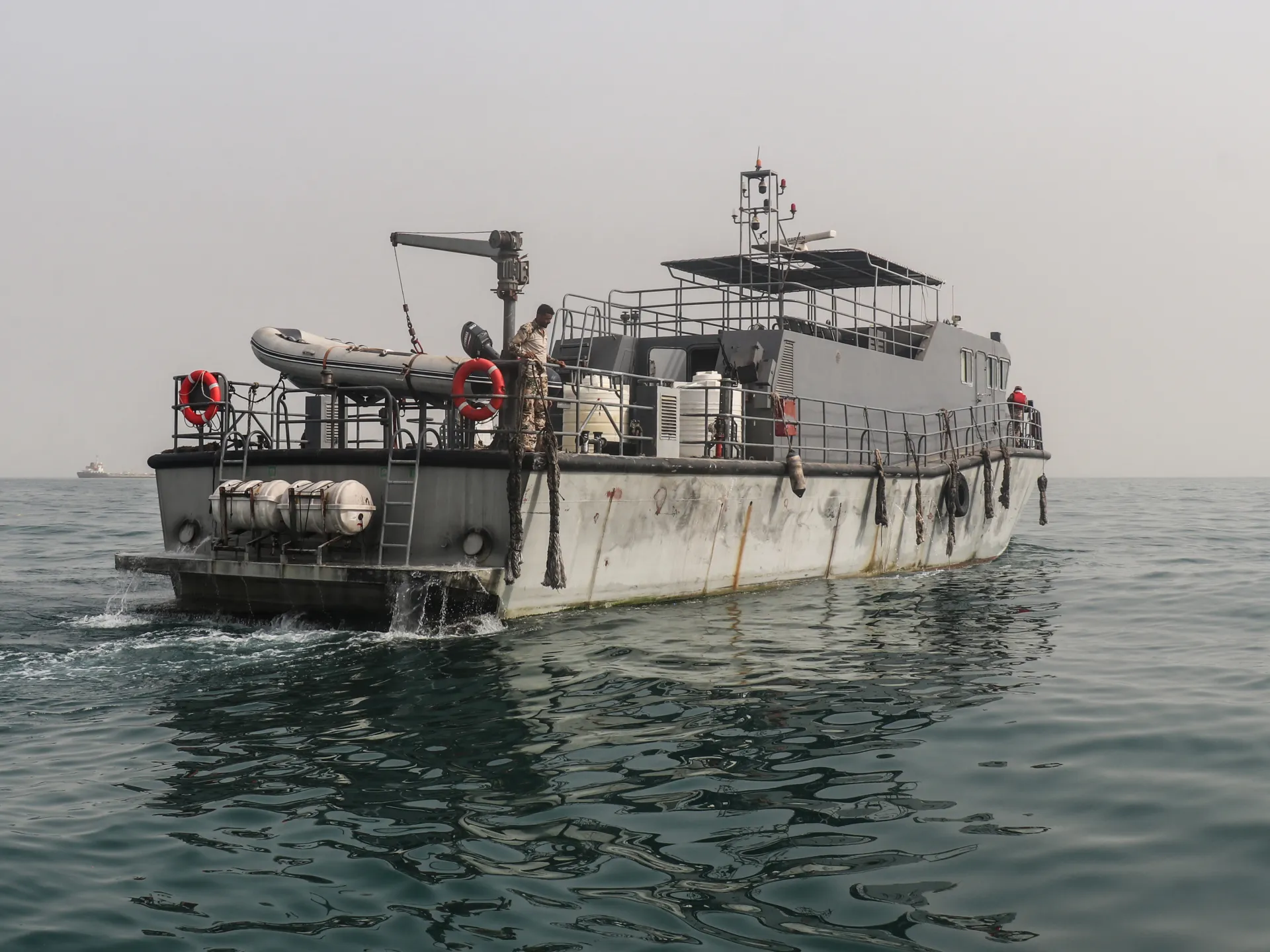
The alliance aims to defend shipping from attacks by Iran-backed Houthis in Yemen.
Saudi Arabia has announced a mission to form an international alliance to guard the Red Sea from attacks on shipping by Iran-backed Houthis in Yemen.
Dozens of countries have been invited to join the coalition, although membership has not been finalised, according to a Reuters report on Wednesday.
list 1 of 4In the waters off Malaysia, Iranian oil sales continue despite blockade
list 2 of 4India’s arms sale to Israel risks complicity in Gaza genocide, Amnesty says
list 3 of 4Is Israel repeating the Crusaders’ fatal mistake?
list 4 of 4US strikes cause extensive damage on Iran’s Qeshm Island
The Houthis imposed a maritime blockade on the kingdom on July 20 , disrupting oil shipments diverted to the Red Sea following the closure of the Strait of Hormuz. Reports have also emerged that they plan to impose tolls on shipping passing through the Bab al-Mandeb Strait off the coast of Yemen.
Tensions along the Red Sea shipping route have further hit global energy prices and supply lines, as severe disruptions to Gulf exports through Hormuz continue to reverberate.
The new Saudi-led alliance is set to be headquartered in Riyadh and could be unveiled as early as Thursday, according to reports.
The list of countries invited to join by the Saudis has not been officially released.
However, the United States, Pakistan, Egypt, Turkiye, Djibouti, Somalia, Sudan, as well as a host of European countries, including Germany, France and Italy, have reportedly been invited.
At least three Red Sea countries, Egypt, Djibouti and Sudan, have agreed to be in the alliance, reported Middle Eastern news website Al-Monitor, citing US officials.
The kingdom set a deadline for around 50 countries to confirm their participation in the alliance, the website said.
While the US, a key ally of Riyadh, has not yet confirmed it will join, it is expected to do so.
The Saudi Defence Minister, Prince Khalid bin Salman, held an urgent meeting with US President Donald Trump and Vice President JD Vance on Wednesday, according to US media.
Prince Salman reportedly conveyed to Washington that the kingdom was opposed to further escalation of the widening US-Israel war on Iran but is ready to “defend itself”, the US news outlet Axios reported, citing a source familiar with the meeting.
Iran has been targeting US military assets and infrastructure in Gulf countries in retaliation for US strikes since they began on February 28 .
The prince also reportedly told Vance that the kingdom can manage the situation with the Houthis in Yemen and does not need the US to get involved now.
On Tuesday, the US and Saudi Arabia launched joint attacks on Iran-backed armed groups in eastern Iraq, in what they said was retaliation for a barrage of Iran-directed drone attacks on Saudi territory.
The accusation prompted a warning by an unnamed Iranian defence official via the state broadcaster, the Islamic Republic of Iran Broadcasting (IRIB), on Wednesday that blaming Iran for such attacks was a “major miscalculation”.
The Red Sea lies between Saudi Arabia and Yemen on one side and Egypt, Sudan, Eritrea, Djibouti and Somalia on the other. It is one of the world’s most important shipping routes, carrying as much as 30 percent of global traffic.
It’s particularly important because of the Bab al-Mandeb Strait, the chokepoint that connects the Red Sea to the Gulf of Aden and the Indian Ocean. The narrow waterway is a critical artery for global oil exports flowing from Gulf states. It is also one of only two exit-entry points to the Red Sea, the other being the Suez Canal.
Bab al-Mandeb is only 29km (18 miles) wide at its narrowest point, limiting traffic to two channels for inbound and outbound shipments.
In 2024, 4.1 billion barrels of crude oil and refined petroleum products passed through the strait – about five percent of the global total.
With the ongoing US-Iran conflict and blockades on the Strait of Hormuz, Saudi Arabia has been forced to direct much of its oil exports through the Red Sea via Yanbu. But the Saudi port is now effectively controlled by the Iran-backed Houthis. As 20 percent of oil and natural gas supplies are shipped through the Strait of Hormuz in peacetime, as much as 25 percent of the world’s supplies are now affected by the conflict.
The Iran-backed Houthis took control of Yemen’s capital Sanaa in 2014.
Since then, they have fought against the Saudi-backed, internationally recognised government in the port city of Aden.
On July 20 , the armed group announced a naval blockade on Saudi Arabia in retaliation for years of Saudi military action. A few days before the announcement, the group also threatened retaliation for strikes on Sanaa airport.
The Houthis have accused Saudi leaders of imposing “an unjust and oppressive siege” for nearly 12 years, “plundering our resources and imposing a comprehensive blockade on our ports and airports by land, sea and air”.
Multiple Saudi-flagged vessels and oil facilities have since been targeted by attacks. Houthi spokesman Yahya Saree posted on X on Tuesday that the group targeted the Saudi oil tanker, NCC Ghazal, with ballistic missiles, forcing it to change course.
In 2023, following Israel’s attacks on Gaza, the Houthis disrupted global shipping by attacking Israeli-linked ships transiting Bab al-Mandeb,
Reuters reported on Wednesday that the Houthis are considering imposing fees on shipping – as Iran is also trying to enforce fees in the Strait of Hormuz.
Yemen’s Information Minister, Moammar al-Eryani, corroborated the news on Wednesday, and alleged that Iran’s Islamic Revolutionary Guard Corps (IRGC), which asserts control over shipping in the Strait of Hormuz, was involved.
Reports indicated that the plan is to create a dedicated “entity” that would collect payments from shipping companies and vessels, he said. A timeline for the tolls is unclear.
It would be “a dangerous escalation aimed at transforming one of the world’s most strategic maritime corridors into a permanent source of funding for the militia’s military and terrorist activities”, Eryani warned.
The issue of tolls has been a flashpoint in US-Iran peace talks as Iran warned that the Strait of Hormuz will never return to the days of free passage for all international shipping, and that some form of fees will be levied in the future.
Under international maritime law, countries bordering natural straits, such as Hormuz and Bab al-Mandeb, are not permitted to charge tolls, even when they flow entirely through territorial waters. However, in some cases, it is permitted to charge “service” fees, such as for docking and insurance.
On Monday, Yemen’s government suggested that the Houthis may be hoping to emulate Iran’s approach. “The Houthis want to copy the Iranian model and this will shut down two main straits, the gateways into the Gulf and Red Sea,” Afrah al-Zouba, the foreign minister-designate for the internationally recognised Yemeni government, told journalists.
Red Sea traffic dipped to its lowest level in months with only 11 vessels over the weekend, according to Reuters.
Before 2023, more than 70 ships passed daily through Bab al-Mandeb.
Oil prices, already volatile since the US-Israel war on Iran began in February, increased on Wednesday.
Brent crude rose to $88.09 per barrel after settling to a low of $72 earlier this month. Prices surpassed the $100 threshold last week.
Source: https://www.aljazeera.com/news/2026/7/30/why-is-saudi-arabia-forming-a-coalition-to-protect-the-red-sea?traffic_source=rss