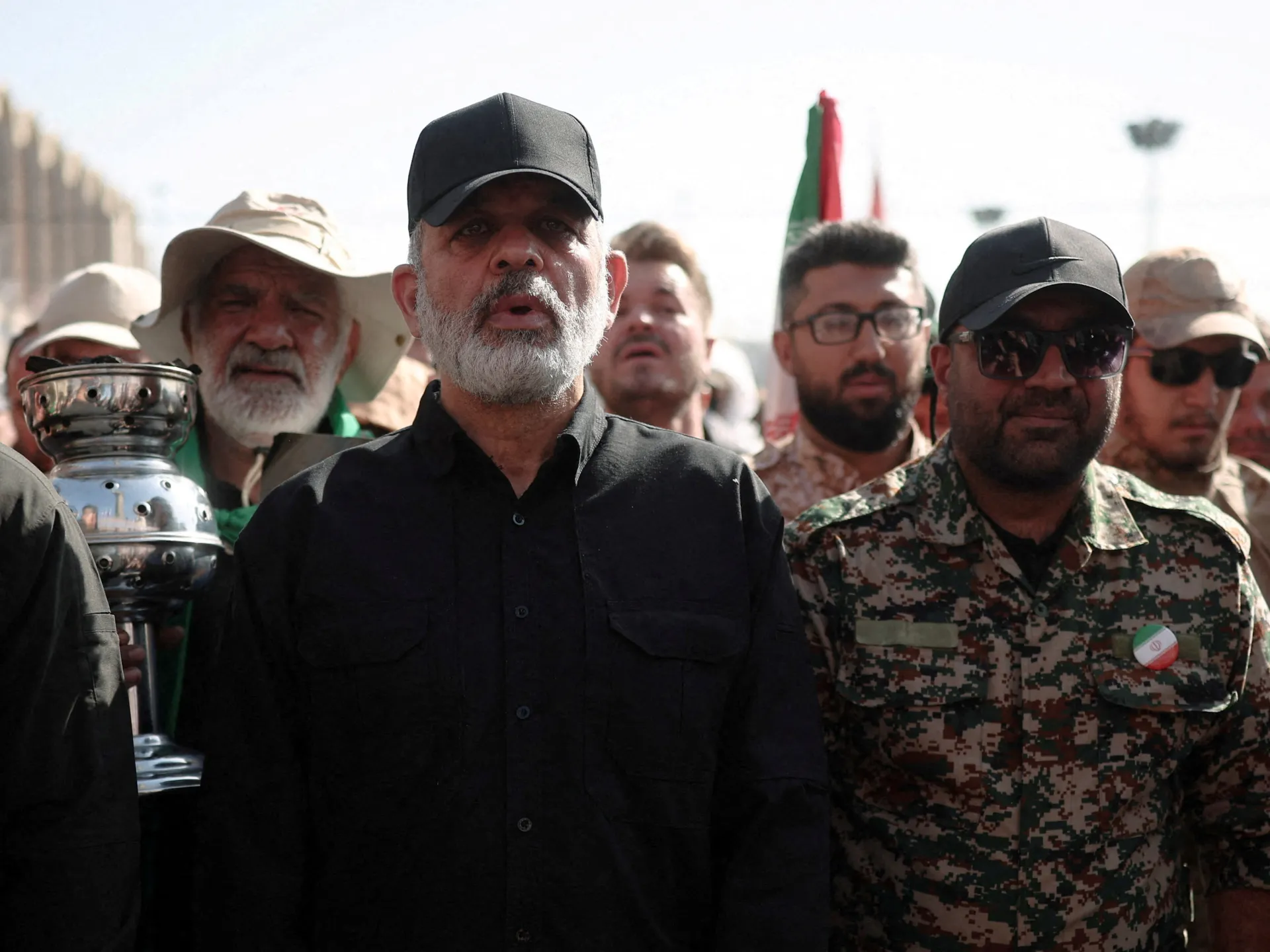
The IRGC has taken the lead in Iran, particularly over the Strait of Hormuz – and the government says it’s on the same page.
Tehran, Iran – According to the United States, Iran’s authorities are fighting among themselves.
“Nobody knows who is in charge, including them,” US President Donald Trump claimed in late April, after a ceasefire was only able to temporarily scale down military operations.
list 1 of 3Will Lindsey Graham’s death affect Israel’s standing in Washington?
list 2 of 3Iraq’s prime minister carries the title, but not the power
list 3 of 3As the US restarts war on Iran, is its weapons stockpile running low?
“They have no leaders left. We don’t know who the leaders are. Nobody knows who the leaders are – I don’t think they know who the leaders are,” he later added.
With Iran and the US moving farther away from a negotiated resolution, nearly five months after the start of the war, Washington is attempting to project the image of a confused Iranian leadership, one struggling for coherency after the assassination of former Supreme Leader Ali Khamenei and other senior officials during the conflict.
But that is a portrayal that Iranian authorities have categorically rejected.
Instead, when it comes to state policy, they have focused on a unified position that Iran will maintain a level of control over passage through the Strait of Hormuz, even in the face of escalating attacks from the US.
That is despite senior officials in Washington initially attempting to portray the fighting over Hormuz as being driven by a faction of hardliners in Tehran.
Multiple tankers and cargo ships have been attacked in the strategic waterway this month, after Iran made clear that it would not allow vessels to take a southern route through the strait near Oman, instead of a northern route passing through Iranian territorial waters.
Kazem Gharibabadi, Iran’s deputy foreign minister for legal and international affairs, told state television in an interview on Tuesday night that Iran had offered a third route for vessels to transit through during talks in Oman, which would also allow “all sides to return to implementing their [agreed upon] commitments”. But that proposal does not appear to have brought a resolution to the current crisis.
The clique of military and security commanders who have wielded power in Iran since the start of the war have shown a united front on the Strait of Hormuz, and have chosen to resume fighting with the US rather than backing down.
The most prominent among the ranks of these leaders include Ahmad Vahidi, the commander-in-chief of the Islamic Revolutionary Guard Corps (IRGC), Ali Abdollahi, the head of the joint wartime command, and Ali Azmaei, the new commander of the IRGC Navy.
They have all made rare public appearances over recent weeks for the funeral of Khamenei and other occasions, and have regularly stated their determination to solidify perceived military gains in the strait.
As secretary of the Supreme National Security Council, the top decision-making body that includes representatives from different political factions within the Islamic Republic, Mohammad Bagher Zolghadr acts as a principal institutional coordinator.
Zolghadr, who is also among the IRGC old guard, has only released several brief messages since replacing assassinated Ali Larijani in March as security chief. He has indicated that negotiation is acceptable only when conducted from a position of military leverage and without capitulation, that the IRGC’s capacities in the Strait of Hormuz are strategic assets, and that Tehran-backed allies in Lebanon and elsewhere remain an integrated part of national security.
Iran’s President Masoud Pezeshkian heads government ministries and budget and economic management, and has lobbied for diplomacy. But he has a weaker influence compared to the military-security elites – even though he technically heads the security council.
Since the beginning of his tumultuous presidency two years ago, he has repeatedly denied reports and speculation inside and outside the country that he has threatened to resign because of his diminished powers. Yet he often ends up as the scapegoat for failed initiatives.
Speaking during a televised meeting on Tuesday night, Pezeshkian once again sought to project an image of unity, especially with the military commanders leading the war, which has killed at least 30 civilians and hit 11 provinces across Iran just in the past week.
“Not only do I not consider myself to be separate from military commanders, but I will defend them strongly and consider it my honour. State television has no right to say the government and the military personnel are separate; that’s what Israel says,” Pezeshkian said, criticising the hardline-led IRIB state broadcaster.
Foreign Minister Abbas Araghchi, a prominent figure in negotiations with the West for two decades, has mostly focused his rhetoric on diplomacy, repeatedly blaming Washington for violating multiple articles of the memorandum of understanding with the US, particularly dealing with Hormuz, Lebanon, and oil waivers.
Mohammad Bagher Ghalibaf, the speaker of parliament, has been appointed as chief negotiator. He has used his background as a former IRGC commander, police chief, and mayor of Tehran to navigate the political landscape of the theocratic establishment in Iran.
But Ghalibaf and others in favour of talks with Washington have repeatedly come under fire from some of the most hardline elements of the Islamic Republic.
Those hardline factions include most of the lawmakers in parliament, which convened on Monday for the first time since the start of the war to renew calls for Khamenei’s death to be avenged, and for control over the Strait of Hormuz to be maintained.
The most hardline faction within the establishment is known as the Paydari Front, led by Saeed Jalili, a representative of the supreme leader in the Supreme National Security Council. State television is controlled by figures close to this faction, which regularly opposes any concessions to the US no matter the cost.
Based on the constitution of the Islamic Republic, ratified after the 1979 Islamic revolution, the supreme leader has absolute authority, and can rule for life.
Ayatollah Ali Khamenei was in total power for nearly 37 years, and the mantle has now been passed to his son, Mojtaba, who has not been seen or heard from publicly – apart from written messages attributed to him – but is backed by the military-security elite.
Last week, he reappointed hardline judiciary chief Gholam-Hossein Mohseni-Ejei, who has a vote in the security council, for another five-year term.
But Mojtaba Khamenei – who Trump claimed this week was “90 percent gone” – does not enjoy the same level of clout as his father, who had the final say in all matters.
Last month, he said he had authorised the memorandum of understanding despite holding “a different view” on it, after Pezeshkian and the security council accepted responsibility for whatever the outcome of the deal would be. He has also emphasised that it is incumbent upon the establishment, as well as “free people across the world”, to embark on a “divine mission” to avenge his father.
Source: https://www.aljazeera.com/features/2026/7/15/who-is-calling-the-shots-in-iran-amid-the-deadly-war-with-the-us?traffic_source=rss