Iraqi prime minister says relations with US shifting from militaristic to economic, vows disarmament of factions.
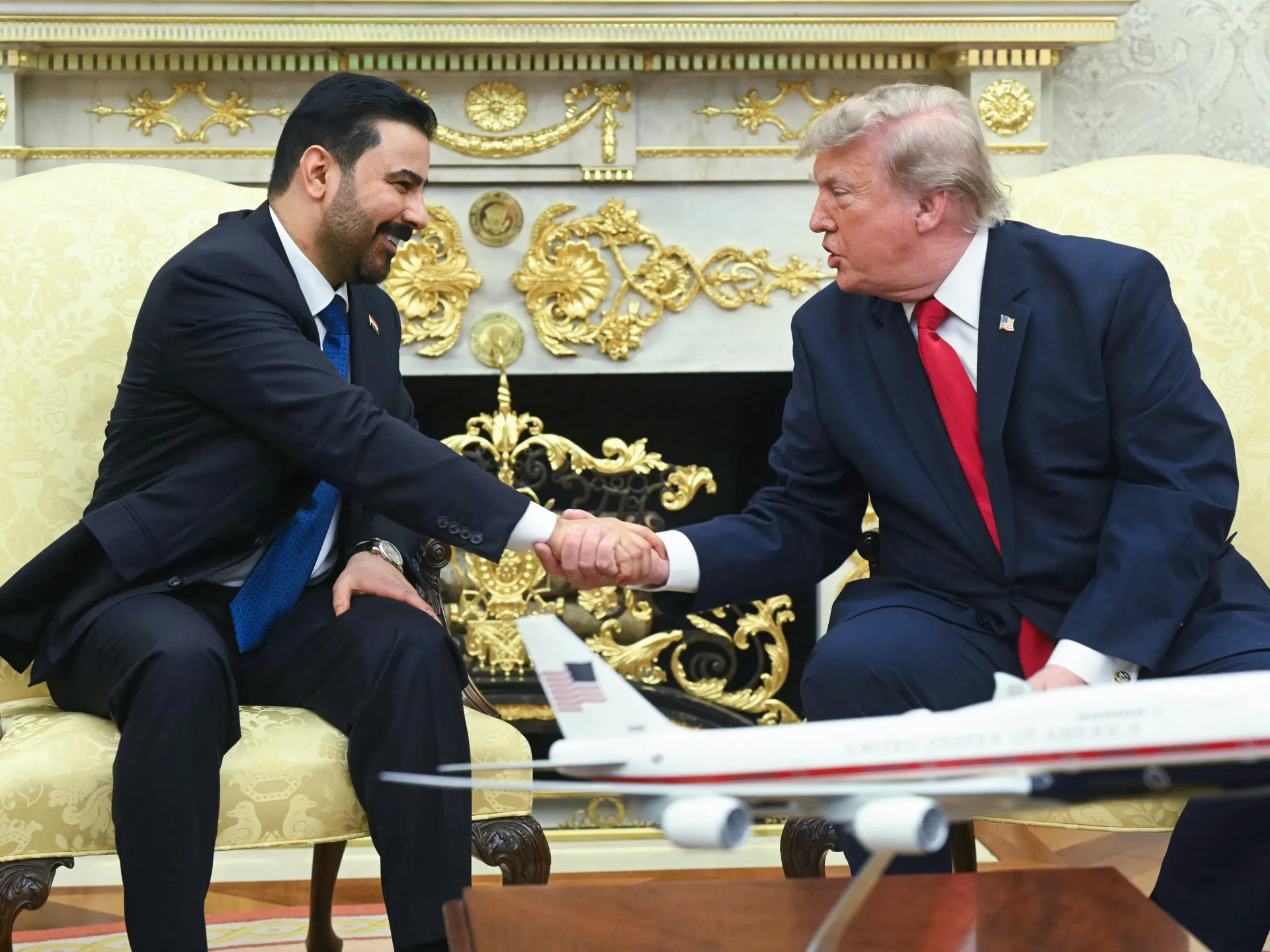
United States President Donald Trump and Iraqi Prime Minister Ali al-Zaidi have met at the White House in Washington, DC, with both leaders pledging to deepen economic ties and boost Iraq’s oil output.
The meeting on Tuesday came after Trump threw his support behind al-Zaidi, a businessman with no history in politics, and publicly opposed Iraq’s former Prime Minister Nouri al-Maliki for the prime minister role earlier this year.
list 1 of 3Trump says US ‘may take over Kharg Island’: Here’s what you need to know
list 2 of 3Strait of Hormuz traffic plunges as US, Iran resume fighting
list 3 of 3The US is building a new pressure architecture against Iran
Al-Maliki, a divisive figure seen as having close ties to Iran, subsequently dropped out of contention in April.
The Iraqi government had previously said it expected several oil and gas agreements to be signed during al-Zaidi’s visit to the US, with Trump also vowing a raft of deals during the Oval Office meeting.
He called al-Zaidi “a fantastic champion, a new champion”.
“Iraq has tremendous potential because of their oil and because of other things, but because of their oil, and we’re going to be doing a lot of deals,” Trump said.
“We’re going to create a lot of jobs for both countries, and we’re going to be taking out a lot of oil. A lot of oil is coming out,” he said.
Al-Zaidi, meanwhile, said the “visit was not like any other visit”, calling it the beginning of an “economic partnership”.
He said US-Iraqi relations were shifting from militaristic to economic.
Both he and Trump said the remaining US forces in Iraq, believed to number less than 2,000, would completely withdraw from Iraq by September 30. That is the same date al-Zaidi pledged that armed factions active across Iraq would disarm.
Iraq has long contended with the competing influences of Tehran and Washington in its domestic politics, with tensions over the continued US troop presence, deployed amid the conflict with ISIL (ISIS), and the pull of Iran-aligned armed groups.
In his first speech in parliament as prime minister, al-Zaidi vowed to disarm the country’s varied paramilitary groups, which have wielded power since the 2003 US-led war on Iraq.
He has not said how he will achieve the ambitious goal. Shortly before his departure, the Islamic Resistance in Iraq, an umbrella group of Iran-backed armed groups in the region, including Iraq, said it would reject any outcomes of al-Zaidi’s visit.
Iraq has also been one of several fronts in the US-Israeli war with Iran that began on February 28, with the conflict looming and its recent escalation looming large during al-Zaidi’s visit.
Iraq’s economy has also been particularly hard hit by Iran’s effective closure of the Strait of Hormuz, with about 90 percent of its 3.4 million barrels per day (bpd) of fossil fuel exports passing through the water.
The recent fighting has thrown into question the future of a memorandum of understanding (MoU), which in June beckoned in a temporary end to the fighting, the opening of the Strait of Hormuz, and the lifting of a US naval blockade on Iran.
Speaking to reporters at the White House, al-Zaidi also said that Iraq needs a “fair share” from the Organization of the Petroleum Exporting Countries (OPEC).
Iraq has been pushing for a higher quota on its oil production, with al-Zaidi saying the need is a direct result of the destruction caused by the war against ISIL, over which Iraq officially declared victory in 2017.
“The damage suffered by Iraq exceeds $400bn, and to this day, some Iraqis still have destroyed homes and are living in camps,” he said. “I have a plan to return them to their homes, and that is why I want a fair share for Iraq in OPEC.”
Source: https://www.aljazeera.com/news/2026/7/14/trump-meets-with-iraq-prime-minister-at-white-house-vows-a-lot-of-deals?traffic_source=rss