As the Ken-Betwa dam displaces thousands, legal protections on compensation are being ignored.
Madhya Pradesh, India - To reach the women of Kupi village, you must first want to find them.
From Chhatarpur railway station in Madhya Pradesh, it is 74km (46 miles) of broken road through hilly terrain. The road narrows as you enter Panna Tiger Reserve, one of central India's most ecologically rich corridors, home to tigers, gharials, and vultures painstakingly brought back from the edge of local extinction.
It is a humid July morning. The monsoon has settled over the reserve, turning the laterite roads to mud and the air thick with the smell of damp earth and forest.
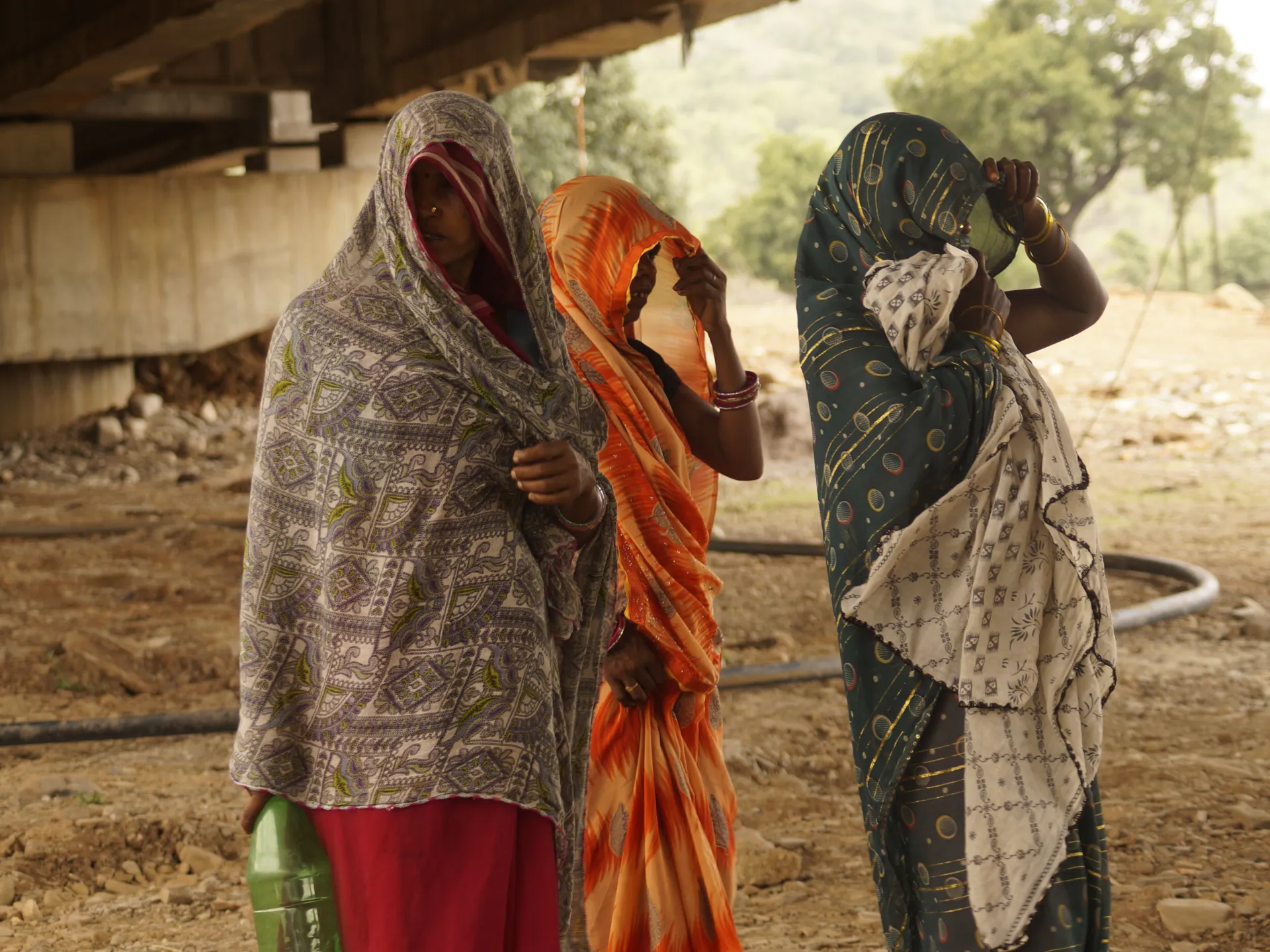
Beneath an unnamed bridge over the Barna River, in the buffer zone of this reserve, the women have gathered.
About 30 women in bright cotton sarees make their way towards the unlit pyres, their husbands and fathers standing a little way behind in white cotton kurtas. There is no ceremony to it. No silence. Some women talk quietly to each other as they settle among the stacked logs, one by one. A few pull their sarees across their faces. Others stare straight ahead, expressions fixed, revealing nothing.
This is the Chita Andolan, or funeral pyre protest. The pyres are not meant to be lit. For the women, they symbolise what displacement without compensation would leave them with: No home, no land and nowhere to go.
Fifty-year-old Gyan Rani Gond moves slowly. Her face carries something between frustration and anger as she lowers herself onto the pyre. She does not look away. She does not speak.
In the background, Amit Bhatnagar, 43, leader of the protest, and other villagers fill the air with slogans. "Inquilab Zindabad" (long live the revolution). "Nyay do ya maar do" (give us justice or kill us). The words rise above the rain.
Their villages lie in the path of the Daudhan Dam, the centrepiece of India's first river-linking project, which will eventually submerge 10 settlements in and around Panna Tiger Reserve. Some 7,000 families face displacement.
Gyan Rani belongs to the Gond tribe, one of central India's oldest Indigenous communities, recognised as a Scheduled Tribe in Madhya Pradesh. Like many families here, hers depends on the forest for its livelihood.
Her face is weathered from years working the fields and collecting forest produce. To get here from her village, she hitchhiked and walked to the nearest bus stop before travelling more than 70km (40 miles) to Kupi, borrowing 200 Indian rupees ($2) for the journey, to lie on an unlit funeral pyre.
She has come because no one is listening, she says. In her eyes, there is sadness, but no tears.
Gyan Rani's family owns 1.2 hectares (three acres) of agricultural land in Pathapur. Her husband, Gayadeen, and elder son, Hardas, have each received 12.5 Indian lakh (about $13,000) in rehabilitation payments, but the family says it has received no separate compensation for its agricultural land.
The adult women received nothing. Not Gyan Rani. Not her 18-year-old daughter, Muliya. Not her elder son's wife. And not Pooja, the 21-year-old widow of Gyan Rani's younger son, who died before receiving compensation himself.
Gayadeen says the money is being treated as a family resource rather than his alone. But he also believes the adult women in his household should have received compensation in their own names. The current payment, he says, is not enough to rebuild the family's life after displacement.
One of the family's two houses has already been demolished. Where it once stood, rubble remains: Broken terracotta roof tiles scattered across the wet ground and brick walls collapsed into a soggy heap, dark with rain. The second house is under threat. Pooja lives there, in a mud hut near a cowshed in Pathapur, waiting.
“Me, my daughter, and my daughter-in-law Pooja should be compensated,” Gyan Rani shares, her voice steady. “They have broken our house. Two houses. One is already broken. One is about to be broken.”
Adjusting her brown-coloured saree to cover her head, she says:
“If the government cannot give us compensation, then they should send us to another country. Because we have voted. We are citizens of this country. We voted for this government. Where is our right?”
On paper, India's land acquisition law appears to protect women such as Gyan Rani and Pooja. In practice, they say, it is doing the opposite.
The Right to Fair Compensation and Transparency in Land Acquisition, Rehabilitation and Resettlement Act (LARR), 2013, passed by Parliament to protect displaced communities, contains an explicit provision: The explanation of Section 3(m) states that every adult, regardless of gender, shall be treated as a separate family for compensation purposes.
In simple terms, Pooja, Muliya and Gyan Rani should each be entitled to independent compensation.
None of them has received a single rupee.
In practice, officials apply only the main text of Section 3(m), which defines family conventionally around a person, their spouse and dependent minor children, while failing to apply the explanation that recognises adults of either gender as separate families. Women without land titles or whose names do not appear on government lists can therefore find themselves excluded from compensation.
Ken-Betwa is the first of 30 planned river interlinking projects under India's National Perspective Plan. Campaigners fear that if the same interpretation of the law is applied elsewhere, women displaced by future projects could face the same exclusions.
As of April 2025, according to a Right to Information request filed by the Press Trust of India, India's national news agency, not a single affected family had been fully rehabilitated.
The government says that has since changed. In July 2026, Madhya Pradesh Revenue Minister Karan Singh Verma told the state Legislative Assembly that all eligible families in Panna and Chhatarpur districts had received compensation and rehabilitation benefits.
But the protests prompted the prime minister's office to seek a report from the state government, including over allegations that in some cases compensation had been deposited into the accounts of agents rather than affected families.
Following Bhatnagar's 18-day hunger strike, the Chhatarpur district administration on July 20 ordered a new verification of affected families, acknowledging that eligible households may have been left out.
On August 6, Union Minister of State for Tribal Affairs Durgadas Uikey told Parliament that his ministry had received no complaint explicitly stating that compensation already disbursed had failed to reach beneficiaries.
Construction of the dam, meanwhile, has continued.
Families whose homes have already been demolished have largely been left to fend for themselves. Using compensation, where it has been paid, they are trying to buy land and build new homes independently. None has yet been formally resettled by the state, and many say the compensation they received was insufficient to rebuild their lives.
From the protest site at Kupi, the road runs another 70km (43 miles) into the forest, towards the villages whose disappearance the women have gathered to resist.
The track is unmarked and largely unmaintained. The monsoon has washed out stretches of laterite, leaving behind mud and loose stone. Rain-washed forest lines both sides of the road.
Kupi will be the last village to disappear. When the Daudhan Dam is fully operational, it will be the final settlement swallowed by the rising waters.
Pathapur sits at the end of that road, quieter still. Several houses stand half demolished. Others are intact but marked, their walls bearing the invisible stamp of government orders. The Barna River runs nearby, its waters feeding into the Ken, the river that the Daudhan Dam will one day hold back.
In the village, Gyan Rani’s daughter-in-law Pooja Gond meets a visitor at the door of her home and offers a cup of sweet black tea.
Pooja is 21 years old, slight and soft-spoken, with a swelling on the right side of her face from a bee sting the night before. She speaks in a quiet, flat voice, the kind that comes not from shyness alone but from a deeper exhaustion, the exhaustion of someone who has already lost too much to spend energy on expression.
She was one year into her marriage when her husband Parshuram died. He was a daily wage labourer. He developed severe abdominal swelling. The family sought treatment from a local doctor, but Parshuram's condition worsened. No formal diagnosis or post-mortem was ever carried out. Their one-year-old son later died after what the family believes was typhoid fever, although there was no formal medical confirmation.
Pooja has not received a single rupee in compensation. Neither has her sister-in-law, who has voted but whom officials describe as underage. Pooja herself does not receive a widow's pension. Officials tell her she is too young for that too.
The compensation built two small rooms. That is all the family has to show for the home they are losing.
When Pooja approached officials after Parshuram's death, she was told her name was not on the compensation list. If she wanted it added, the Gram Panchayat secretary told her, she would need to pay 100,000 Indian rupees [$1,050]. She did not have this money.
The secretary sits in Kishangarh, 10km (6 miles) from Pathapur. Pooja walked there. She also travelled by bus to the district headquarters in Chhatarpur, carrying her documents. She spent 800 Indian rupees ($8) of her own money on the journeys.
Each time, officials collected her papers. Each time, nothing happened.
“Bina paise ke koi baat nahi sunta,” she says quietly. Without money, nobody listens.
One of the two houses her family occupied was demolished without notice. Pooja was there as neighbours watched and the family asked officials to stop. Nobody listened.
Officials told her mother-in-law they were demolishing this house first. Nobody told the family where they were expected to go.
They moved into the house that remains.
It is a small mud house with white walls and a hay-and-terracotta-tiled roof. Faded tribal hand-painted art runs along the walls, its colours worn thin by rain and time. A wooden door opens into a small courtyard. Inside, a wood-fired mud oven sits in the kitchen.
This house is next. Pooja knows that, but she does not know where she will go.
If relocation becomes unavoidable, she says she wants to remain close to the forest. She does not want to move to a city.
“It would have been much better if they had given us land in exchange for land,” she adds. “We don’t just want money. We want land.”
Then there is also Muliya, Gyan Rani's 18-year-old daughter. She has a voter ID. She has voted. Officials told her she was too young for compensation.
She has sores inside her mouth that have not healed. Her sister-in-law Pooja speaks for her. If compensation comes, Pooja says, Muliya would use it for treatment. For an 18-year-old fighting to be recognised as an adult by the state, compensation means something immediate: The chance to see a doctor.
Every summer, she collects mahua flowers and chironji from the forest to sell. Mahua also feeds the family, is used in traditional cooking and medicine, and forms part of Gond cultural life. "The forest gives us everything," she says.
What happened to Gyan Rani, Pooja and Muliya is not an administrative oversight, says Bina Agarwal, professor of development economics and environment at the University of Manchester and author of A Field of One's Own. It reflects a contradiction in how the law defines a family.
"Article 3(m) of the LARR Act defines the family conventionally," Agarwal says. "But the explanation that follows treats every adult as a separate family. If the explanation became the main text of the law, it would unambiguously benefit women."
In practice, officials apply only the conventional definition of the family, she says, meaning wives, widows and adult daughters are routinely excluded from compensation lists.
The solution, Agarwal argues, requires no new legislation.
"Financial compensation should go into the bank accounts of all adults in the family separately," she says. "Land should also be registered jointly, with equal rights for women."
Back at the protest site, Amit Bhatnagar, 43, convener of the Jai Kisan Sangathan, a farmers’ rights organisation, sits quietly beside the Barna River as the slogans rise around him.
For nearly four years, he has organised resistance to the Ken-Betwa displacement. During that time, he says, hundreds of protesters have faced criminal cases, while electricity, water and ration supplies have been disrupted in some affected villages.
“Suppose the survey was conducted in 2018 but displacement occurs in 2026,” he shares. “During those eight years, children become adults, daughters get married, and family structures change. Despite those changes, compensation continues to rely on the old survey.”
Bhatnagar says the problems do not end when compensation is paid. He has documented cases where men spent the money on expensive motorcycles and alcohol, leaving nothing for their families. Some, he adds, were later involved in near-fatal accidents on those same bikes. Money intended to secure a family’s future, he says, was gone before replacement land had even been found.
From his experience working in the affected villages, Bhatnagar estimates that 400 to 500 women, particularly widows, have been excluded from compensation because their names never appeared on the original lists. There is no independently verified count of how many women have been excluded.
After two weeks on hunger strike demanding that officials address the issue, Bhatnagar, now even leaner than his usual frame, explains he was arrested by police on July 19 along with hundreds of protesters as officers moved in to end the demonstration. Authorities said the action was taken because of rising water levels and monsoon conditions.
Bhatnagar's arrest brought the latest protest to an end. The questions raised by the protesters, however, extend far beyond Kupi village. Ken-Betwa is not only transforming one river basin. As the first of India's 30 planned river-linking projects, it could set a precedent for how people displaced by the projects that follow are compensated.
Ken-Betwa is India's first river-linking project under the National Perspective Plan. When complete, the Daudhan Dam will submerge 10 villages inside Panna Tiger Reserve and displace thousands of people. Supporters say it will bring irrigation, drinking water and hydropower to drought-prone Bundelkhand.
Critics have challenged the environmental assessment and approval process. But for women in villages such as Pathapur, the more immediate concern is how compensation is distributed, and whether the interpretation being applied here will be repeated as India's river-linking programme expands.
Officials approached by Al Jazeera either referred questions to publicly available government material or did not respond to specific questions about compensation for women affected by the project.
Back in Pathapur, Pooja sits in the verandah of the family's remaining house and points towards the rubble where the first one stood.
If she ever receives compensation in her own name, she says, the first thing she would do is pay for Muliya's treatment.
For now, she waits. She knows the second house will fall. She just does not know where she will go after it does.
Source: https://www.aljazeera.com/features/longform/2026/8/15/the-women-indias-biggest-river-project-forgot?traffic_source=rss