Ryan O'HanlonJul 8, 2026, 03:13 AM ETCloseRyan O'Hanlon is a staff writer for ESPN.com. He's also the author of "Net Gains: Inside the Beautiful Game's Analytics Revolution."
Since the World Cup expanded to 32 teams in 1998, there have been 28 quarterfinal matches. Of those 28 games, 14 were decided by one goal and just five saw someone win by two goals or more.
The remaining nine matches? They ended in penalty kicks.
What that all means is that 82% of modern World Cup quarterfinals have been decided by a single goal or less, and just about a third of them have been tied after 120 minutes. As we whittle the 2026 World Cup field down to a final four, it's likely that at least one quarterfinal will go all the way to penalties and at least three of the games finish with nothing more than a one-goal win.
Given how low scoring soccer is and how unlikely it is that any given shot becomes a goal, a one-goal margin tells us who kicked or headed more shots into the goal -- and not much else. Systematic dominance produces more wins over the long haul, but we've reached the part of the tournament where individual brilliance and high-leverage execution overwhelms everything else.
As we approach the quarterfinal round -- when individual players may very well be the deciding factor -- now is the time to look at the superstars and supporting players who are likely to have an outsize impact on what happens.
These are the eight most important players for the quarterfinals of the 2026 World Cup.
France are very close to being a broken team. I don't mean that in the way that it would normally describe Les Blues: that their players hate each other, their manager is using the Zodiac cycle to select his lineups and they're one bad result away from a full-scale mutiny.
No, I mean that the pieces of the team don't really work together.
There are four defenders who mostly just defend, there are four attackers who mostly just attack, and then they have two midfielders who do a bunch of running but don't connect the front four with the back four in any kind of consistent way.
The best teams in the world usually have attackers who defend, defenders who attack and midfielders who modulate the transitions between the two. The more players who contribute to the attack, the more goals you'll score -- and vice versa.
France don't really have that, but they do have Olise. Put simply: This team would not work without him. But with him? They're the favorite to win the World Cup.
Soccer is supposed to be a game of trade-offs. If you complete a lot of aggressive passes, you have to sacrifice your completion percentage. If you want to touch the ball a lot, you can't be as involved near the goal. If you want to create chances, you have to give up goal scoring. If you're an active defender, you're giving up energy you could use when you're in possession.
All of that is usually true, except for with someone such as Olise.
Per the stats app Futi, he's involved in 11% of France's phases of play -- most on the team. And yet he's second on the team in expected goals (xG) generated. He's second on the team in xG and yet he's leading the tournament with five assists. He's completing 83% of his passes, and yet he's leading the team with 32 progressive passes. He's second on the squad in defensive actions in the attacking half, and yet he's leading the team in progressive carries.
This image of Olise's progressive carries and passes throughout the World Cup comes courtesy of Futi:
France can have defenders who only defend and attackers who only attack, and it can add up to the best team in the world because Olise multiplies the team's performance at all levels.
He's an elite passer who is also an elite shot getter. He's a world-class attacker who touches the ball as often and loses it as rarely as a top midfielder. He dribbles past defenders as easily as he slips through balls between them.
Most teams will be worried about how to stop Kylian Mbappé. But the way you stop Mbappé? It's by stopping Olise.
Hakimi is basically Morocco's Olise: the singular player who's able to do so many things that it allows everyone else to worry only about doing the things they're good at.
He's involved in 12% of all of Morocco's phases of play -- most on the team -- and he has won 80 of those phases, which means that his involvement ended up increasing their probability of scoring a goal. No one else on the team has won more than 55 phases, and Hakimi has almost 100 more touches in the attacking third than anyone else on the squad.
Oh wow, cool. There's a team in this tournament that basically uses its right back to do the job of a great midfielder?
That is cool, but you know what's even cooler than that? A team that uses its right back as if he's a great midfielder and an elite goal scorer. Hakimi is leading Morocco in shots (13) and expected goals (2.1). Just for fun: He's also leading the team in chances created with 13, while no one else is even in double digits.
Can he do all of that and stop Mbappé when Morocco meet France? I'm going to go out on a limb and say that no, Hakimi will not put Mbappé in his back pocket, complete double the number of passes of all of his teammates, lead the team in goals and create more chances than anyone else Thursday.
But what I will say is that Hakimi is the only player in the world who is capable of defending Mbappé and contributing in the attacking third consistently over the course of the same match.
If you're an underdog trying to upset France, then it's hard to think of a better superstar to have built your whole team around than the world's greatest right back.
I mean this with as much love as possible: Haaland is what a dumb guy thinks a great soccer player looks like. He runs fast, he jumps high and he kicks the ball into the goal.
And, well, he's so fast, he jumps so high and he kicks the ball so hard that the dumb guys are right: He might be the best soccer player.
Haaland is involved in only 4% of Norway's phases of play. He has completed 35 total passes and he has dribbled by one defender -- the same number as Cape Verde's 40-year-old keeper Vozinha. And yet, per Futi, Haaland ranks in the 99th percentile for the value he creates from shooting and the 99th percentile for the value he creates from receiving passes.
The 25-year-old has attempted 18 shots, while no one else on Norway is north of 10 and only one other guy has taken more than four. He has generated 4.9 expected goals, and his next-most-dangerous teammate, Martin Ødegaard, is at 1.0.
Calling Haaland "the most important player on Norway" isn't interesting or insightful. I am aware of this. But what is interesting about Haaland is how he allows Norway to play any kind of game that they want.
A lot of center forwards tend to be better suited to a certain style of play -- some flourish when they have space to run into on the counter, while others are better suited to the subtle movements required to convert possession dominance into goals.
For most of the tournament, we saw Haaland rip teams apart on the counterattack. Presumably, Brazil were aware of this when they let Norway dominate the ball in their round-of-16 matchup. Without space to run into against the Brazilians, Haaland ... scored twice and pretty much won the game by himself.
I'd imagine England will go the other route and try to pin the Norwegians into their own third, like they did against Panama and Ghana and eventually Congo DR. But that English backline looked quite shaky in the handful of moments when those teams were able to get out and run. I'd be frightened by the possibility of Haaland getting those same opportunities.
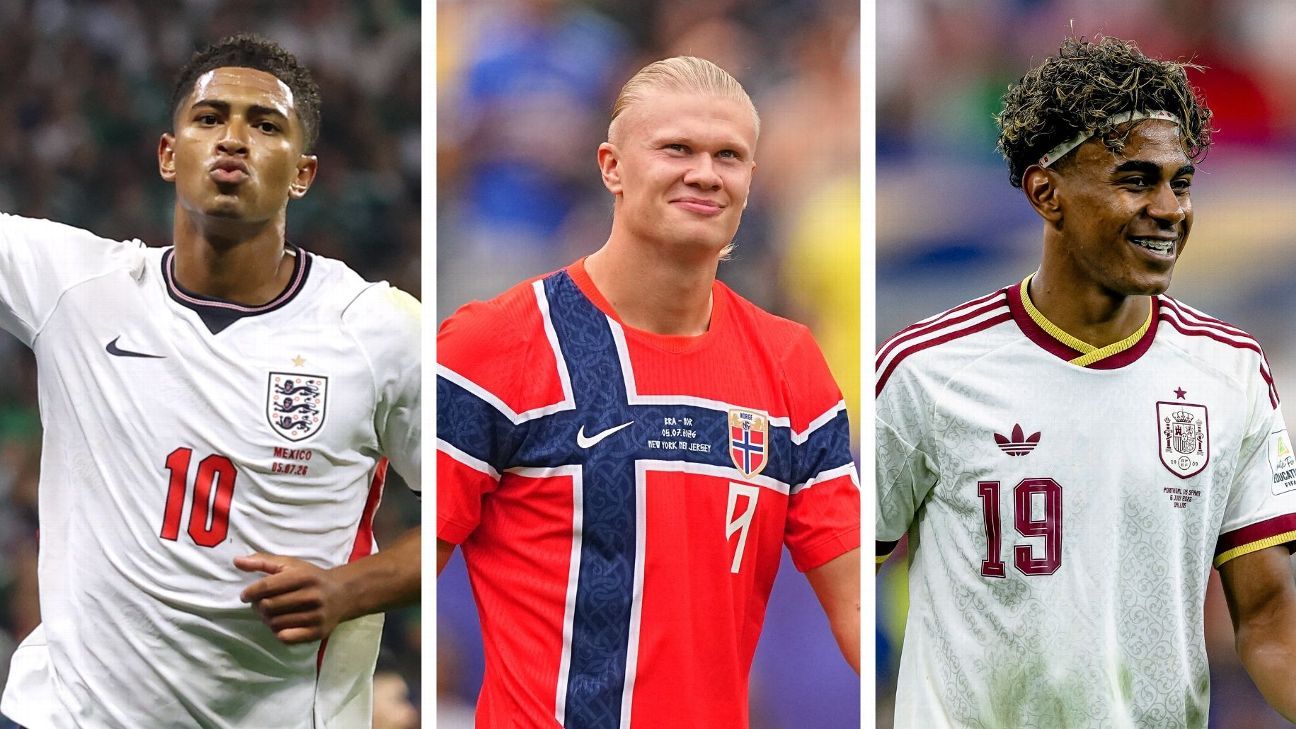
Harry Kane is probably England's best player, but Bellingham is their most important.
Actually, you know what? Bellingham might just be their best player, too. He's good at everything -- he rates out as above average in shooting, dribbling, linking and ball winning, per Futi. But his superpower is what he does off the ball: He's in the 91st percentile for passes received.
Want to understand why? Just rewatch his opening goal against Mexico. Bellingham is 40 yards from goal when Bukayo Saka starts his initial dribble. There are five players between him and the center of the box, and yet he beats all of them to the spot.
HEY JUDE! gbengEngland takes a 1-0 lead in Mexico City courtesy of the Jude Bellingham header! pic.twitter.com/p0oE3MWRdb— FOX Sports (@FOXSports) July 6, 2026
HEY JUDE! gbengEngland takes a 1-0 lead in Mexico City courtesy of the Jude Bellingham header! pic.twitter.com/p0oE3MWRdb
I'm of the opinion that something good happens pretty much every time a midfielder makes a run from deep into the box. The runs are so dangerous for a couple of reasons: (1) It's hard work for any defender, who just wants to mark space, to follow, and (2) it requires NBA levels of on-a-string, cascading coordination for the opposition defense to handle them without getting disorganized.
England generally play a very conservative positional game when they're in possession. Bellingham's off-ball movement is the one real risk they take when they have the ball, and it has been at the core of the majority of the goals they've scored thus far in the tournament.
Of course, having a midfielder who just runs into the box and does nothing else would be incredibly destabilizing for a team. Bellingham, though, does everything else at a good-enough-to-great level, too.
Bellingham leads England with 58 phases won. He has received a team-leading 37 progressive passes, which allows center forward Kane to drop deeper in possession. He has beaten more defenders off the dribble than any England player. He leads the team in attacking-third touches. He's third in attacking-half defensive actions and sixth in defensive-half defensive actions.
In other words, Bellingham is England's glue guy and their game winner.
Through five games, Spain have taken 2,944 touches in the attacking third. No other team has even reached 2,600 thus far. In Spain, a baby is born every 90 seconds who will eventually learn how to complete 89% of his passes in a LaLiga match against Osasuna.
This team has been systematically moving the ball into the attacking third and keeping it there for almost 20 years now. If Spain lose a game at the World Cup, it is, without fail, accompanied by some absurd statistic like "Spain completed more passes in this match than the nation of Egypt has attempted in their entire history at the tournament."
Keeping the ball and moving the ball forward is never a problem for this team. Honestly, Spain's top 50 players could all get injured and it would still be a competent possession team.
The issue, instead, has almost always been: How do you turn that into goals? Here is the answer:
The difference between Spain being an imperfect, frustrating contender and Spain being, clearly, the best team in the tournament is going to be whatever happens after those dribbles.
Per Futi, Yamal is in the 99th percentile for dribble and carry value added. But he's only in the 56th percentile for the shots he's getting and the 22nd percentile for the shots he's creating. His ability this past season to generate shots for himself and his teammates at an elite level is what turned him into arguably the best player in the world.
We haven't seen that yet at the World Cup. Yamal has scored only once, and he has created only five total chances for teammates.
Ahead of the quarterfinals, Belgium are the second-biggest underdogs to win their next three matches and lift the World Cup trophy. According to Michael Caley's PADDLIN' model, Belgium have just a 4% chance of winning it all and only a 26% chance of advancing past Spain to the semifinals.
So, here we're going to focus on a volatile player with a high ceiling -- someone who, if they do somehow make it to the final, will likely be a driving force behind it. And someone who also might not even start the quarterfinal and might play just 30 minutes between when you read this and the end of the tournament.
Doku has started only three of Belgium's five matches, and he has played significantly more than an hour in only one. When he's out there, he hasn't really done all that much, either -- outside of some decent minutes in garbage time against the U.S. men's national team. The 24-year-old has zero goals, zero assists, 0.2 xG, 0.2 expected assists, three shots attempted and three shots assisted. That's one half of work for a bunch of the other guys on this list.
In the Premier League this past season, though, Doku finally became one of the best players -- full stop. Futi's model rated him as the fourth-best player in the league, behind his Manchester City teammates Haaland and Rayan Cherki, along with Manchester United's Bruno Fernandes. To put it simply: Doku is the best ball carrier on the planet. He completed 238 progressive carries this past season. Next most in the league was 151.
In the past, his game was all ball carrying and little else. This year, though, he turned that into 8.2 expected assists -- sixth most of any player in England. When he's at his best, he's basically unstoppable. We saw that a lot more with his club team. Will we see it for his country?
Uh, is that an alternative spelling of "Lionel Messi"?
Yes, Messi might still, somehow, be the best soccer player in the world. He and Haaland are the only two players, per Futi, who rate in the 99th percentile for overall value added in possession at the World Cup. He leads all players in expected goals and expected assists. He's Argentina's best goal scorer, their best creator, their best facilitator, their best dribbler and ... their worst penalty taker?
The point is: You are not going to stop Messi. It has never happened. If he's not scoring goals, he's creating goals. If he's not creating goals, he's moving the ball up the field so someone else can create and score the goals. Messi is so good at everything that, outside of injury, illness or alien abduction, he is all but guaranteed to have a large impact on every game he plays in -- still.
The key, I think, is to make it so Messi has to drop farther away from his goal to have an impact. Back around 2018, Argentina needed Messi to move the ball up to the attacking third and then also create chances and goals after he did that. They barely got out of their group and then were detonated by eventual champions France in the round of 16.
A big change since then comes in how Argentina support Messi: with younger players who cover the ground he no longer can, and with lots and lots and lots of passing. Messi walks whenever he can and gets service much closer to the goal now. You can see the result: two straight Copa America titles, a World Cup title and goals in nine straight World Cup matches.
Manager Lionel Scaloni is refusing to play with wingers this summer, which means Argentina have to progress the ball up the center of the field since that's where all of their players are and do it through a higher density of bodies since there's no one to worry about out on the wings.
The most important part of this plan might be Manchester United's Lisandro Martínez. He set up the opening goal against Cape Verde, and he has completed nine more progressive passes (31) than any non-Messi teammate. These are all of his progressive passes and carries, via Futi:
Because Messi barely engages on the defensive end, it's really hard for Argentina to press and pin the ball in their attacking third. When they defend well, it's because all of their defenders are making defensive plays. Martínez ranks second on Argentina for defensive actions in the attacking third and for defensive actions in the attacking third.
Outside of Vozinha and Eloy Room, there hasn't been a ton of great goalkeeping this summer. Or, at least, there weren't many goalkeepers who were the main reason why their teams got as far as they did.
Switzerland are the biggest underdogs in the quarterfinals, and if they do find a way past Argentina, it's hard to see it happening without Kobel standing on his head. And it's not like we haven't seen him do it before.
He was the main reason a mediocre Borussia Dortmund team made it to the Champions League final in 2024, and he has been the best goalkeeper in the Bundesliga for the past half-decade.
If we look at where the shots he faced ended up on the goal frame, Kobel would have been expected to concede about 200 (199.5) goals in his five years at Dortmund. He has allowed only 181. That 19-goal gap is by far the largest of any long-tenured goalkeeper in the German top flight. Among players with at least 100 starts, no one else has saved more than seven goals above average.
Kobel's shot stopping has carried over to this summer, too. He made a fantastic save to give Switzerland the edge in their shootout win in the round of 16. Overall, he has faced shots on target worth 4.96 expected, and he has allowed just two non-own goals. That nearly three-goal gap? It's the biggest for any goalkeeper in the tournament.
Source: https://www.espn.com/soccer/story/_/id/49301521/most-important-player-every-2026-world-cup-quarterfinal-team