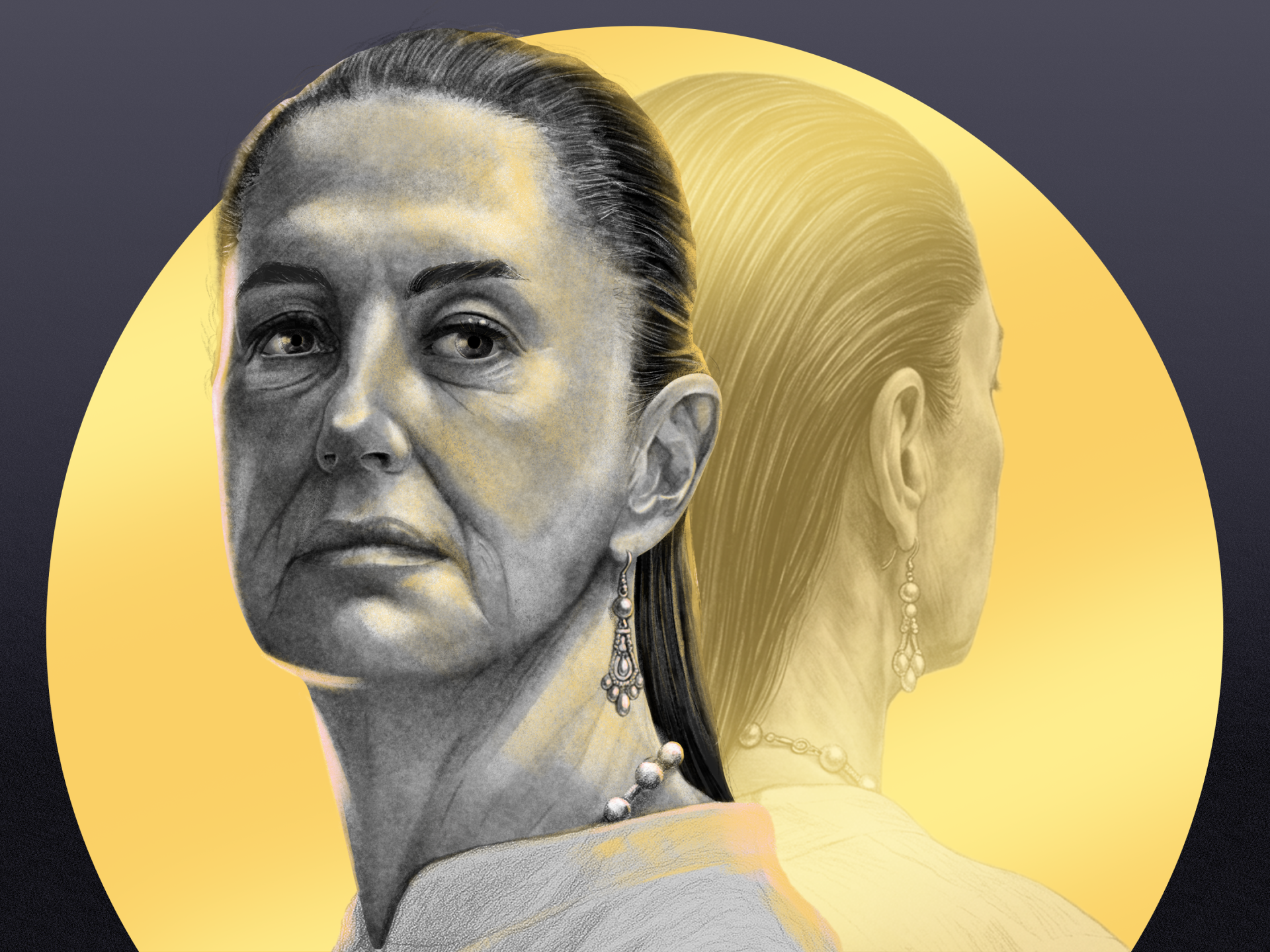
One of Claudia Sheinbaum’s earliest childhood memories is visiting political prisoners with her parents, a moment that helps explain why she calls herself a “child of 1968” — the year protest movements erupted around the globe.
In Mexico, mass student protests targeted the Institutional Revolutionary Party (PRI), which had governed Mexico since 1929. Often described as the “perfect dictatorship,” the PRI maintained the illusion of democracy through symbolic elections while suppressing dissent.
After months of protests, a crowd of activists assembled in Mexico City’s Plaza de las Tres Culturas on October 2, 1968. Helicopters circled overhead and flares were reportedly fired into the crowd, before snipers opened fire from nearby rooftops. As bodies fell, a panicked crowd scrambled for cover.
Estimates vary, but up to 300 were believed to have been killed and more than a thousand arrested, effectively quashing the movement.
Sheinbaum has recalled how her mother and father took her to visit their friend and protest leader Raul Alvarez Garín at Lecumberri prison. To this day, she considers him one of her mentors.
Decades later, that political inheritance helped shape the career that won her the presidency in 2024.
“She’s the first woman to become president of the Mexican republic – a country that, because of our culture and the way we’ve been raised, is very macho; a country that seems eternally in crisis,” said Baltazar Gomez Perez, an old friend of Sheinbaum’s and a history professor at the National Autonomous University (UNAM).
Before assuming office, many assumed Sheinbaum would be a carbon copy of her mentor, populist Andres Manuel Lopez Obrador — better known as AMLO — who was president from 2018 to 2024. A climate scientist by training, she has taken a more pragmatic and security-minded approach than AMLO, while navigating intense pressure from the United States.
In January, after Delta Force abducted Venezuelan President Nicolas Maduro in a nighttime raid in Caracas, President Donald Trump used the occasion to suggest that the US might expand anti-cartel operations onto land in Mexico.
“We categorically reject intervention in the internal matters of other countries,” she said.
“Cooperation, yes; subordination and intervention, no.”
Several weeks later, she showed she could confront cartels on her own terms. Army helicopters closed in on luxury cabins in the wooded hills on the outskirts of Tapalpa, a quiet town in central Mexico. Federal authorities had intelligence that the gated compound hid Nemesio Ruben Oseguera Cervantes, aka “El Mencho”, Mexico’s most-wanted and dangerous drug lord and head of the Jalisco New Generation Cartel (CJNG).
Groggy from a late-night party, Mencho’s armed entourage was caught by surprise when special forces stormed the perimeter. A firefight erupted, and Mencho fled to the nearby woods, where he was found mortally wounded in the undergrowth.
The Mencho operation demonstrated that Sheinbaum wasn’t afraid of taking on the cartels, but it might not have been enough. The following day, Trump posted online that Mexico must do more to fight crime and drugs.
The White House has also exerted trade pressure, using tariffs over the past year to squeeze Mexico and declining to renew the United States-Mexico-Canada Agreement (USMCA) in its current form.
Yet, despite fears that Mexico is too dangerous to cohost the World Cup, the games there have proceeded smoothly. The president was spotted watching Mexico’s opening match against South Africa in a fan zone in the capital, having given her stadium ticket away to a young female fan. This sort of down-to-earth image evoked the ‘man-of-the-people’ leadership projected by her mentor, AMLO, but Sheinbaum has also sought to step out of his shadow and define herself as a pragmatic leader capable of handling cartel crackdowns, violent crime and mounting pressure from the White House.
Claudia Sheinbaum Pardo was born in Mexico City in June 1962 to Carlos Sheinbaum, a chemical engineer and Annie Pardo, a biologist, both of Jewish heritage.
Her paternal grandfather, Chone Sheinbaum, was a Lithuanian Jew who fled anti-communist persecution in his homeland to Cuba before being deported to Mexico. There, he joined the Mexican Communist Party, which was also persecuted but well-established and included many high-profile foreigners. At one point, Chone was kidnapped by government agents who interrogated him and tried to expel him to Guatemala.
Her mother’s side of the family fled Bulgaria in the 1940s during the Holocaust.
“They were saved by a miracle,” Sheinbaum once wrote, adding that many family members “were exterminated”.
Though both Carlos and Annie were Jewish, Claudia was raised in a secular home. As a child, she eavesdropped on political discussions between her parents and their friends and found books by Karl Marx hidden away in closets so as not to attract unwanted attention.
Sheinbaum attended the Escuela Manuel Bartolome Cossío, a private school in the Tlalpan district, where pupils were allowed to set their own curriculum. Videos show the future president playing a charango, a type of guitar.
From the age of 15, Sheinbaum began attending protests and even participated in hunger strikes, including one at Mexico City’s Metropolitan Cathedral, organised by the mothers of those who disappeared under PRI repression.
After high school, Sheinbaum enrolled in UNAM to study physics. While there, she became more involved in student activism.
“We met at preparatory school [for university] when we were very young, 18-19 years old, because we were both student activists in support of workers’ movements and peasants,” remembered Gomez.
“I came from a working-class neighbourhood, so Claudia [and her friends] were bourgeois rich kids to me. We were different, but we realised we shared the same ideals,” he said.
“She was a girl who was not only concerned about social issues but also liked to participate in cultural activities. She practised ballet, and one day she invited us to see Swan Lake at the lake in Chapultepec Park.”
In 1986, their university announced controversial reforms, including tuition fee increases and plans to privatise. In response, the University Student Council (CEU) was formed and organised a mass protest in Mexico City’s main Zocalo square, forcing the university administration to back off.
“We all got together and started calling all our colleagues from different student organisations to unite under one flag, which was free, scientific and popular education for young people at UNAM,” said Gómez.
In 1988, Cuauhtemoc Cardenas, son of left-leaning former President Lazaro Cardenas, split from the PRI and announced he was running for president and forming the Party of the Democratic Revolution (PRD). Sheinbaum hosted a meeting with Cardenas at her house and agreed to organise a rally for him on campus, helping him win over intellectuals.
But, ultimately, Cardenas lost to PRI candidate Carlos Salinas de Gortari, in an election widely considered rigged: a computerised system for counting the votes purportedly crashed, and opposition ballots were reportedly later found burned.
After the election, Sheinbaum turned away from politics and became the first woman to study for a Master’s degree in energy engineering at UNAM. She travelled to Indigenous communities in Michoacan, central Mexico, where she developed a new type of wood stove that consumed less fuel and emitted fewer noxious fumes.
While at UNAM, Sheinbaum became romantically involved with another student, Jesus María Tarriba, but the couple broke up. In 1987, she married fellow CEU organiser Carlos Imaz. The family had two children — a son, Rodrigo, from Carlos’s previous marriage and a daughter, Mariana.
In 1991, Sheinbaum’s young family moved to Palo Alto, California, where Imaz pursued a PhD in education at Stanford University. Sheinbaum conducted her doctoral research at Lawrence Berkeley National Laboratory, while earning her doctorate from UNAM.
Still, politics was never far behind. That same year, President Salinas stopped by Stanford to extol the virtues of the North American Free Trade Agreement (NAFTA). Sheinbaum protested and made the front page of The Stanford Daily while holding a placard reading “Fair Trade and Democracy Now!!”
The Mexican left opposed NAFTA, believing it threatened domestic industry and agriculture. When the agreement took effect in 1994, it opened trade between the three countries, but also flooded Mexico with cheaper American foodstuffs, pushing many Mexican farmers out of business.
But the PRI’s grip on power was starting to fade, and newspapers began openly criticising the party. In 1997, Cardenas was elected mayor of Mexico City, breaking the PRI’s stranglehold and paving the way for political alternatives. Three years later, rancher and former Coca-Cola executive Vicente Fox won the presidency for the conservative National Action Party (PAN), becoming the first non-PRI president in seven decades.
Democratisation had unintended consequences. Mexico’s drug trade took root in the early 20th century, when U.S. alcohol and narcotics prohibitions encouraged cross-border smuggling. Under the PRI, traffickers were often allowed to operate in exchange for a share of the profits. But with their political protection gone, drug barons began recruiting former special forces soldiers into private armies.
In the meantime, Sheinbaum had returned to Mexico in 1994 and remained active in the PRD. In 2000, at the recommendation of a mutual friend, she was appointed environmental secretary for the party’s new leader and mayor of Mexico City, Andres Manuel Lopez Obrador, a populist everyman who drove himself without bodyguards in an old Nissan and raged against corruption, elites and the “power mafia.” His powerful influence proved central to Sheinbaum’s rise to power.
As environmental secretary, Sheinbaum was tasked with tackling air pollution in the smog-choked capital and responding to persistent water shortages.
Then, in 2005, AMLO appointed Sheinbaum as spokeswoman for his presidential campaign, which he lost to PAN’s Felipe Calderon. Undeterred, in 2012, AMLO founded a new party: the National Regeneration Movement, or Morena.
Meanwhile, Sheinbaum continued to pursue her scientific endeavours. In 2007 and 2014, she contributed to the Intergovernmental Panel on Climate Change (IPCC) reports, sharing the 2007 Nobel Peace Prize with Al Gore for highlighting the climate crisis.
But her mentor, AMLO, was an enthusiastic proponent of fossil fuels, considering them a symbol of energy sovereignty. When the government moved to privatise the oil industry in 2013, Morena held a rally where Sheinbaum gave a speech defending PEMEX, the state-owned oil company – a position seemingly at odds with her climate-scientist background.
“The reality is she’s probably spent more time in Mexican politics than her profession as a scientist,” said Guadalupe Correa-Cabrera, a politics professor at George Mason University in Virginia.
“I don’t think this has to do with her background as a scientist [but] as an astute politician and the lessons that she learned from Andres Manuel – she has always been connected to him,” she said. “She has been very savvy, [and] scientists are not very savvy in politics, to be honest.”
Morena rapidly gained momentum, and in 2015, Sheinbaum was elected mayor of the Tlalpan borough in Mexico City. By 2018, Morena was the dominant political party and AMLO ran for president again, this time asking his protege to be his campaign manager.
She has been very savvy, and scientists are not very savvy in politics. by Guadalupe Correa-Cabrera
She has been very savvy, and scientists are not very savvy in politics.
She decided instead to run for mayor of Mexico City, and they both won their respective races.
By then, the cartel wars were already well underway.
In 2006, masked gunmen burst into a nightclub in Michoacan, firing shots in the air and rolling five severed heads onto the dance floor.
“La Familia doesn’t kill for money. It doesn’t kill women. It doesn’t kill innocent people – only those who deserve to die. Let the people know this is divine justice,” read a message scrawled on cardboard and left with the grisly sight.
Shortly after, President Calderon declared war on the cartels, deploying thousands of troops and armoured vehicles, first against La Familia, then against other gangs.
But instead of making the country safer, the situation seriously deteriorated whenever crime bosses were captured or eliminated, leaving their lieutenants fighting for power. An underworld arms race broke out as drug lords became warlords commanding personal paramilitaries, allowing them to muscle in on other industries. The avocado business, for example, is notoriously compromised by cartels, especially in Michoacan, where they extort farmers, hijack supply chains and control orchards.
“Extortion affects common people in everyday life,” said Cristina Reyes, general manager of Mexico United Against Crime (MUCD). “If you have a business of any kind, organised crime will come to your door and will charge you for being there.”
“Mexico is a great example of militarisation not working to tackle organised crime and drug cartels, but having the opposite effect. Now they are stronger, diversified organisations, and that strategy of decapitating organisations [leadership] created dozens of competing groups that fight over control of territory, with very extreme and violent consequences for the population that lives there,” she explained.
By 2018, the year AMLO became president, Mexico was in the grip of a deadly crime wave with homicides at record levels, nearly 90 percent of which were left unsolved. The cartel crisis also sharpened tensions with Washington, especially as AMLO bristled at what he saw as US meddling.
In 2020, former defence minister General Salvador Cienfuegos was detained by the DEA at Los Angeles International Airport for allegedly colluding with a drug ring. AMLO demanded the general’s release, outraged by what he saw as the US operating behind Mexico’s back, and cooperation between the two countries nearly collapsed. The U.S. ultimately dropped the case and returned Cienfuegos to Mexico, where he later stood beside AMLO at the inauguration of the Felipe Angeles International Airport.
But while the rest of the country was engulfed in a storm of bullets, Mexico City remained relatively safe. As mayor, Sheinbaum helped cut the capital’s homicide rate by roughly half, raising police salaries, establishing a new intelligence task force and hiring thousands of new officers.
At the same time, however, the number of unexplained disappearances surged, and as observers pointed out, a significant portion of those missing were likely dead. Could it simply be that criminals had gotten better at hiding their victims?
As a trained scientist, Sheinbaum’s leadership in Mexico City was described by former aides as disciplined and data-driven. She backed green initiatives, including Metrobus expansion, the capital’s first fully electric bus line and large-scale solar projects that helped cut emissions.
But her green agenda took a backseat to infrastructure projects, including a controversial bridge in Xochimilco that critics argued endangered one of the city’s last major wetlands.
“She allowed the construction of a highway in one of the very last green preserves in Mexico City to favour more traffic,” UNAM climatologist Ruth Cerezo-Mota told Al Jazeera.
“In six years, Lopez Obrador only talked about the environment once, as a joke. Morena and Lopez Obrador have been very clear that the environment was definitely not a priority, and she has continued with that line,” she added.
During the COVID pandemic, Mayor Sheinbaum began differentiating herself from her mentor. While AMLO was dismissive of the virus, Sheinbaum was managing a city where the outbreak was severe. She ramped up testing, tripled ICU beds and repurposed a local factory to produce masks. In contrast to AMLO’s folksy charm, Sheinbaum’s leadership appeared more technocratic and pragmatic.
By the time she ran for president in 2024, Sheinbaum had been divorced from Carlos Imaz for several years and had reconnected with Jesus Maria Tarriba, her college sweetheart, on Facebook. The couple wed in 2023. That same year, she stepped down as mayor of Mexico City to launch her presidential campaign.
“When she became the candidate, there was obviously a lot of euphoria among those of us who knew her,” said Gomez, her old college friend.
When she became the candidate, there was obviously a lot of euphoria among those of us who knew her. by Baltazar Gómez Pérez
When she became the candidate, there was obviously a lot of euphoria among those of us who knew her.
“We were very excited to see someone with political ideals so close to mine in such a role. I felt very proud and happy with this news as someone who knew her personally.”
But before she could take office, cartel violence and security concerns began to overshadow Sheinbaum’s rise.
In April 2024, Sheinbaum’s campaign was briefly interrupted by a security scare in Chiapas, where cartels were battling over smuggling routes on the Guatemala border. Masked men stopped her vehicle at a checkpoint in the southern state and urged her to address the violence affecting their community if elected. She listened calmly, shook hands with at least one of the men, and was allowed to leave.
Others were not so fortunate. Nationwide, more political candidates were assassinated that year than in any other in Mexican history, and with roughly 80 murders a day, public safety became a top campaign issue.
Sheinbaum’s main opponent was businesswoman Xochitl Galvez, who led an opposition coalition of the PRI, PAN and PRD. Galvez favoured a hardline approach, including building mega-prisons like El Salvador’s Nayib Bukele, while Sheinbaum pledged to address the root causes of crime, such as socioeconomic inequality, corruption and weak law enforcement.
In addition to political violence, Sheinbaum also faced anti-Semitism on the campaign trail. Mexican identity has long been shaped around mestizaje — the idea of a mixed Spanish-Indigenous nation — a framework that has often excluded minorities such as Jewish, Chinese and Afro-Mexicans. In that context, right-wing attacks on Sheinbaum drew on a familiar nativist playbook.
Former President Vicente Fox called her a “Bulgarian Jew” and claimed that Galvez was “the only true Mexican” in the race, echoing the kind of birther-style smears once levelled at Barack Obama. But Sheinbaum’s public record told a different story.
“She was being very careful not to make [her ancestry] part of her political platform or her electoral platform or anything like that,” said Correa-Cabrera.
Suspicions that Sheinbaum’s allegiances lay elsewhere, a common anti-Semitic trope, were unfounded. In 2009, when Israel unleashed a massive offensive on the Gaza Strip, killing around 1,400 Palestinians, Sheinbaum wrote a letter to the newspaper La Jornada calling for freedom for Palestine and comparing it to her own family’s history of persecution.
“Because of my Jewish origin, because of my love for Mexico and because I feel like a citizen of the world, I share with millions the desire for justice, equality, fraternity and peace,” she wrote. “No reason justifies the murder of Palestinian civilians.”
Despite all this, Sheinbaum remained the frontrunner throughout, vowing to continue AMLO’s popular welfare programmes. She enjoyed massive support and won in a landslide with nearly 60 percent of the vote.
That broad backing translated into a mandate many Mexicans saw as a continuation of the social progress of her predecessor.
“I am one of those people who believe that the arrival of Lopez Obrador was fantastic in Mexico,” said Gomez Perez, “and now that Claudia has arrived, I have great faith that she is going to lead this country forward”.
At her inauguration, dressed in a white sheath embroidered with flowers, Sheinbaum paid her respects to her mentor.
“Andres Manuel Lopez Obrador, one of the greats,” she said.
“And for millions, although he doesn't like to be told so, the best president Mexico has ever had.”
“Because of the way that Andres Manuel Lopez Obrador has supported her career and passed on the staff of office, there was an assumption that when she became president ... she was still under the influence of AMLO,” said Correa-Cabrera.
“[AMLO’s] legacy was handed onto Claudia Sheinbaum … [She] has not deviated herself from the project, and she continues to work with a number of people that were inherited from the previous administration.”
Yet that handoff also set the stage for moments when she would be tested on issues that mattered to her personally and politically.
Despite being the most powerful woman in the country, Sheinbaum still had to contend with everyday sexism.
Last November, Sheinbaum was walking between meetings in the capital when a drunken man broke through a crowd waiting to greet her and tried to grope and kiss her, an incident caught on camera.
“If this happens to the president, where does that leave all the young women in our country?” she asked. “No man has the right to abuse women’s personal space.”
Seventy percent of Mexican women over 15 have experienced violence, including sexual violence among about half of that group, and Sheinbaum has spoken about being harassed on a bus when she was 12 and later by a professor at university.
Sheinbaum, who identifies as a feminist, vowed in her campaign that it was “time for women”, and she has since opened a dedicated Ministry for Women.
But some feminists have been disappointed because services such as women’s shelters have seen their budgets cut and the Ministry for Women is under-resourced.
“When Claudia Sheinbaum arrived at the presidency, there was a lot of hope,” said Correa-Cabrera.
“And just by being a woman, there was the assumption that she was going to do a better job for the women.”
But the professor has been disappointed.
“I don’t see a difference, to be very honest, from other administrations,” she said.
As a climate scientist, many hoped that Sheinbaum would lead her country in a greener direction.
But Raúl Zepeda Gil, a politics professor at UNAM, says Sheinbaum has made some progress.
“She has discreetly corrected some of the policies implemented by AMLO,” he said. “She has opened the door to collaborate with the private sector on energy and returned to clean energy production, policies AMLO rebuked as neoliberal.”
But, he added, “the core policies and orientations of AMLO’s administration remain.”
Mexico is still dependent on fossil fuels, as a major oil producer and natural gas exporter. While Sheinbaum has promised to lead a greener transition, it is difficult to untangle PEMEX from the state finances, and the president has championed new pipelines and refineries, even as Mexico suffered extreme heatwaves and droughts so severe that monkeys dropped from trees, dead from dehydration.
“Two years ago, she said in the same speech, ‘we want clean energy, but we will support PEMEX,’” observed Cerezo-Mota.
“She didn’t win the presidency because she was campaigning for the environment. She won because she was following the same line as Lopez Obrador.”
She didn’t win the presidency because she was campaigning for the environment. She won because she was following the same line as López Obrador. by Ruth Cerezo-Mota
She didn’t win the presidency because she was campaigning for the environment. She won because she was following the same line as López Obrador.
In April, Sheinbaum unveiled plans to increase fracking — a practice scorned even by AMLO – albeit with improved extraction methods and fewer chemicals to balance the country’s emergency energy needs, while also being trapped by tight fiscal constraints that prevent her from solving Mexico’s energy crisis in other ways.
“She is constrained by her and AMLO’s fiscal rules: low debt, no new taxes,” said Zepeda.
“Without a broader budget, she cannot expand the energy sector to meet the economy's demands, as PEMEX's oil extraction capacity is waning. Therefore, fracking is what it seems to be: a more viable alternative.”
But this decision, said Cerezo-Mota, is “very scary because [Sheinbaum] must be aware of the impacts on the environment and water, and that it’s a terrible idea. Everybody was expecting more from her on the environment, and she hasn’t delivered anything.”
The climatologist acknowledged that Mexico is facing many problems — including violent crime and thousands of unexplained disappearances — that can overwhelm environmental priorities.
“I can understand why it seems that the environment might not be as important as [other issues], but it is equally as important because we are going to face a lot of problems of water and food security and impacts from stronger hurricanes and droughts,” she said.
“I hope she reconsiders her policies in the years that she still has as president.”
But Sheinbaum faces competing crises. Her most immediate challenge is security, with thousands disappearing and violence surging across the country.
On the evening of November 1, 2025, Carlos Manzo was out celebrating the Day of the Dead and carrying his infant son, who was dressed in a skeleton costume for the candlelit festival. The popular, cowboy hat-wearing mayor of Uruapan in Michoacan was outspoken against the gangsters terrorising his community and called on the federal government to intervene. Manzo put his son down to speak to his constituents, and moments later, a hooded teenage gunman walked up and shot him seven times.
Protests and riots erupted, the result of years of frustration with a seemingly endless crime wave. The protesters accused Sheinbaum of heading a “narco-government”.
Sheinbaum responded with a more proactive approach than her predecessor’s. Under her leadership, security forces have raided drug labs and taken out leaders such as Mencho. This has had some success. But, according to Amnesty International, while the overall murder rate fell by 27 percent last year, disappearances rose by 10.5 percent, leading some to question the statistics.
“I think [the drop] has to do with a lot of factors – with the rise of the disappearances in Mexico, but also with the changed methodologies that the government uses to measure homicides,” explained MUCD’s Reyes.
“When they find human remains, they categorise those remains not as a homicide, but as an unidentified cause of death … homicides committed by security forces, they are categorised as abuse of power instead of homicide.”
Since 2006, more than 130,000 people have gone missing in Mexico, at the hands of both criminal groups and elements within the security forces (though officials deny this). Search parties keep finding mass graves, and mothers scour burial sites reeking with the stench of death, sifting through human remains to look for their missing children.
In March last year, activists made a chilling discovery. At an abandoned ranch in Jalisco state, the birthplace of tequila, volunteers unearthed charred bone fragments, teeth and, hauntingly, hundreds of pairs of shoes. The property was believed to be an extermination site used by the CJNG. Three ovens found at the scene were thought to be used as makeshift crematoriums to dispose of victims.
The discovery shocked the nation and Sheinbaum ordered a review of the missing persons database. The authorities narrowed the 130,000 tally down to 43,600 for whom there were grounds to keep looking. But victims’ families argued this downplayed the problem: at least 72,100 bodies were lying unclaimed in Mexico’s morgues.
“A lack of information makes it impossible for the authorities to search and find the person that is missing, so they prioritise,” Reyes explained.
“But it is a crisis so great that there is this perception that the government is not doing enough.”
In April, when a UN committee concluded that disappearances in Mexico frequently involve the authorities and appear to constitute crimes against humanity, Sheinbaum hit back, saying “there are no enforced disappearances perpetrated by the state,” and solely blaming criminal gangs.
Mexico’s drug cartel problem has also become a political football north of the border, where fatal overdoses were claiming the lives of over 100,000 Americans a year by the early 2020s – largely from fentanyl, a synthetic opioid manufactured in Mexico using Chinese chemicals.
“The cartels are waging war on America, and it’s time for America to wage war on the cartels,” Trump said last year.
Soon after returning to the White House, Trump threatened tariffs on imports from Mexico, Canada and China over fentanyl and undocumented migration. Mexico responded with high-level consultations and direct talks between Sheinbaum and Trump, and the tariff threats were repeatedly delayed or modified as negotiations continued
The tariffs were set to start on March 4, 2025, but Sheinbaum reached out to Trump and presented data showing a decline in fentanyl seizures at the border after her troop deployment. Shortly after, Trump announced he would waive most of the general tariffs, though not the sectoral tariffs on products such as steel and aluminium.
“Despite high US tariffs on Mexican steel, aluminum, copper and autos, among others, most Mexican products that meet USMCA rules of origin enter the US duty-free,” said David Gantz, a fellow at the Baker Institute for Public Policy.
Sheinbaum understands that being confrontational with Trump will not help.
“So she’s been very pragmatic and smart in that regard, I would say… Claudia has made sure that she is collaborating closely with the United States," said Correa-Cabrera. "But at the same time, working with her base of support, saying, ‘We don’t want intervention. We want to be sovereign.’”
Claudia has made sure that she is collaborating closely with the United States. by Guadalupe Correa-Cabrera
Claudia has made sure that she is collaborating closely with the United States.
The latest round of economic pressure came on July 1, when the USMCA review was due. Originally signed by Trump in 2018 as a replacement for NAFTA — which he described as “the worst trade deal ever made” — his administration has refused to renew USMCA in its current form. Negotiations will continue for years to pressure the US’s two closest and biggest trade partners into concessions (for example, ramping up auto rules of origin percentages and other protectionist policies).
While Canadian Prime Minister Mark Carney has been openly defiant, using retaliatory tariffs and vowing the US won’t “dictate the terms,” Sheinbaum’s more accommodating approach to Trump’s demands may lead to a better deal for Mexico.
“Sheinbaum seems to be doing well in maintaining cordial relations with Trump, particularly compared to Carney,” Gantz said, suggesting that Mexico may be farther along in securing tangible benefits.
Though she once campaigned against NAFTA, Sheinbaum seems to have changed her mind about free trade — or, at the very least, taken a pragmatic approach to it.
“It seems clear to me that Sheinbaum, as a wise politician, realised long ago that NAFTA/USMCA was vital to Mexico’s economic success,” Gantz continued.
“Sheinbaum is a strong and vocal supporter of USMCA and, in my view, will do everything in her power to maintain Mexican access to the US market.”
Sheinbaum has repeatedly signalled she’s willing to cooperate with Trump while maintaining a strict line on US interference. Last February, she signed off on the mass extradition of 29 narco heavyweights but shut down any talk of US troops on Mexican soil – a painful topic, given how Mexico lost half its territory in the 1840s Mexican-American War.
“We have a saying here in Mexico, which is: ‘So far from God, but so close to the United States!’” quipped Gomez Perez, reflecting Mexican frustration with being trapped in America’s powerful shadow.
In any case, solving the cartel problem will take more than rounding up gangsters, because that does not address the demand for drugs. Sheinbaum has blamed the United States for not doing enough about addiction. But corruption within Mexico’s own government complicates the picture. In April, US prosecutors indicted Sinaloa state governor Ruben Rocha Moya over alleged ties to the Sinaloa Cartel. He was a Morena politician and an ally of both AMLO and Sheinbaum, who questioned the evidence.
“The way that the United States has used its drug policy, it’s pretty directly to continue pressure on Mexico’s government,” said Correa-Cabrera, author of Carteles, Inc, adding that narco allegations are a common smear and that Sheinbaum is “probably right” to demand evidence.
As US pressure has escalated, Sheinbaum has denounced outside interference.
“When the idea that another country can interfere in matters that are solely the responsibility of Mexicans becomes normalised, we are no longer talking about cooperation; we are talking about interference,” Sheinbaum said recently.
“The legitimate question arises: Is it really a legitimate, genuine interest to help Mexico? Is it really a legitimate interest to combat organised crime?”
“No!” sounded the chorus through the crowd.
“Mexico,” Sheinbaum announced, “is nobody’s pinata!”
Pushing back against Trump’s pressure has boosted Sheinbaum’s image at home.
“The defence of the sovereignty that the president has made publicly, denying the entry of US troops in Mexico, I think it has made her image a bit stronger,” said Reyes.
“The accusation against the governor Rocha Moya hurts the image that Sheinbaum has built. But I think her popularity is still very high in Mexico, because of her position against these interventionist policies from the United States.”
Despite concerns about crime, Sheinbaum remains broadly popular and enjoys an approval rating of 68 percent, according to a May Enkoll poll. Particularly appreciated are her social programmes, with free universal healthcare set to start next year.
“I think she’s changed a lot as she’s matured,” reflected Gomez Perez.
He looked back on their school activism, noting their impulsivity.
“If there was a social problem, we’d immediately go and see what we could do: maybe support a strike, maybe support a farmers’ group,” he said.
“We were very spontaneous, very quick to act and offer support. I think she’s more mature now, in that she thinks about the decisions she makes, analyses them and discusses them with some people on her team… she is a very mature, very sensible and very calculating woman in all her positions and ideas.”
Last year, Sheinbaum faced criticism for pushing through a major justice reform that let voters choose judges nationwide, but critics said Morena used unfair tactics to back friendly candidates.
“There’s a lot of corruption, impunity, and now there’s a concentration of power in Mexico in the party, and that’s not very different from what the PRI was,” considered Correa-Cabrera.
Source: https://www.aljazeera.com/features/longform/2026/7/11/sheinbaum-takes-on-cartels-trump-and-the-legacy-of-1968?traffic_source=rss