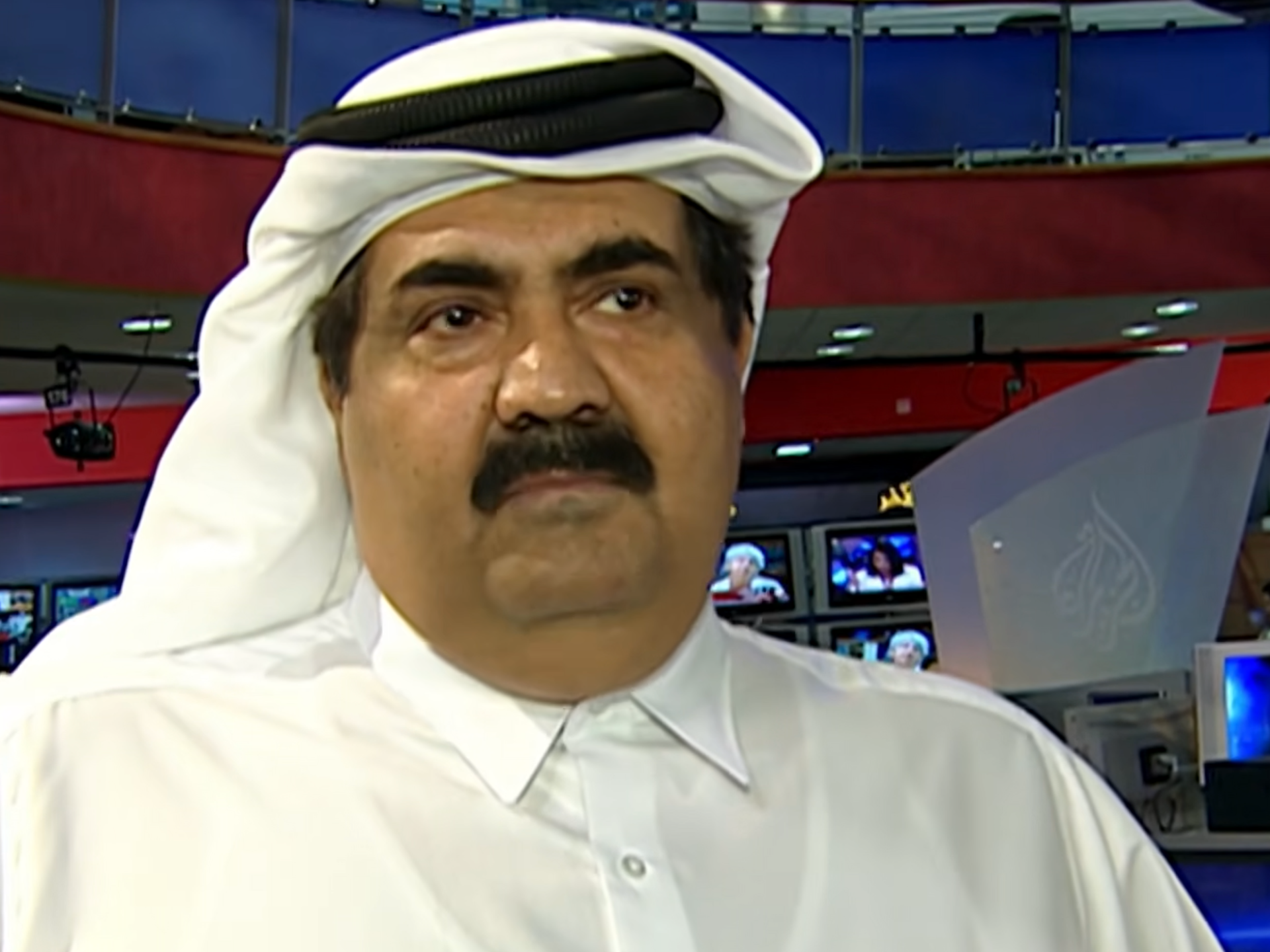
A tribute to the late Father Emir whose vision and resolve made Al Jazeera possible.
Ahmed Al Sheikh is the former chief editor of Al Jazeera Arabic.
The morning the death of Father Emir Sheikh Hamad bin Khalifa Al Thani was announced, I was asked to write about Al Jazeera and the man whose vision brought it into being. May God have mercy on him.
I found myself unsure where to start: with Sheikh Hamad, the man behind the idea and the project, or with Al Jazeera itself? In truth, the two are difficult to separate. Every project begins as an idea before the determination of those behind it turns it into reality. Al Jazeera was Sheikh Hamad’s brainchild. Through his resolve, persistence and courage in standing by his positions and decisions, it became what it is today: a force in the media world and a presence impossible to ignore.
Let me roll the camera back 30 years or more.
By a remarkable coincidence, that very morning the BBC announced the closure of its Arabic television service, less than two years after it had gone on air. The newsroom doors were closed to us, and suddenly we were looking for work again. For someone like me, accustomed to seeking work far from home, the situation itself was hardly unfamiliar, even if the news had come out of nowhere.
Then a colleague arrived with word that a Qatari team in London was recruiting journalists for a television news channel it planned to launch in Qatar. The channel, he said, would be free to report the news and broadcast talk programmes according to their importance, just as leading broadcasters in the West did.
Could such a thing really be possible in an Arab country? It was a sad question to have to ask.
I had lived in Kuwait for 15 years and left after the Iraqi invasion. The Gulf held many memories for me. My children were born there. Hearing about the new Qatari project brought those memories flooding back, and I decided, as I had so often before, to follow where work might take me.
The BBC had closed its doors. Al Jazeera opened them.
On June 1, 1996, our plane landed at Doha’s old airport. My colleague and friend, the late Ahmed Al-Shouli, was wearing a suit and tie. When the plane door opened and the hot air poured in, he turned to me and said: “If only I had travelled light, like you.”
The newsroom was small. Beside it was an equally small studio, and behind them five small editing suites, a tape library, an office for the editor-in-chief and a larger one for the director-general and his staff.
It was clear that the idea of launching the channel had been taking shape in the mind of the man behind it for some time. The foundations were already in place before he began bringing in the journalists, technicians and administrators who would enter that newsroom and put their skills and experience to work.
It was equally clear that those who had designed and equipped the building had not imagined how quickly the channel would grow. Within a few years, the building would be too small and its facilities unable to keep pace with the demands of expansion.
Yet it was a warm home for us all. The intimacy of the place only gave us greater energy and resolve as we set about building a channel that could rival those that had come before it and change the balance of media between the Global North and South.
During the five months of trial broadcasting, the team grew in strength and cohesion by the day. Yet all of us wondered whether the freedom we had been promised was real. Those doubts gradually faded with every news bulletin we completed. We saw no interference in the content, the reports or the way stories were told.
Before long, our frustration was of a different kind. We were producing bulletins that rivalled the BBC’s, and even surpassed them, but no audience could yet see them.
On November 1, 1996, Arab media finally found its voice. In Al Jazeera’s first news bulletin, the late Jamal Rayyan announced the channel’s launch to the world.
The man who had promised us freedom had kept his word. There was no picture of him in the bulletin. There was no story about him.
People across the Arab world could scarcely believe that the news bulletins and talk programmes they were watching were being broadcast from a Gulf Arab country. They were accustomed to television that sang the ruler’s praises and was never allowed into the field to bear witness to reality, convey people’s concerns freely or give them space to raise their voices in joy or sorrow and speak openly of their dreams, visions and opinions.
The man behind the idea and the project kept a close eye on its progress. He would visit, offer broad guidance and encouragement, and sometimes joke with us. But Sheikh Hamad never once intervened in a news report or a talk programme. Nor did the aides he had entrusted with overseeing the project.
He gave his word and kept it. We knew then that success would be ours.
But let me move the camera forward, so I do not linger too long.
Within months, others had begun to notice the arrival of a new channel from what they called the Global South. They began carrying its reports because Al Jazeera and its correspondents were present in places they themselves hesitated to enter.
Images of the suffering of children in Palestine, Iraq and Afghanistan, and across the Global South, were seen exclusively on Al Jazeera. Recognition soon became an acknowledgement that Al Jazeera had taken the lead.
Success made it necessary to reach wider audiences in other languages. Al Jazeera English and the network’s online presence followed, transforming the channel into a network that spoke to the whole world, North and South.
For decades, news had travelled in one direction. Western cameras captured it through Western eyes and a Western understanding of the world, often shaped by colonial and cultural biases that were sometimes explicit and sometimes hidden between the lines.
The media equation had changed. News could now travel from South to North, seen through the eyes of the people and places it came from.
The network’s expanding reach and growing presence across the world also reshaped the cultural and intellectual landscape of the South. It opened new cultural horizons in the region where it began, across the wider Muslim world and the Global South, and even in the distant West.
But the years have taught us that success can carry painful consequences. Some came from the immediate region. Many more came from farther afield.
The region around us could not tolerate the free word or its effects, and so it invented an enemy for itself. Offices were closed. Correspondents were hounded, arrested and killed. The country that hosted the network came under fierce attack.
Beyond the region, offices were bombed. Reporters and camera operators were killed, imprisoned and tortured. Pressure on the country hosting the network’s headquarters intensified.
With his characteristic boldness, he would ask those nearby: “When will you stop treating the free word as an enemy?”
And to those farther afield, he would say: “Are you not the ones who have spent years preaching freedom of expression, democracy and the human right to know?”
Sheikh Hamad was a shield for the network and those who worked for it. He and the people he entrusted with running Al Jazeera would tell us: “Your only red lines are the rules of the profession. Nothing else.”
May God have mercy on the man behind the idea and the project.
The views expressed in this article are the author’s own and do not necessarily reflect Al Jazeera’s editorial policy.
Source: https://www.aljazeera.com/opinions/2026/7/14/sheikh-hamad-gave-arab-media-a-voice?traffic_source=rss