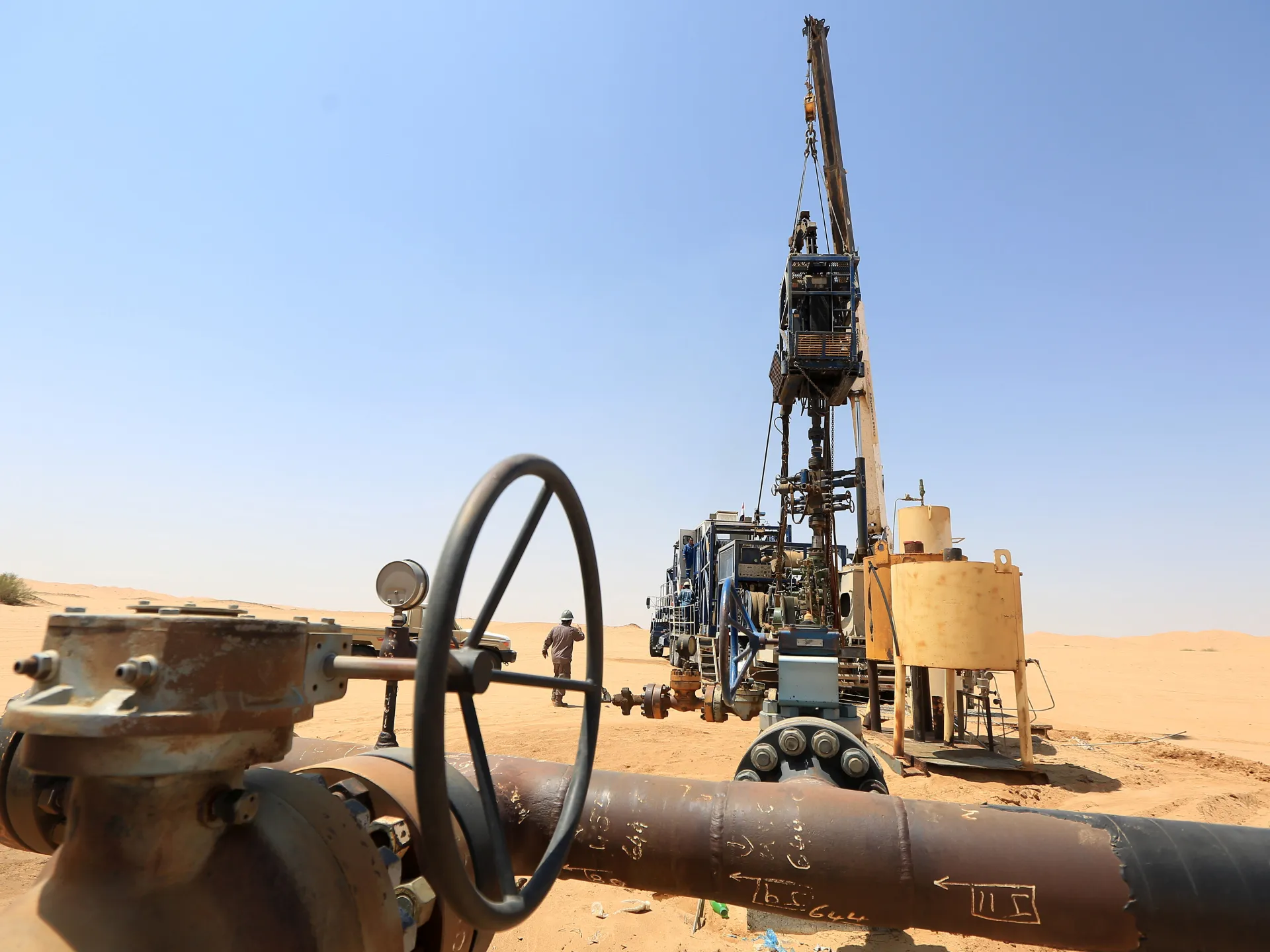
Yemen has proven oil reserves estimated at three billion barrels, but the security environment hinders its export.
The announcement by the head of Yemen’s Presidential Leadership Council, Rashad al-Alimi, to resume oil exports starting July 20 following a halt that began in late 2022 has revived hope that the Yemeni government’s most important source of foreign currency will be restored. The government, struggling economically and facing continued Houthi rebel control over Yemen’s northwest, needs the money – and has pledged to direct the revenues towards paying salaries, improving services, and supporting economic stability.
However, the flow of oil from Yemen’s fields to global markets does not depend solely on a decision made by politicians; it requires creating a security environment, after years of war, that allows for the protection of facilities, pipelines and ports, in addition to restoring the confidence of shipping and insurance companies, as well as international buyers.
list 1 of 4Yemen’s Houthis claim attack on two Saudi oil tankers
list 2 of 4Between hope and fear: Yemenis react to Houthi blockade on Saudi Arabia
list 3 of 4Rubio says Iran ‘begging’ for a deal with US but not ready to make one
list 4 of 4How shipping insurance rates are rising, as Hormuz, Bab al-Mandeb shut down
With Yemen’s war threatening to escalate after a four-year period of calm, the stability the country needs to resume oil exports may be elusive.
Yemen has proven oil reserves estimated at about three billion barrels, primarily concentrated in the Masila, Marib and Shabwa basins. While the United States Energy Information Administration (EIA) indicates that the country still holds sufficient resources for production and export, the security environment hinders their extraction and transport to global markets.
Yemen’s oil production reached a historical peak of about 439,000 barrels per day (bpd) at the beginning of the millennium, but it has gradually declined due to the depletion of some old fields. This decline accelerated with the outbreak of the war in 2014 and the targeting of oil infrastructure, settling at a level of 19,000bpd in 2024, according to the International Monetary Fund (IMF).
A report published by S&P Global estimated actual production, following the halt in exports, at about 7,000bpd to 10,000bpd in 2023 and 2024, almost all of which was for domestic use.
Yemeni Minister of Oil and Minerals Mohammed Bamqaa said that export revenues would be deposited in the Central Bank as part of a government directive to bolster the state’s financial resources, pointing out that there are oil stockpiles exceeding 1.7 million barrels ready for export.
Bamqaa added that total production will initially reach about 60,000bpd. He explained that the ministry has directed oil companies to prepare timelines to increase production and develop the fields, in a way that raises production capacity by up to 25 percent during the first month after exports resume.
Professor of financial economics at Hadramout University, Mohammed al-Kasadi, told Al Jazeera that while he expected oil production to meet the 60,000bpd figure mentioned by Bamqaa, the figure does not reflect the actual volume of exports, as the local market consumes about 20,000bpd to operate refineries and power plants, which makes the quantities available for export likely to hover at about 40,000bpd.
Hassan Mohammed Moghalis, an expert in Yemeni affairs, told Al Jazeera that most of the fields located in government-controlled areas remain capable of production. At the forefront of these are the Masila fields in Hadramout and the al-Uqla fields in Shabwa, which represent the fundamental base for any anticipated resumption. Moghalis explained that crude oil can be transported via pipelines to Arabian Sea ports.
However, Moghalis pointed out that resuming exports does not simply mean opening the valves, as some fields require maintenance and restoration after a long period of suspension. Additionally, pipelines and pumping stations require technical reviews to ensure their readiness before resuming regular operations.
Despite the importance of restarting production at the oilfields, experts believe bigger obstacles await after the oil reaches Yemen’s ports. Houthi attacks targeting export ports in Hadramout and Shabwa in late 2022 made shipping and insurance companies more wary of handling Yemeni crude, pushing up insurance costs and weakening buyers’ willingness to enter into contracts.
The Houthis have conditioned the resumption of exports on them receiving a share of the revenues to cover public sector salaries.
Al-Kasadi, of Hadramout University, says that the government’s success in pumping oil to the port does not automatically guarantee a successful export process. Maritime transport and insurance companies primarily assess the level of security risks and the likelihood of ports or tankers facing renewed attacks – currently a particular concern in light of Houthi attacks on shipments tied to Saudi Arabia, which supports the Yemeni government.
Al-Kasadi added that the oil market relies heavily on trust and stability. Therefore, any export operation requires buyers to be convinced that shipments will depart safely and that export activities will not suddenly halt again.
Moghalis, the expert, believes that providing military protection for ports and pipelines is the first step, but not the only condition. It is also imperative to restore the confidence of insurance companies and international buyers, as oil does not reach markets solely through production, but rather via an interconnected system of transport, financing and insurance.
He added that any new attack on the ports, even if it does not cause significant material damage, could be enough to send the sector back to square one, given shipping companies’ sensitivity to risks in conflict zones.
But, as al-Kasadi pointed out, a resumption in exports is vital. He argued that the halt in exports was not merely an oil sector crisis, but rather developed into a comprehensive financial crisis. The government lost its most crucial source of foreign currency, which negatively impacted the Yemeni rial’s exchange rate and the state’s ability to finance basic services.
Despite the importance of resuming exports, Yemeni affairs expert Abdul Karim al-Ansi warned against overstating its immediate impact on the Yemeni economy.
He told Al Jazeera that the resumption of exports will undoubtedly provide a vital source of foreign currency and afford the Central Bank greater leeway to support monetary stability. However, it will not be enough on its own to end the economic crisis, as the Yemeni economy faces broader challenges related to the division between government- and Houthi-controlled areas, weak non-oil revenues and declining economic activity.
Al-Ansi added that the extent to which Yemenis benefit from oil revenues will ultimately depend on how these funds are managed and the government’s ability to channel them into salaries and basic services, rather than solely on the volume of exports.
And while successful initial shipments could send a positive signal to markets and investors, al-Ansi stressed that the real test would be whether exports can be sustained. Yemen’s economy needs a steady flow of foreign currency, rather than sporadic shipments that stop whenever security conditions deteriorate.
The suspension of oil exports has not only deprived the government of its most important source of revenue, but also intensified pressure on the foreign exchange market. As dollar inflows from oil sales have dried up, demand for foreign currency has remained high to finance imports of essential goods, particularly food, fuel and medicine. The resulting shortage has weakened the Yemeni rial and contributed to rising inflation.
These pressures have been compounded by the monetary division between the Central Bank in Aden and the Houthis in Sanaa, which has created two separate financial systems and exchange rates. The split complicates monetary policy and limits the authorities’ ability to use oil revenues in a coordinated way to stabilise the economy.
Al-Kasadi said that Saudi financial support for the government had recently helped contain currency volatility in government-held areas. However, he stressed that such support was no substitute for a steady and sustainable flow of oil revenues – which needs a period of stability, something that may be difficult if the conflict escalates in Yemen, as it is currently threatening to do.
Source: https://www.aljazeera.com/economy/2026/7/23/resumption-of-oil-exports-will-yemen-recover-its-economic-lifeline?traffic_source=rss