Gabriele MarcottiMay 31, 2026, 09:00 AM ETCloseGabriele Marcotti is a senior soccer writer for ESPN.com. Read his archive here and follow him on Twitter: @Marcotti.
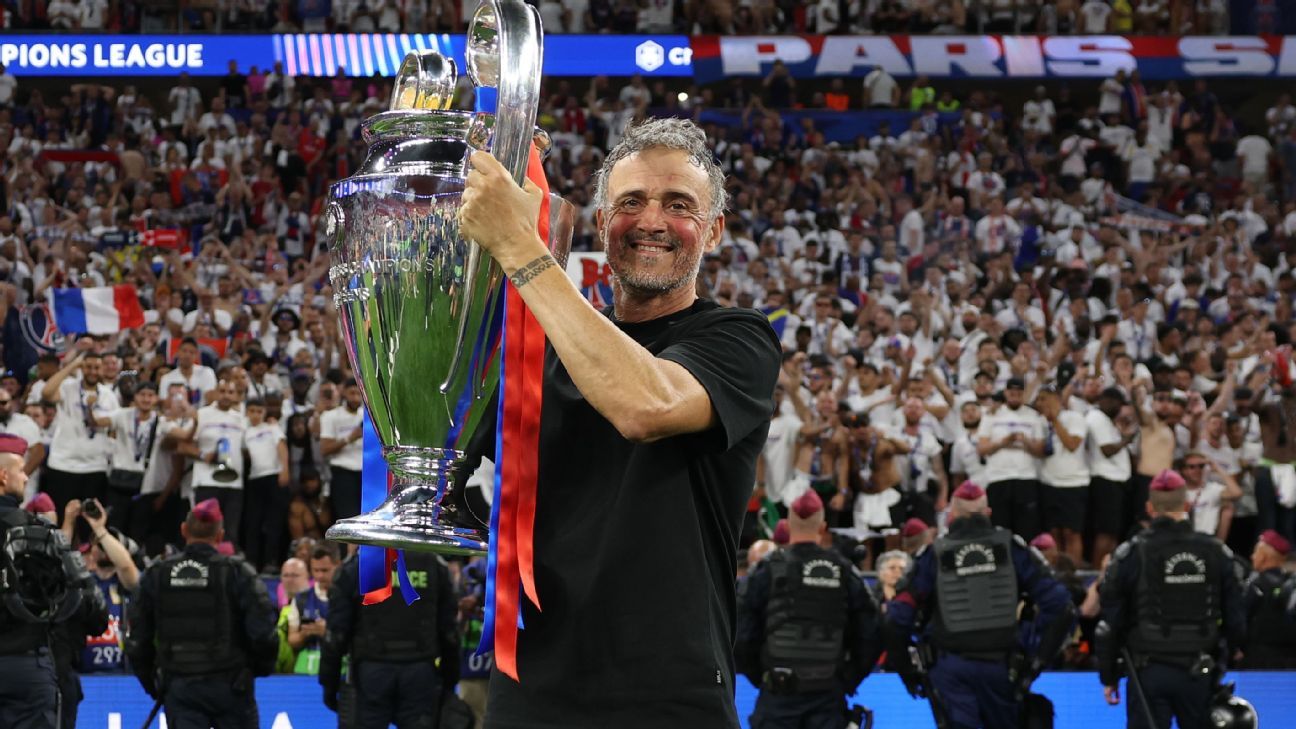
BUDAPEST, Hungary -- Now that Paris Saint-Germain have won back-to-back UEFA Champions League titles in such a comprehensive manner -- and, penalty shootout notwithstanding, the win over Arsenal was comprehensive, not just for the chances created but for the journey to the final, beating Liverpool and Bayern Munich en route -- it's fair to ask the question: What does it mean? What does PSG's success tell us about the modern game? Have they captured lightning in a bottle? Can -- and should -- others emulate them?
It's not easy to answer, because there are so many inherent contradictions.
PSG coach Luis Enrique's brand of football is in some ways the synthesis of what clubs aspire to. A 4-3-3 with plenty of athleticism and fluidity, a two-footed center-forward who can pop up anywhere along the frontline, a side that can both stick the button on fast-forward AND slow the game to a crawl as needed (that "control" thing that some coaches prattle on about endlessly). A team chockfull of ballers, who have licence to follow their creative muse, but only at certain times and in certain areas, to ensure it remains a choir and not a poetry slam.
- How PSG bested Arsenal to win UEFA Champions League - Arsenal are hard to beat, but in UCL final they found it hard to win - VAR review: UCL ref got the Mendes-Madueke call right, but it was close
With some exceptions -- like the Premier League champions who PSG just beat in the final -- the concepts above epitomise the high-end modern game around Europe. Sure, top sides will have tweaks based on personnel and preference, but this is the way things are going in terms of concepts and approach. This is what most coaches aspire to achieve with the resources available to them.
At the same time, their situation is fairly unique. They started the season with Luis Enrique announcing that, because they played in the FIFA Club World Cup (reaching the final), they didn't have the luxury of a proper preseason and therefore would ease into the campaign, rotating heavily and treating the first few months of the regular season as if it were training camp.
It feels like a long time ago (because it was) but they needed a goal deep in injury time to avoid defeat in August's UEFA Super Cup to *ahem* Tottenham Hotspur, who ended up nearly relegated from the Premier League. And for the second consecutive season, they had to go through the playoff rounds to get into the knockout phase of the Champions League.
But playing in an 18-team Ligue 1, with a budget that dwarfs everybody else's, means they don't need to put the hammer down every weekend. Instead, they can cruise at half-throttle for much of the campaign and peak when it matters. These are pretty unusual conditions not enjoyed by their peer clubs, and therefore difficult to emulate.
That said, it still takes a lot of coaching nous to fully exploit those conditions and Luis Enrique deserves a ton of credit. Because let's face it, there's the "iron sharpens iron" argument too. If you play in LaLiga or the Premier League you face a higher standard of competition, and therefore you are more battle-tested and prepared when it comes to Europe. We've been hearing that trope for years. (That proverb, by the way, is flawed: you don't sharpen iron with iron, you sharpen it with ceramic or diamond or whetstone).
It's equally unusual to have a coach who is so secure -- mainly because he genuinely doesn't care what anyone, from the media to fans to his bosses think -- and confident in his decision-making that he tends to overshadow the players (and, reportedly, is better compensated than they are too). Much has been made about PSG's decision to pivot from the superstar era of Lionel Messi, Neymar and Kylian Mbappé toward a group of younger, more pliable and perhaps hungrier players. It wasn't an entirely footballing decision -- the need to cut costs played a part -- but it certainly gave Luis Enrique the piece of clay he wanted, as well as the licence to go to work. It's hard to imagine a Bayern or a Liverpool, let alone a Real Madrid, putting a coach at the centre of the sporting project the way PSG has.
They have nailed the whole "brand" thing. It's not just their ubiquitous branded apparel and blend of urban/Parisian cool that, somehow, resonates from Durban to Dubai to Dhaka (to cite the provenance of three sets of PSG supporters I met in Budapest). It's their snackable highlights, TikTok-friendly style of play that adds to their mystique. Because they play in Ligue 1, most fans outside France don't watch entire PSG games start to finish, unless it's in the Champions League. Instead, they're served up snippets and highlights which tend to ratchet up the razzle-dazzle and minimise the warts. It's a club for the social media age that has managed to turn itself into a globalised, aspirational luxury brand.
And they've monetised it exceptionally well. According to Football Benchmark, PSG make more than €160 a game for every seat at the 48,000-capacity Parc des Princes. That's more than one-and-a-half times what Arsenal, no commercial slouches themselves, earn for every fan who passes through the turnstiles at the Emirates. Do the various Qatar and Qatar-adjacent deals help tremendously? Of course they do. Hugely. But PSG are going to toe-to-toe without the weekly exposure of the Premier League or LaLiga, without a 60,000-seater stadium and without more than a century of history to sell.
Here too, there's an apparent contradiction however. Go to a home game and the motto/battle cry "Ici c'est Paris" ("This is Paris") is everywhere. The Eiffel Tower is in their freaking logo. They leverage their city and their roots to a degree that few others do. And to most Parisian PSG fans it genuinely feels authentic. There's a difficult balancing act between clubs wanting to be global and monetise supporters around the world while also keeping their week in, week out match-going support engaged and empowered. PSG manage to thread the needle like few others, in part because it's objectively difficult to do. United can't claim Manchester. Barcelona can't claim Barcelona. Arsenal certainly can't claim London. Nor would they necessarily want to.
PSG right now is the gold standard and there is much to admire and learn from the way the club have grown. But they're also somewhat unique, with unique challenges and advantages. In a world -- not just in football terms -- that's changing and where the future is unclear, PSG have staked a direction of travel and a way of operating that works for them.
It has taken them to the top of the world's biggest sport.
Source: https://www.espn.com/soccer/story/_/id/48928519/paris-saint-germain-rule-champions-league-way-no-other-club-hope-replicate