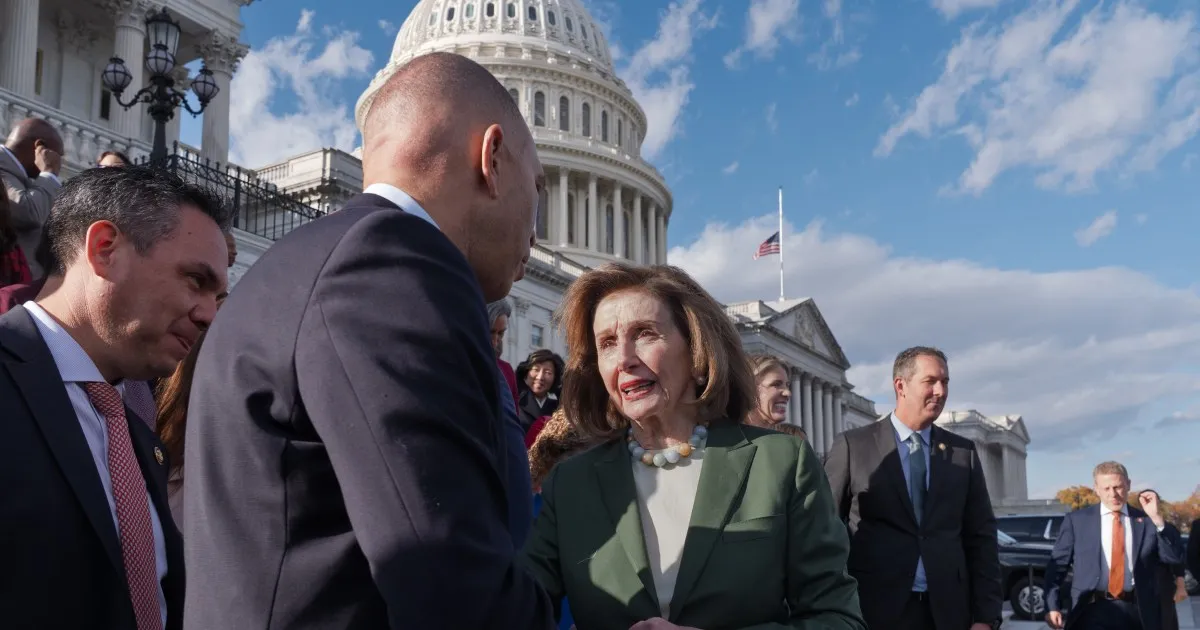
The Democratic establishment is still firmly in the pro-Israeli camp while trying to appeal to its pro-Palestine voters ahead of the midterms.
Recent progressive wins of outspoken Israel critics in Democratic primaries have generated a lot of optimism. Abdul El-Sayed won the Democratic nomination for a Senate seat in Michigan after AIPAC and its allies spent more than $54m against him in what came to be the most expensive Democratic Senate primary in US history.
In New Jersey, a surgeon named Adam Hamawy, who as a medical volunteer refused to leave Gaza until the last member of his team could evacuate, won a 12-person primary in a House of Representatives race.
Years ago, such breakthroughs would have seemed impossible. For many on the left, it now seems like their hard work at the grassroots level is paying off.
And yet, all the talk of a “shift on Israel” within the Democratic Party is premature. The Democratic establishment remains firmly in the Israeli camp, even if it is striking a more critical tone ahead of the midterm elections. We should not mistake election-season displays of sympathy for a human-rights awakening on Palestine.
We have now reached a point where the shift in attitudes towards Israel can no longer be ignored. A May poll by New York Times/Siena suggested that nearly three-quarters of Democratic voters did not approve of aid for Israel. Another survey by Quinnipiac University showed that 66 percent of Democrats thought the US was too supportive of Israel. A poll published in April by Pew Research found that 80 percent of Democrats viewed Israel unfavourably – up from 53 percent in 2022.
These numbers have made the Democratic leadership realise that open support for genocidaires is becoming too costly politically. Democratic voters, who watched a livestreamed genocide, clearly no longer see Palestine as a secondary issue in their political and moral choices.
This awareness has finally come after Democratic leaders spent 2024 attacking students who protested the genocide on campuses across the country. Prominent Democratic members of Congress called the protest encampment at Columbia University a gathering of “anti-Israel, anti-Jewish activists” and a “breeding ground” for anti-Semitic attacks and demanded that the university dismantle it. Many praised the violent crackdowns on the student protesters.
Today, some of these same leaders are striking a conciliatory tone. Former presidential candidate Kamala Harris, who lost in part due to the Biden administration’s support and funding for the genocide in Palestine, now regrets that she did not pressure the president to be firmer with the Israeli government. Former State Department Spokesperson Matthew Miller now admits Israel “without a doubt” committed war crimes.
And yet, there isn’t much beyond rhetoric and election strategy that we can see.
Some point to the July 15 vote in the House of Representatives to strip Israel of $3.3bn in military aid yearly as a clear break in the bipartisan consensus on Israel. Nearly half of House Democrats supported the measure, including former House majority leader Nancy Pelosi.
But enough Democratic Representatives still voted with the Republican majority against it. The vote was politically useful precisely because it was powerless. The 103 Democratic votes in favour of cutting aid to Israel gave the party something to campaign on, while ensuring Israel still had the weapons it needs to continue its brutality.
It is a strategy that the party is likely to repeat in the next Congress to secure Israeli interests while appearing to acknowledge voters’ demands.
Furthermore, the Democratic establishment has shown little interest in breaking its dependence on AIPAC. In April, the Democratic National Committee rejected even a symbolic resolution condemning the lobby’s interference in Democratic primaries.
AIPAC, meanwhile, has responded to its growing toxicity by learning how to disappear. Its super PAC has routed millions through other organisations whose funding is disclosed only after voters cast their ballots. It has also directed donors through candidate-specific portals that leave individual names, rather than AIPAC’s, in public campaign records.
Having spent more than $100m on this midterm race, AIPAC will continue to influence Democratic congressional politics to ensure it is in favour of the Israeli government.
Its defeat in a number of Democratic primaries is significant, but we should remember the limits of that. We have to recognise that the elected progressives, while critical of Israel, are not prepared to go all the way on recognising Palestinian rights.
Representative Ro Khanna, for example, has been calling for aid cuts to Israel and an end to financing for the Iron Dome. He even went on a visit to the occupied West Bank where he witnessed settler violence firsthand.
Even then, standing before the Democratic National Committee earlier this month and calling for zero aid to Israel, he led with the disclaimer that Hamas’s attack must be condemned unequivocally. He still refuses to say that the Palestinians have the right to self-defence.
Brad Lander, who won the New York primary for a House seat in June and was backed by New York City Mayor Zohran Mamdani, has described what is happening in Gaza as genocide. And yet, his criticism goes only that far. He identifies as a “liberal Zionist” and has made clear he does not support BDS.
Prominent progressives like Bernie Sanders and Alexandria Ocasio-Cortez, who are already in Congress, have also demonstrated that they can only offer a partial solidarity with Palestinian people – one that does not acknowledge their status and rights as occupied people.
On the Palestinian side, many would say that we have already buried too many people to be thankful for the crumbs of solidarity thrown our way by politicians who use our cause to win their electoral races. That is true. And yet, achieving a true shift in the Democratic Party can go a long way in helping us in our pursuit of freedom.
That is why we should support every progressive candidate willing to confront AIPAC and Israel in November, because every seat won places another potential vote for Palestinian human rights inside a Congress that has spent decades denying them.
Movements build power by turning each election into leverage for the next fight and continuing the pressure on elected officials even after they take office. We must reject every attempt by the Democratic Party to pay lip service to our cause; we must continue to push for real action on Israel.
The views expressed in this article are the author’s own and do not necessarily reflect Al Jazeera’s editorial stance.
Source: https://www.aljazeera.com/opinions/2026/8/25/no-the-democratic-party-is-not-shifting-on-israel?traffic_source=rss