At a Kathmandu hospital, families peer at lists of those who are critical, dead — or have been released.
Kathmandu/Nuwakot/Trishuli, Nepal – Loknath Chaulagain is looking for his 23-year-old nephew Sudarshan at Tribhuvan University Teaching Hospital in Kathmandu, Nepal’s capital.
A bus conductor, Sudarshan was waiting at the checkpoint in Timure, a town bordering Tibet, when the flash flood that devastated parts of Nepal and Tibet struck on Wednesday. His family says a phone call went through to his number at 9:54am local time – after the flash flood struck the border region – but Sudarshan did not pick up the call. Since then, his phone has been unreachable.
The family has been searching for him – near where the floods struck, and now in Kathmandu’s hospitals, where some survivors have been brought. But so far, they’ve had no luck.
They’re not alone. Thousands of families in Nepal are still stranded in the no-man’s land between hope and fear: hopes of an impossible miracle and worst fears of losing someone they love.
Two days after the flash flood swept away much of what lay in its path along the Bhotekoshi River in the northern Himalayan region bordering Tibet, the full scale of devastation is yet to be ascertained in Nepal. The death toll is on the rise, with nearly 500 bodies recovered. The missing toll is well over 1,000 and is expected to rise further.
The wall of water with ice and mud that surged downstream with fury on August 26 caused maximum damage to Timure, Rasuwagadhi and Syabrubesi in the higher Rasuwa region nearer to Tibetan border checkpoints.
Downstream, it washed away buildings, electric poles, bridges, markets, homes and vehicles that stood in its path in Trishuli and Nuwakot regions.
The usually buzzing Trishuli market is today covered in mud, sludge and debris. Locals, including many Indians who have made the area their home for many years, beg and plead with relief workers to take them to their destroyed homes in earthmovers to retrieve whatever may be left of their belongings.
Helicopters whirred nonstop on Wednesday and Thursday in these areas, trying to rescue those trapped under the rubble or washed away and stranded in dangerous situations. Those rescued with lighter injuries are being treated at the army camp helipad medical unit, while those with grievous injuries are being airlifted to bigger facilities in Kathmandu.
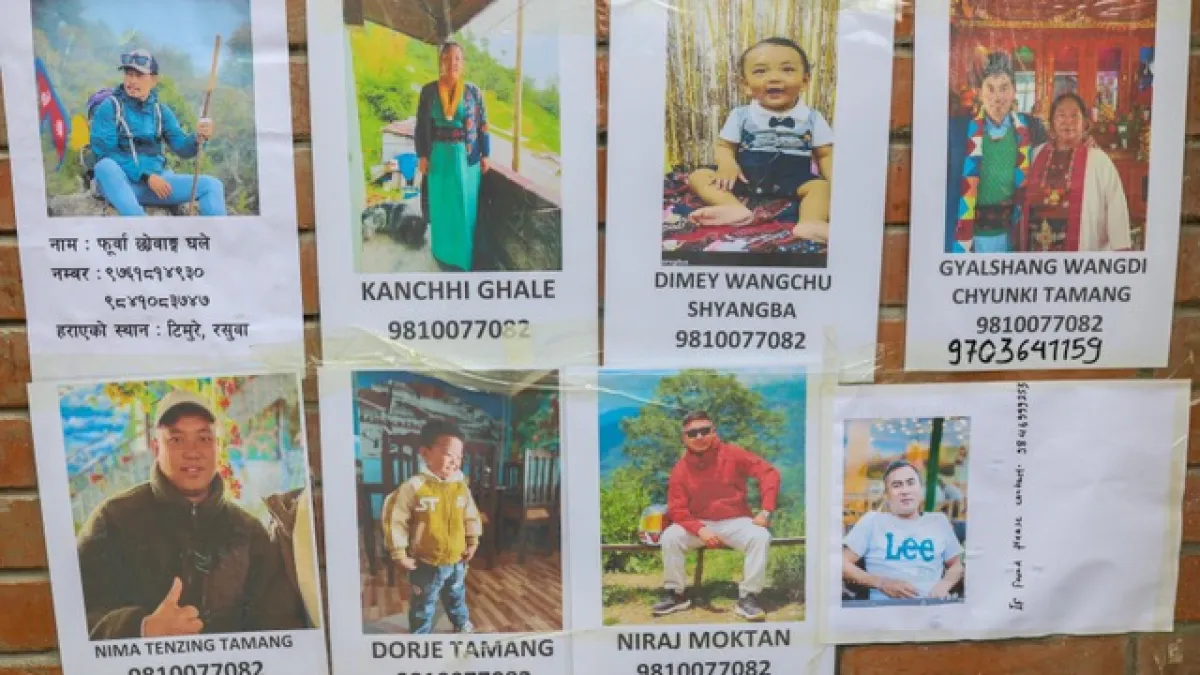
At the Tribhuvan University Teaching Hospital, people come by and plaster posters on walls with photographs and contact details of missing friends and family. Other hospital pillars bear lists of those who have been admitted or are in critical condition – or those who have been killed: five-year-old Ishara Tamang in paediatric surgery; 30-year-old Tej Bhadur Tamang in the ICU; 25-year-old male Kusal Magar, listed as dead. Multiple pairs of concerned eyes gaze intensely at these lists, hoping to find their loved ones there.
Among them is Sohan, a young man who does not want to speak to journalists on camera. He is searching for his 42-year-old father, Gyan Bahadur Rana Magar. “Three days on, we are searching and still trying to find him,” he says. His father went with Indian tourists as a guide to Rasuwa, the border district with Tibet that is one of the worst affected.
When the lists on pillars offer no answers, people searching for their loved ones head to the mortuary where photographs of some of the recovered bodies have been glued to the gates. Many bodies were found dismembered; some were missing limbs. When someone finds a hint of familiarity, they inform security officials, who let them in after some identification check to take a look at the body.
Dressed in a red saree and blouse, and wearing a red pothe necklace – a traditional glass-bead necklace worn by married women in Nepal – Lal Kumari is desperately looking for her husband, Arjun Shreshtha. A tourist van driver in his late 40s, he was swept away by the flood in Rasuwa district. Kumari has three children, including a married daughter and a grandchild, and her only question is: Could her husband, miraculously, still be alive?
Source: https://www.aljazeera.com/features/2026/8/28/nepali-families-pray-for-miracles-with-relatives-missing-after-flood?traffic_source=rss