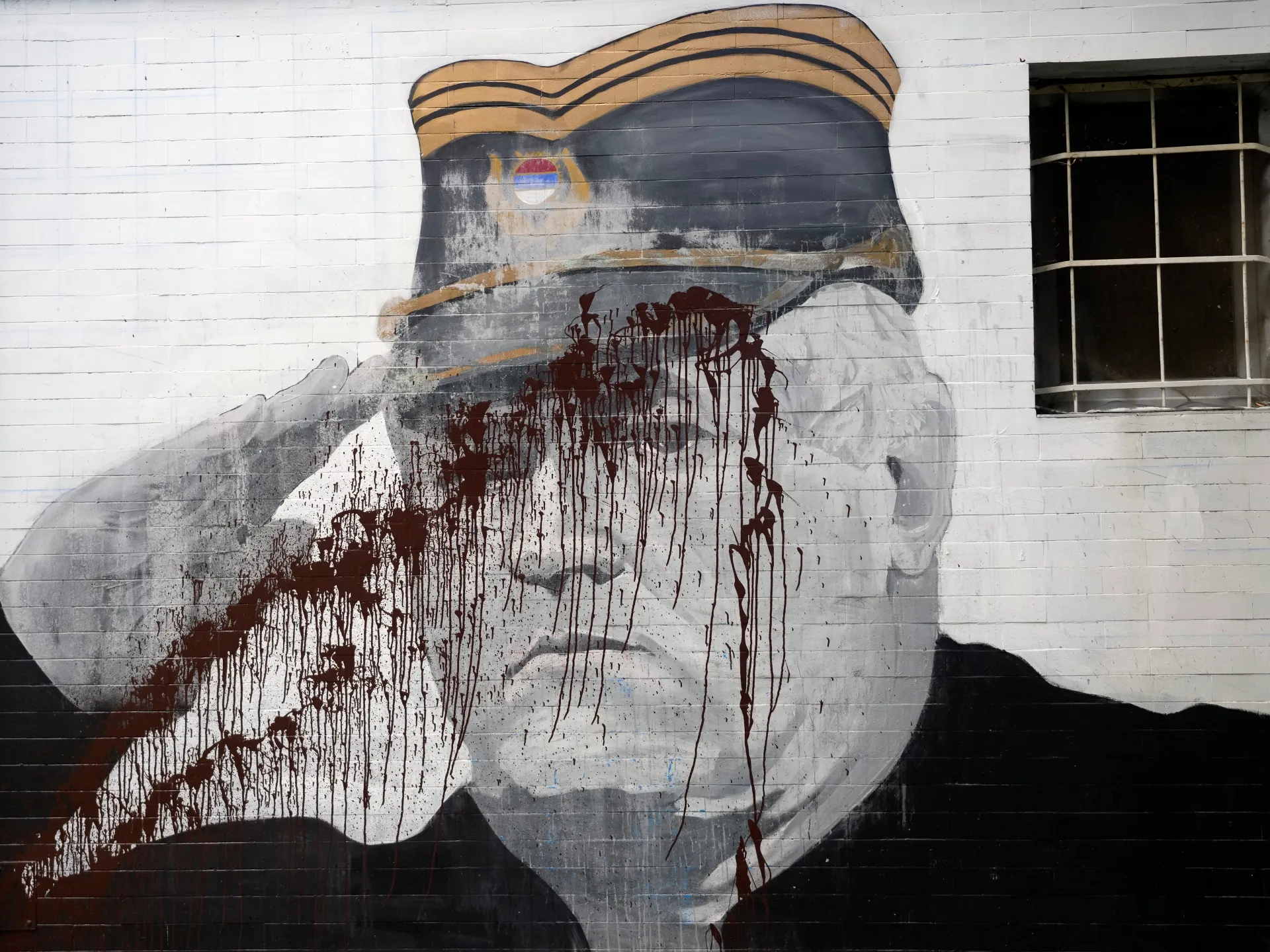
He fought for fascism to triumph. And it did.
The death of war criminal Ratko Mladic made headlines across the world. “The Butcher of Bosnia dies in The Hague”, the international media announced, seemingly suggesting that justice has been served at least in his case.
Nothing changed on November 22, 2017 when he was sentenced by the International Criminal Tribunal for the former Yugoslavia (ICTY) to life in prison for genocide, crimes against humanity and war crimes committed in Bosnia more than 10 years earlier. Nothing will change now after his death.
Contrary to what some may think, the world will not become a better place now.
I hate writing this sentence, but here it is: Mladic won. He and his ideas won. He must have died happy, watching the world be overtaken by fascism—a world in which genocide has become normalised. It is what he fought for, after all.
In 2017, after Mladic’s verdict was pronounced, I expressed my fear in an op-ed published by Al Jazeera that his ideas had not been defeated, but would instead spread like a drug-resistant bug, adjusting to different circumstances and times.
It is painful to see today that my prediction has come true. It is clearly visible in the Balkans.
In Serbia—a country the European Union is considering accepting as a member — the ruling regime’s survival depends on maintaining an ideology of death and denial.
Decades after the war, no real change has been achieved. The power of President Aleksandar Vucic, a politician seen as an equal by many EU leaders, is cemented by the denial of responsibility for crimes committed in the 1990s in Croatia, Bosnia and Kosovo.
Then there is Bosnia, a country divided by the Dayton Accords that stopped the shooting and created a divided state that struggles to build a present, much less a future. It is a country where over 100,000 people were killed, and then nothing changed; where genocide denial is an official policy in one part of the country, Republika Srpska; where many of the people who took part in committing war crimes still live freely.
And yet, as much as fascism has maintained its grip on our region, there has also been resistance.
“Ratko Mladic, former head of the Army of Republika Srpska and convicted war criminal, sentenced to life for the genocide in Srebrenica, crimes against humanity and war crimes, died. We will not mourn for him. We will not glorify him […] Death does not delete verdicts. It does not delete established facts. And it does not delete responsibility.”
This is part of a public message from Ostra Nula, a small nongovernmental organisation established by young Serbs in Banja Luka, the capital of the Serb-dominated entity of Republika Srpska in Bosnia and Herzegovina. They posted it on social media a few hours before politicians and former soldiers who fought under Mladic took to the streets across Republika Srpska to pay their respects to a murderer who ordered the mass killing, torture and rape of people in Bosnia and then spent 30 years denying his crimes.
Ostra Nula was not the sole voice among Bosnian Serbs that rejected the mourning of Mladic. The magazine Buka, the youth group Kvart, and others, also demonstrated their condemnation of Republika Srpska’s official policy of genocide denial and genocidaire celebration.
Pressure and threats have not stopped people of conscience from fighting against denial of crimes committed during the war, for justice and acknowledgement of moral responsibility. They speak up because they know what fascism left without a response can look like.
In Bosnia, we struggle a lot with the issues left behind by the war, but at least there is awareness. I can’t say the same about most of the rest of the world, which still believes that fascism was defeated 80 years ago.
Many do not recognise it when they see it, but the evidence is there: the public denial of the genocide of the Palestinians, the ignorance of crimes committed in Sudan or the DRC, the indifference to migrants and refugees left to die at sea or on dangerous land routes, the suffering of people deprived of access to basic needs – including medicine – by sanctions, the increase in military spending, inflation, deadly border policing, mass surveillance, and ultra-right politicians in parliaments and governments.
This is the world Mladic dreamed of. And he lived to see it.
The question for the world now is: do you really want to live in Mladic’s dream?
Once, more than 35 years ago, I was forced to live in it, in a Bosnia facing a genocide. And it was a nightmare, an unspeakable horror.
We, genocide survivors, have been calling on the world to wake up. Will it listen?
The views expressed in this article are the author’s own and do not necessarily reflect Al Jazeera’s editorial stance.
Source: https://www.aljazeera.com/opinions/2026/8/29/mladic-died-a-happy-man-he-won?traffic_source=rss