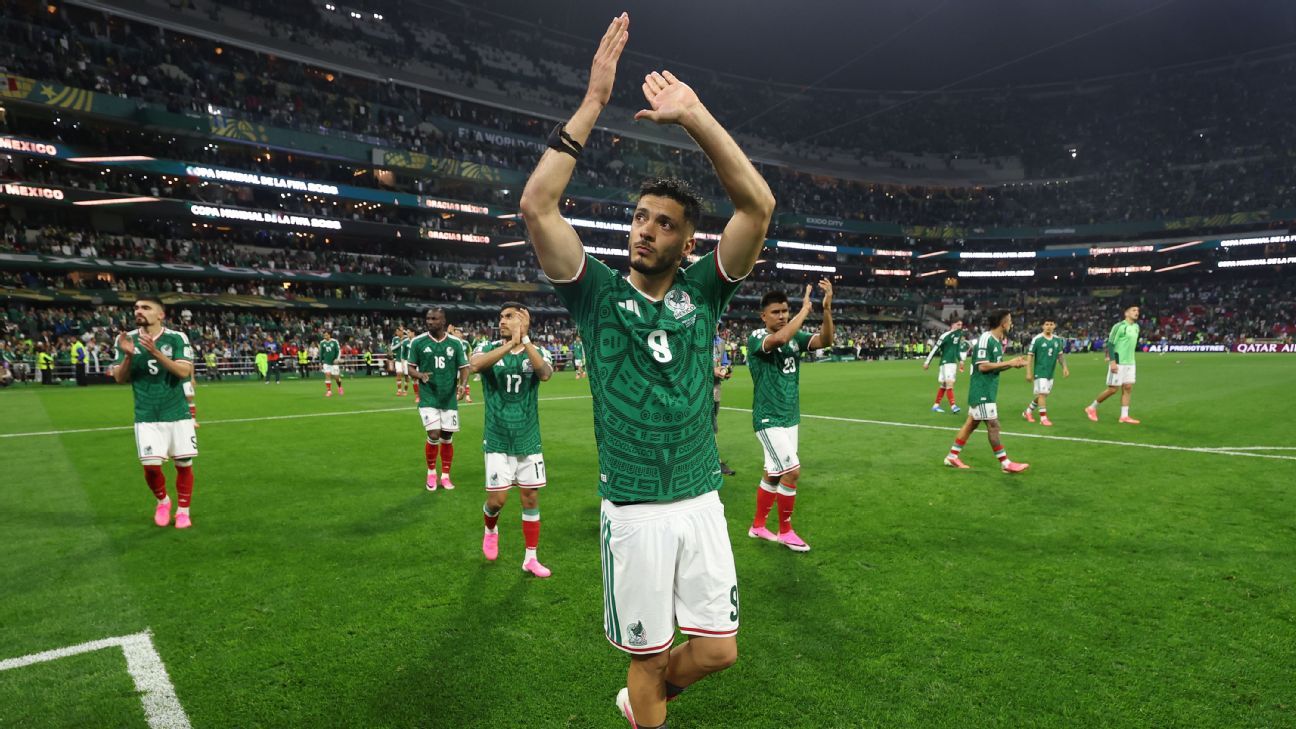
Among the anguish and frustration that followed Mexico's dramatic 3-2 loss to England that knocked the co-hosts out of the FIFA World Cup, another surprising emotion emerged: a renewed connection with the national team.
"Gracias, Mexico," read the front page of one local sports paper, noting that the squad led by manager Javier Aguirre had "allowed fans to dream." Another paper went further, adding that "tears appeared on several faces, but an entire nation joyfully bids farewell."
No matter the defeat to England that led to a fairly standard round-of-16 exit on Sunday night, this year's World Cup has Mexico believing again.
There are skeptics who may roll their eyes at this, and there's obviously still much-needed growth in Mexican soccer, but on the streets across the country, in the stands and on the pitch in all five of their games, there's now a restored hope for the future.
Mexico's World Cup became synonymous with the phrase "y si si?" ("what if we do?"). The phrase was stamped onto the back of national team jerseys, almost every football-related billboard en route to the stadium, and even eggs. The LED screens at each Mexico City airport gate projected "y si si?" in red, white and green.
Players on Mexico's World Cup roster began using a version of the phrase before the tournament kicked off as a way to convey confidence, but fans didn't buy into the concept until the second group-stage match against South Korea. Mexico began the tournament with a difficult victory against South Africa that left fans cautiously optimistic, but the three points against South Korea clinched the group and support.
El Tricolor gave fans a reason to believe in the team with each passing victory, as results provided tangible evidence that "y si si?" could be more than just an idea, it could be a reality. By the round of 16, the phrase unified the country, and against England, the effects of a united Mexico felt tangible at the Estadio Azteca.
Historically, Mexico and its fan base crumble when facing adversity in a match. The pattern initially repeated itself when El Tri conceded first against England in the first half, when players failed to react sufficiently. In the span of three minutes, Jude Bellingham scored twice and Mexico faced a massive uphill battle.
Suddenly, a deafening "Si se puede" ("Yes you can") echoed throughout the stands at the Estadio Azteca. Mexican fans, the vast majority of the overall 80,843 in attendance on Sunday, chanted their message to the players. And it worked.
Mexico responded with a goal to cut the deficit before going on to play with the determination worthy of the support they received. Players fought until the very end, pinning England in their own half while attempting a flurry of shots in search of an equalizer.
El Tricolor's performance allowed supporters to keep dreaming until the final whistle blew in the 101st minute.
When asked what legacy this Mexico team will leave behind, Guillermo Martínez gushed over the unity between team and country.
"The legacy is family," Martínez said following the England defeat. "We started out with no one believing in us, but together within our core group at the [training center], we grew strong enough to convey our spirit to the people. I believe the public felt truly represented by this team because we fought to the very end."
Mexico lost in the round of 16, but their World Cup cemented a foundation of hope within the fan base that so desperately needed it. United, Mexico will continue to pave a path forward.
"We didn't finish within the top eight teams in the world, but we did plant a seed," Aguirre said after their elimination. "That I am sure of." -- Lizzy Becherano
It's easy to feel positivity when you consider how bleak things were a few years ago.
Following a dismal group-stage exit at Qatar 2022 that led to the firing of coach Gerardo Martino, the Mexican federation held a press conference in a cramped gymnasium in which decision-makers admitted that "we're embarrassed and we have to apologize" about the team's "failure."
As for the next two coaches? Both Diego Cocca and Jaime Lozano were dropped in less than two years.
With legend Rafael Márquez hired as a prominent assistant, the federation made a rare commitment to a long-term plan when it announced that Aguirre, who had already coached Mexico at two World Cups, would take charge. The plan: Aguirre would lead Mexico through the 2026 World Cup, and would then promote Márquez (who is now in charge) in the lead-up to 2030.
As seen this summer, there was a notable look toward that 2030 future with some of the names that were added. Thriving in a handful of matches was 17-year-old Gilberto Mora, the youngest player in the 2026 World Cup. Alongside him, minutes were also given to promising U23 prospects such as Obed Vargas, Mateo Chávez, Brian Gutiérrez and Armando González.
On the grandest platform in the sport, these names were a meaningful part of the team that went into the knockout round.
While giving these minutes may not be out of the ordinary for nations that like to hand younger players opportunities, this act is atypical for a Mexican program that traditionally relies on veterans. And that wasn't the only favorable change seen that will be a blueprint for Márquez.
Tactically, pragmatism made a needed return.
Due to the popularity of an almost-irresponsible level of attack-minded soccer in Liga MX, the same is often expected of the national team. Aguirre, well versed in helping relegation-threatened clubs, bucked that trend with his approach that prioritized backline organization. Márquez, a former defensive stalwart who spent seven seasons at Barcelona, was a key figure in these tactics.
The results? Ahead of their loss against England, Mexico were undefeated in 2026 with a 10W-2D-0L record. In those 12 games, they allowed an astonishing two goals. Granted, they still ended up in a similar exit in the round of 16 that has become familiar since the late-1990s, but there's a sense that they were on the cusp of a historic result after keeping pace with the European giants.
"Today, we planted a seed that we'll look back on in the future," midfielder Érik Lira said postgame. "I'm certain that great things lie ahead for us."
Dual-nationals have also become a welcome part of the equation. Once overlooking such options, Mexico entrusted a total of five foreign-born players who were eligible for the country in 2026.
Without question, this expands the player pool. It can also help stop the dependence on Liga MX players who struggle to make it to European clubs because of a domestically inflated transfer market. A perfect example of this is Vargas, who recently moved to Atlético Madrid from MLS' Seattle Sounders, and likely wouldn't have been able to do the same if he had been playing in Liga MX.
The blueprint is there for Márquez, and of course, there's plenty more that Mexican soccer must improve on. Covering that is a full article in itself, but as Lira noted, a seed has been planted. Let's see what it grows into by 2030. -- Cesar Hernandez
Source: https://www.espn.com/soccer/story/_/id/49297074/mexico-world-cup-reunited-team-country-created-blueprint-2030