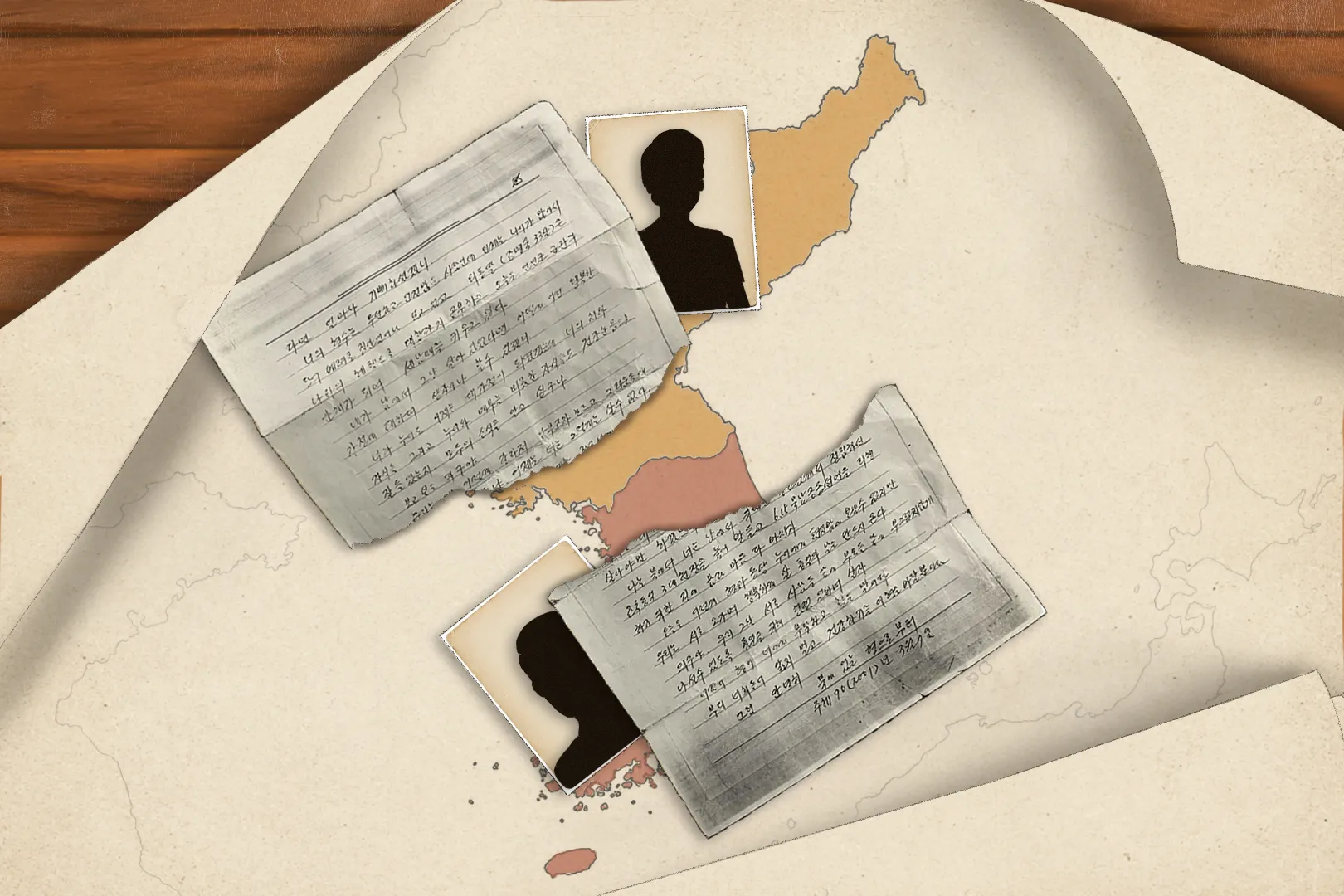
This feature is part of a series examining how artificial borders reshape daily life, divide families and force loved ones to navigate the human cost of political geography.
Kang Myung Sook was 63 the last time she saw her brother in North Korea. She is 87 now and lives in an elderly care facility in rural South Korea, about 32 kilometres (20 miles) from the border with the Democratic People’s Republic of Korea.
For two days in 2002, the siblings sat across from each other in a hotel banquet hall in a North Korean resort town, surrounded by hundreds of other families doing the same thing: trying to compress 50 years of life, thoughts and memories into a handful of hours, with government minders standing close enough to hear every word.
Then, the buses came to take the families home, half to North Korea, half to South Korea.
“My brother called out from the window of the moving bus, telling me to take care of myself,” Kang said. “We were all crying — it was chaotic. And then we never saw each other again.”
She is one of roughly 34,000 living South Koreans officially registered with the government as separated from family members in North Korea by the Korean War — a fraction of the 134,500 who have registered since the government began keeping records in 1988. More than 100,000 others have since died.
But the registry only counts those who applied, mostly for a shot at the now-suspended reunion programme. It says nothing about the far larger, uncounted number of Koreans — descendants, distant relatives, childhood friends, North Korean escapees — who still carry some connection to someone on the other side of the border.
This is a story about two of them: a woman who has been waiting nearly 75 years for the war between North and South to end properly, and a young man who managed to get back across the line separating both Koreas — twice — to bring the last of his family out.
The line that now separates the Koreas — and therefore a whole people — was drawn almost arbitrarily, on a night in August 1945.
As Japan’s colonial rule over Korea collapsed at the end of World War II, two American colonels, Dean Rusk and Charles “Tic” Bonesteel III, were tasked with quickly dividing the peninsula between Soviet and United States occupation forces.
They picked the 38th parallel, chosen mostly because it neatly bisected the country and kept Seoul on the US side. Neither man had spent much time in Korea, and in his 1991 memoirs, Rusk recalled that their commanders “accepted it without much haggling — and, surprisingly, so did the Soviets.”
The division was meant to be temporary. The plan agreed among the wartime allies was a several-year international trusteeship that would prepare Korea for independence as a single country. Instead, Cold War distrust scuttled the trusteeship almost immediately, and the two occupying powers backed rival governments — a Soviet-aligned North under Kim Il Sung and a US-aligned South under Syngman Rhee — both declared in 1948. The “temporary” line hardened into a border.
In June 1950, North Korean forces crossed the parallel, and for the next three years the front line swept violently up and down the peninsula — north almost to the Chinese border, then back south past Seoul, then north again — sending refugee columns fleeing in both directions.
It was in this chaos that Kang lost her brother, Kang Won Gu. While she and her family lived in the countryside, her 14-year-old brother was attending middle school in Seoul when North Korean forces occupied the city, she recalled, her mind still sharp at 87. Her granddaughter, Lina, 28, arranged the visit with Al Jazeera — she likes hearing her grandmother tell these stories.
When United Nations troops pushed the North Koreans back out, the fighting that followed sent a new wave of refugees fleeing north. The only one of his family to attend school in Seoul, Kang Won Gu was swept up in the crowd. By the time the armistice was signed in July 1953, he was still in North Korea, with no way back. Millions were permanently stuck on whichever side of the border they were on when the armistice was signed.
The armistice fixed a new line close to, but not identical to, the 38th parallel. Fighting had shifted it slightly east and west, and it was then fortified into the Demilitarized Zone (DMZ). Today, the DMZ is one of the most heavily militarised borders on Earth, lined with minefields, barbed wire, and thousands of troops. The Korean War was halted in 1953 with the armistice, but because no peace treaty was ever signed, the war never formally concluded and remains, technically, a ceasefire.
For Kang Won Gu, as the only person from his family to end up North, “there was no way for him to survive on his own,” Kang said. “So to get food and shelter, he enlisted in the North Korean army.”
She only learned her brother's fate because she found him again, more than half a century later, through a state-led reunion programme.
The reunions, launched after the 2000 inter-Korean summit, were never intended to be simple family gatherings. They grew out of a short-lived diplomatic thaw known as the Sunshine Policy, and the programme turned the deeply private tragedy of separation into a highly choreographed state spectacle.
The process of finding separated family members relied on a government-led registration system, where individuals in the South submitted details about their former hometowns and lost relatives, hoping for a match within a database managed by the authorities.
South Koreans registered with the Red Cross, listing their name and what they knew of their relative's identity and hometown. When a reunion would be announced, participants would be chosen by a computerised lottery weighted by age and family ties, then narrowed through interviews and medical checks. On the North Korean side, the selection process has never been disclosed
For Kang, the match arrived by phone. “It was my younger brother calling. He said, ‘Sister, turn on the TV quickly!’ I asked why, and he said our brother was looking for us.” By the time she got to a television, the broadcast announcing matches had already ended. Her son-in-law bought a newspaper instead, and her brother’s name was in it.
Before meeting, her younger brother received a handwritten letter from their older brother in North Korea, dated March 7, 2001. “Not a moment has passed, not even in my dreams, without missing you,” he wrote. “I left our hometown and our family without even a proper goodbye, telling myself I’d be back again soon ... but because of the tragedies that befell our hometown, I was unable to go back.”
In the letter, he thanked North Korea’s founding leader Kim Il Sung for enabling him to live a comfortable life in the North. After his military service ended, he said he worked his way up to become a director of a factory.
“Through the great mercy of the Great Leader [Kim Il Sung] and Dear Leader Kim Jong Il, the nation gave me great benefit; my life has been settled and secure, and they gave me a warm home and family. If our parents, still living, could see this son's happy life, how happy they would have been,” he wrote in the March letter.
But mostly, he expressed his longing to see his siblings once more. “Why did we have to live like this, cut off from each other, unable even to ask after one another, carrying this longing all this time?” he wondered.
Still, the reunion would take even longer. Originally planned for that same year, North Korea called off the reunions in October 2001, using the security alert South Korea had put in place after 9/11 as its excuse — though the real cause was likely a broader chill in North-South relations that had set in earlier that year.
But then in 2002, Pyongyang gave the greenlight. The reunion itself was a massive logistical undertaking. Participants travelled in a large convoy of more than 20 buses, which transported families into the North for a two-day, one-night trip. Kang made the trip with her older sister and younger brother.
In a hotel hall at the Mount Kumgang Resort in North Korea’s southeast, crowded with dozens of other reunited families, her older brother walked in. She recognised him immediately.
The resort sits at the bottom of the granite peaks of Outer Kumgang, on the Korean Peninsula’s most scenic mountain ranges. For a while, it functioned as an inter-Korean tourism destination, but North Korea in recent years started dismantling the resort and last year even destroyed the Inter-Korean Family Reunions Center at the hotel.
“I remember him as plump and round-faced, but [in 2002] he was thin and gaunt — like all the North Korean people you see. He approached in a formal and somewhat reserved way saying, ‘Nice to meet you.’”
Kang, however, dropped the formalities as soon as she saw him.
“I screamed, ‘Oppa!’” — Korean for older brother — “and I just cried.”
They reminisced about childhood memories, but their meeting was heavily monitored. North Korean minders stood near enough to hear everything, and her brother performed for them accordingly.
“He kept saying, ‘Don’t cry, thanks to General Kim Il Sung we’ve eaten well and lived well,’” Kang recalled. “But I could tell he didn’t mean it.”
Later, at the table, he told her he had named his only daughter after her — Kang Myung Sook.
“I asked him, ‘Out of all the names you could've picked, why did you name her Kang Myung Sook?’ He stared at me for a long while, and said, ‘I wanted to be able to call your name.’”
That meeting was the last time Kang ever saw her brother, or heard from him. In March this year, Kang’s younger brother recorded a video message to his older brother in North Korea as part of an initiative by Seoul’s Unification Ministry to preserve family histories and to facilitate exchanges with North Korea and hopefully, one day, more reunions.
“I have no way of knowing if my brother is alive or not, and there is no way to contact him. I heard that he lives in Nampo City in the North, but it has been about 25 years since we last met,” he says in the video, recalling how he and his older brother used to fish and play together in the village. “There was not much else to do.”
The family has no address and no way to send letters to the North. While the current South Korean administration would be eager to restart reunions, Pyongyang is keeping all doors shut.
While Kang’s story symbolises the division of the Korean Peninsula, it would be wrong to think such tales only belong to an older generation of Koreans.
Kim Kang-woo, 31, has also been directly affected by the division.
Today, Kim lives in Siheung, a satellite city of Seoul, but he was born in Hyesan, a North Korean city on the Chinese border. At age 22, he made the biggest decision of his life: He decided to escape to South Korea.
Kim left out of necessity. During his second year in high school, his father was beaten to death during an interrogation in a North Korean state security detention facility. His father had crossed into China to earn money for his family, which had fallen into poverty after the North Korean government implemented a currency reform in 2009, but after just a few months, he was caught illegally staying in China and forcibly repatriated to North Korea.
Kim’s dad had been deemed a political criminal, and as his son, Kim would be barred from military service, which in North Korea meant his adult life was effectively over before it began. Those who don’t serve in the military have essentially no status in North Korean society and are subjected to a lifetime of unpaid labour, with no path out.
Defectors’ relatives left behind in North Korea are held responsible for the escapee’s actions under the regime’s guilt-by-association policy. Reporting based on defector testimony describes heightened surveillance, forced relocation to remote areas and downgrades in songbun — the hereditary loyalty ranking that shapes access to housing, food and opportunity. Schooling and job prospects for the next generation are often among the first casualties. In the most serious cases, families have been sent to labour camps.
What helped convince him to leave, however, were the smuggled South Korean films he watched in secret. Most foreign films, music, and other cultural content are banned in North Korea, but in border towns like Kim’s hometown, South Korean media slips in through smugglers, often carried on small hard drives or USB sticks. Through these dramas, part of the global wave of South Korean media that has reshaped pop culture in recent years, Kim learned of a very different South Korea from the one he was taught about in school.
“I was taught that South Korea was full of poor children selling cigarettes and gum. That kids couldn’t go to school and that there were lots of shantytowns. So we thought South Korea was worse off than we were,” he said.
But after seeing South Korean TV series, particularly “Prosecutor Princess” (2010) and “Boys Over Flowers” (2009), he came to a realisation: “We had it all wrong.”
In “South Chosun,” as North Korea calls the South, ”even kids like me with no money and no connections have opportunities if they work hard. Realising that gave me the courage to defect,” he said.
Kim defected from North Korea on May 26, 2016, and entered South Korea that same year in October. He explained to Al Jazeera that he fled over the border with China, making his way to Southeast Asia from where he could reach a South Korean embassy — the most common route for escapees since crossing the heavily fortified and mined DMZ is close to impossible.
After completing his mandatory South Korean government security screening that is meant to filter out spies, and a resettlement course, he entered South Korean society in February 2017. His mother, however, had remained in the North, and he had promised to come back and free her once he made some money.
So he started taking all kinds of work, from construction to store clerk, saving enough to pay for brokers who would facilitate his mother’s escape.
In 2019, he returned to the Chinese border with a broker he had arranged to bring his mother out. But the plan fell apart when his mother, frightened and without a phone of her own, got cold feet. Kim regrouped and came up with a new plan. He figured that the only way to get her out would be to convince her himself. That meant crossing the Yalu River again, but this time from China into North Korea. So he remained near the border and watched the North Korean patrols along the river for two days before timing his crossing to a shift change.
Crossing into North Korea is extremely dangerous. Border guards have a shoot-on-sight order for anyone nearing the North Korean border, and many have not made it alive. But Kim succeeded.
Once across the border, Kim made his way, undetected, back to the house where he had grown up. His mother could not believe he came back for her, and was at times doubtful of whether she should also leave for the South.
But Kim had brought his iPhone to show her photos and videos of his life in South Korea as proof that what he had seen in dramas was true. Despite showing her evidence, such as his home, the variety of food, and amenities like a refrigerator and running water, she initially had difficulty believing him because she was unfamiliar with these technologies. But he successfully convinced her to join him.
For nearly a month, he worked in the North with brokers on both sides of the border, trying to get them both out.
His hair was dyed at the time — a strict no-no in North Korea, where even fashion and hair are regulated by the state. So he wore a cap to hide it, but he mainly just stayed inside to avoid being caught.
Then, one day, North Korean surveillance intercepted one of his phone calls, and agents came for his mother while he was away from the house. They held her, demanding to know if her son had returned. A friend hid Kim and told him to leave, for both their sakes.
Kim crossed back into China alone, and when he landed back in South Korea, intelligence agents were waiting for him. They had tracked his movements and questioned him about his stint in the North.
Then word came through a new broker Kim had hired: another attempt to get his mother out succeeded. She was on her way to him.
South Korean authorities soon arrested Kim for illegally re-entering North Korean territory, which is a crime regardless of intent.
A judge, citing Kim’s remorse and clean record, cut what could have been a three-year sentence down to six months, plus two years’ probation. His mother made her way to Seoul while her son was in jail, and when he was freed in September 2020, she was waiting for him at the gate.
The experience of crossing that border twice, he said, changed what he understood a border to be.
"Before, I thought a border couldn’t be crossed. But if it’s for family, you need the moral courage to cross that boundary,” he explained.
It also means North Korea has never felt far away to him.
“I still have many friends back in my hometown, and thinking of them, I feel a lot of guilt. Because of that guilt, I have a desire to someday help bring them over here, or do something toward reunifying North and South Korea.”
There are things he misses from his life in the North.
“Here, there’s less warmth between people,” he explained. “It’s fast-paced and highly competitive. By contrast, North Korea is a society where a bit more of that human warmth remains. neighbours and friends still help each other and get by together. I miss that.”
Now living with his mother, Kim says he enjoys his life in the South. He’s made a decent living repairing air conditioning units and is currently pursuing an undergraduate degree in political science at Kookmin University in Seoul. His passion is motorbikes: he currently rides a 500cc Honda, though his dream bike is a Kawasaki GSX-R 650. It’s too expensive for now, but he's confident that one day, it will be his, too.
His mother has also said she appreciates the South for offering stability and a high quality of life, complete with consistent access to electricity, gas, and heating - none of which are a given in the North. She has struggled to work because of health issues, but she has trained to become a counsellor for other escapees.
For Kim, transitioning to a new life in the South was far from easy, especially when he was on his own. While struggling to adjust, he wrote about his experiences and published his memoir, Hell Could Not Kill Me, in June.
“Before I brought my mother out, I lived alone in South Korea for about three years, and during that time I lived with an overwhelming sense of loneliness, fear, and anxiety,” he said. “I wrote [the memoir] hoping it could be even a small comfort to people who, like me, find it hard to take even one step forward.”
He said he’d also like for copies to reach his friends in North Korea, one day.
“If my friends there could read it, I think they’d all want to defect,” he said.
While life in South Korea is by no means easy, he says he can work towards making his dreams come true.
Ultimately, he hopes to pursue a career in academics, or perhaps politics.
“Here in South Korea, I get to study things freely that I couldn’t in North Korea,” he said. “There is great internet access, libraries full of books — it’s a wonderful environment.”
He has hundreds of books in his apartment, which he shares with his mother. He hopes to continue writing, and ultimately, earn a PhD in the United States. Afterwards, he wants to return to South Korea to teach and work as a scholar.
“I really enjoy studying. I like the social sciences — sociology, politics, diplomacy, international relations. But history is my favourite overall.”
Of different generations and from different parts of the Korean Peninsula, Kang and Kim both hold onto a grain of hope that one day they’ll be able to see their loved ones in the North again.
For now, however, the border is more sealed than it has ever been. South Korea’s Ministry of Unification recently announced that only 43 North Koreans reached the South between January and March of 2024, compared with more than 1,000 annually, before the pandemic.
During the pandemic, North Korean leader Kim Jong Un used the shutdown as an opportunity to fortify the North’s borders, adding fencing along the Chinese frontier, much of the coastline, and, more recently, new layers near the DMZ itself.
Cross-border movement in the opposite direction has also stopped. There have been no family reunions between North and South since 2018, and inter-Korean relations remain, by most accounts, at their lowest point in decades.
Despite this, Kim is determined: “I want to meet my friends and talk. I’d want to share how I’ve spent the past 10 years since coming to South Korea, and hear how they’ve been doing,” he said.
Kang echoed his sentiment. “If I could speak to my brother, I would tell him that I miss him,” she said.
Kang’s granddaughter, Lina, recalled her great uncle’s promise that one day, he’d reunite with her grandmother.
“I’d want our family in North Korea to know my grandmother remembers that promise, and that there are people here in South Korea who keep thinking of them. Even just a short message getting through to them would mean the world to her.” Lina is also just curious about family she has never met: “We could be strangers, but they are not strangers. If there is any opportunity to meet them, I want to stay connected. Bottom line: I don't think borders and time take away the fact that we are still family.”
Grandmother Kang said she hopes to get the chance to see her brother once more.
“There’s nothing in particular I’d want to do — just talk about old times. I wish I could see him one more time, but given our age,” she said, not finishing the thought.
The Berlin Wall separated his family. Its legacy still endures
Source: https://www.aljazeera.com/features/longform/2026/8/29/korea-divided-a-sisters-long-wait-and-a-defectors-bid-to-save-his-mother?traffic_source=rss