Tom HamiltonJul 7, 2026, 05:04 PM ETClose• Joined ESPN in 2011 • Covered two Olympics, a pair of Rugby World Cups and two British & Irish Lions tours • Previously rugby editor, and became senior writer in 2018
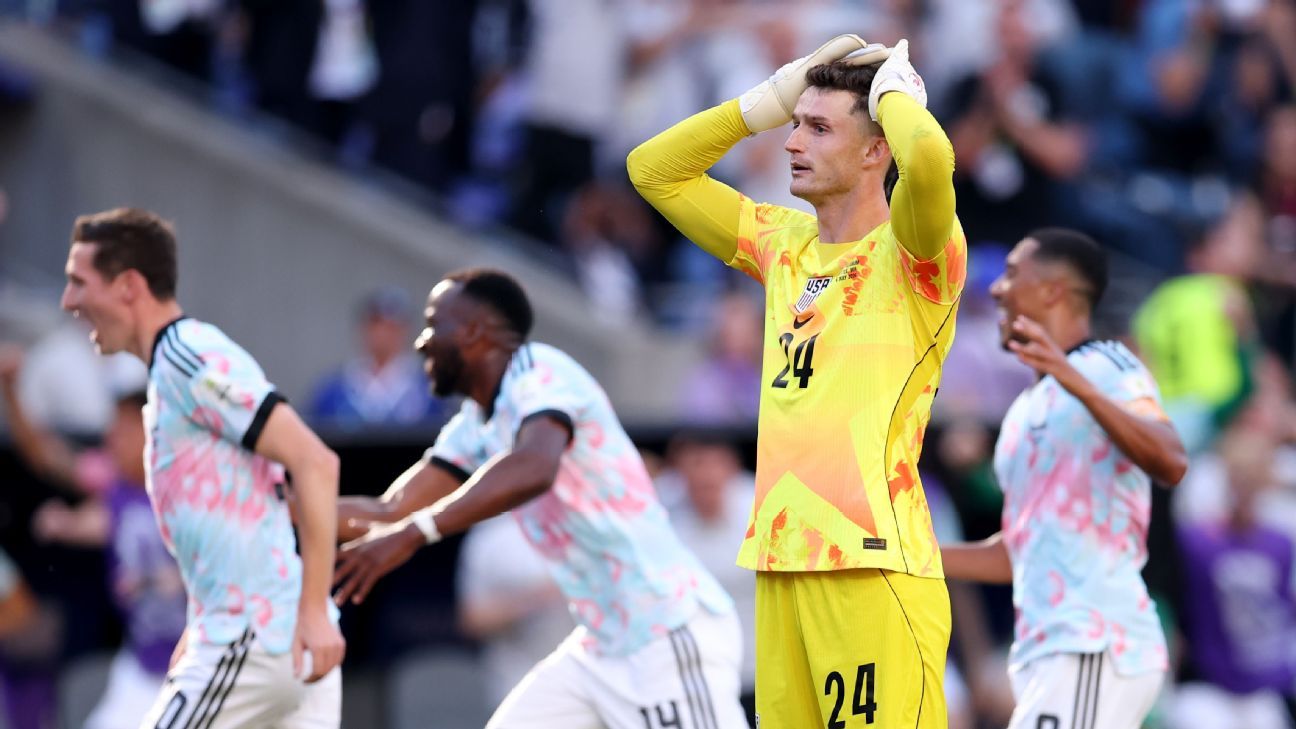
United States goalkeeper Matt Freese must have felt like the loneliest person in the world. After his error allowed Belgium to make it 3-1, the camera panned back to Freese and caught his look of utter desolation.
"Yeah, obviously disappointed for my involvement and error and judgment on the third goal," Freese said after the 4-1 loss. "I know the guys in front of me did everything they could today to get to win, and so proud of them and wish that obviously that moment was different."
He's not the first, nor the last, goalkeeper to feel like he wants the ground to open up and swallow him after a high-profile mistake. Antonín Kinsky's Tottenham Hotspur debut lasted a mere 17 minutes. After Atletico Madrid's third goal in their UEFA Champions League round-of-16 first leg tie, in which he lost his footing and passed the ball directly to Julián Álvarez, Kinsky spent a moment flat on the ground, staring into nothing. Two minutes later, he was hauled off by his manager, Igor Tudor. A couple of teammates gave him a consolidatory tap on the back of the head as walked off, head down, and Spurs went on to lose 5-2.
But goalkeepers past and present sympathized. Eventually, Kinsky allowed himself to read their messages of support. "No one who hasn't been a goalkeeper can understand how difficult it is to play in this position. Keep your head up and you will go again," former Spain and Manchester United keeper David de Gea posted on X. Real Madrid's Thibaut Courtois sent Kinsky a message directly on Instagram "to cheer him up a bit."
Being a goalkeeper can be a "lonely" existence, according to Netherlands great Edwin van der Sar. "At a basic level, we have a different color jersey on to our teammates. You stand out," he tells ESPN. "We've all had moments like Kinsky's, and that's where advice and support helps."
That's the beauty of the so-called "goalkeepers' union" -- when one goalkeeper is wronged or struggles, others speak up. "There is a duty between goalkeepers to look after each other," Millwall and New Zealand goalkeeper Max Crocombe tells ESPN. But it's not unqualified support, and there are moments the bond fractures. Ultimately, all goalkeepers want to be No. 1 -- and sometimes the values of the union are forgotten.
Crocombe, who started all three of New Zealand's matches at the World Cup, and Cieran Slicker, who spent last season on loan from Ipswich at Barnet, have similar approaches to social media: block it out. But it doesn't always work. "I've come home and though my missus hadn't watched the game, she's seen comments and says, 'Are you all right?'" Crocombe says. "I'm like, 'Yeah, I'm good. Why? Have people been battering me or something?'"
Slicker had to have a word with his mother, Amanda. "I think I was only 17, playing Scotland under-21s. I think I chucked one in and mum was replying to comments on Facebook. I said, 'Mum, you have to leave it.'"
Crocombe laughs and says, "It's so funny, sometimes you get messages off friends saying, 'Oh, mate, I hope you're well' ... Obviously people are just trying to support and sometimes you need it, but you have to develop ways to overcome it. If a keeper's had a beast, I'll wait a couple of days before messaging them. It's part of life."
Over the videoconference call, they smile at each other's anecdotes, and nod as they dissemble the challenge of staying level-headed through patches rough and smooth. They talk about Kinsky. "It's unbelievable how every single goalkeeper's gone through certain mental head spaces, making errors, and as you watch him, you replay so many moments in your career where you've been in a similar situation," Crocombe says. "I know that's obviously why a lot of people showed empathy, because like I said, everyone's been there, like everyone's made their mistakes," Slicker continues.
Slicker's memory flits back to one match where he struggled: his Scotland debut. He was on Ipswich's books at the time, having joined them from Manchester City. He wasn't meant to play against Iceland, but Robby McCrorie went down in the warmup, and Angus Gunn was injured in the opening exchanges of the match. So six minutes and 37 seconds into the game, Slicker was ushered onto the Hampden Park pitch.
He conceded three goals, the spotlight on his errors afterward. "He got thrown into a situation that he wasn't quite ready [for]," Scotland manager Steve Clarke said postmatch.
"I turned my phone off for two or three days," Slicker says. "I didn't reply to any messages, but when I was sort of looking through, I picked out the ones that were important."
One message was from his goalkeeping coach at City. Another came from his Ipswich captain Sam Morsy, who told him to learn from this setback as it'd make him hungrier to succeed. And of course, there were messages from other goalkeepers.
"Since I've been young, the goalkeepers' union has always been a thing, whether you're playing or not," Slicker says. "Maybe it comes from when you're younger you have shared games (standard practice at youth level, where keepers would play a half each to ensure both get game time) -- you want to support the other guy. It's like karma, I guess, you hope you get back what you offer."
- Borden: USMNT will look back at 2026 World Cup as a missed opportunity - Carlisle: Belgium handed USMNT a FIFA World Cup reality check - Connelly: Ronaldo's World Cup era is over. Where did each tournament go wrong?
When former Rangers and Manchester City goalkeeper Andy Dibble picks through over three decades of experience on the field, he remembers the messages he received after a game in March 1990. During that match, Dibble was preparing to clear the ball long. Nottingham Forest's Gary Crosby noted how Dibble held the ball with one hand as he assessed his options. On one occasion, Crosby crept up on Dibble, headed the ball off his hand and scored. "My phone didn't stop from that moment till the end of the season," Dibble tells ESPN. "Everybody was so supportive."
Richard Lee played for Watford and Brentford and is now an agent with over 130 goalkeeping clients. He was on the Watford bench back in March 2007 when Tottenham keeper Paul Robinson launched a free kick high into the White Hart Lane sky; it bounced once and over Watford starting goalkeeper Ben Foster's head for the most unlikely of goals from 80 yards. You could've forgiven Lee if his first thought was that the error might help him usurp the top dog, but it wasn't. "I felt horrible for him, because instantly you're like, 'God, if that had happened to me, how would I have felt?'" Lee tells ESPN.
The loneliness of the goalkeeper used to be even more stark. Dibble remembers back to when clubs had just a single goalkeeper on their books, and minimal position-specific training. But as specialist coaches crept into the sport, deepening the divide between goalkeepers and outfield players, the union's bond was further cemented. Then the change to the back-pass rule in 1992 changed everything. It meant goalkeepers became far more integrated into the wider team's tactics, and the expanded number of substitutes saw clubs recruit more goalkeepers on their books.
"The goalkeeper coach will naturally have a very good relationship with the goalkeepers -- they understand what you're going through," Lee says. "I can remember from personal experience, if you lose 1-0 and it's your mistake that's cost you, you're sat in the changing room after, and your manager's not talking to you, the lads are annoyed, the fans are giving you the cold shoulder and all you can think about is the mistake over and over again, but it'll be the goalkeeping coach who'll come up to you and put their arm around you."
Dibble agrees: "You are a bit like a dad to them at times. Not only do you have to deal with football problems, but also lifestyle problems at home."
Now, when teams train, goalkeepers head off as a group to work with the goalkeepers coach. The same goes for matches; at Euro 2025, England trio Hannah Hampton, Khiara Keating and Anna always came out onto the pitch about 15 minutes before their teammates. They had their routines; they'd kick a ball from one side of the penalty area to the other, trying to stop it on the opposite line of the box -- nearest wins.
"You go off and train on your own as a group normally for the first 45 minutes of a session," Lee says. "You are segregated from the rest of the players, and naturally you do build that union. I do believe that if the environment and the dynamic between the group is right, then you find the goalkeeping units are very tight." But all it takes is one bad apple, and things can fall apart.
Former West Ham, Portsmouth and Newcastle United goalkeeper Shaka Hislop has lived both sides of the coin -- the backup eyeing the starting role, and the first-choice keeper usurped by another. One goalkeeper brought in to replace him simply refused to speak with him. "It was the most bizarre thing. I'd come in and say good morning, and he wouldn't say anything back. ... It doesn't help the team, and ultimately didn't save the individual."
It's a balancing act that Lee weighs when looking at where to move his clients. He evaluates squad dynamics and where his players could fit in. But he also knows a backup goalkeeper's instincts. "There is obviously that feeling of empathy towards a goalkeeper but if there's an opening, you have to do what's right for you," he says.
Crocombe and Slicker have had similar experiences as Hislop, but they are rare. "Sometimes those who see you as direct competition hate you, and you in turn hate them back," Crocombe says. Slicker agrees: "I know that some goalkeepers hate-watch you when you're playing, but I've never been like that. I'm a believer in creating your own luck." Crocombe finishes: "But I always start out with respect for the other goalkeeper and support. If your rival goalkeeper makes a mistake, I'd always try and get behind them because I think at the end of the day, you should work together."
Slicker grew up with England's James Trafford as competition. They were friendly rivals in Manchester City's academy, and friends once they went separate ways. Trafford joined Burnley in 2023, then re-signed for City in July 2025 for £31 million. He started City's first three games, but on August transfer deadline day, manager Pep Guardiola brought in Italy star Gianluigi Donnarumma.
As a result, Trafford has served as a cup goalkeeper and the No. 2 to Donnarumma. "I didn't expect the situation [of playing backup to Donnarumma] to happen, but it happened, so just get on with it," Trafford said after City's FA Cup win over Salford in February. "Work very hard every day and then see what happens and give it my best shot."
"His mentality has been spot on: training well and being ready. But I think he's handled it so well," Slicker says with admiration. "At City, I learned so much from training with Éderson and Zach [Steffan], and when I was at Ipswich, I feel I really embraced that. I always tried showing [Václav Hladky], Christian [Walton] and Alex [Palmer] a lot of love and supporting them on matchday."
Crocombe was there for New Zealand's 2-2 draw with Iran, their 3-1 defeat to Egypt and 5-1 loss to Belgium. Though the tournament finished earlier than they'd have liked, the goalkeepers helped each other through the experience. "You want to get in the team because you're the best keeper, not because you're the least worst," Crocombe says. "And that's down to teamwork between the keepers."
Van der Sar has just about seen it all after playing at the top for 21 years, featuring for Ajax, Juventus, Fulham and Manchester United while winning 130 caps for the Netherlands. What unites him and the current generation of goalkeepers is the beauty of silence.
"You don't want to draw attention to yourself; you just want to save your job. A lot of what happens to you in goal is down to the strength of the defensive unit," he says. "You want that aura of invincibility, and while you want to work hard on your crosses and all the individual stuff, you fundamentally work as a unit to keep the ball out."
"Silence is praise when you're playing in goal, because ultimately, you'll get told if you've done something wrong," Crocombe says. "I think a lot of young goalkeepers are searching for highlights and attention for gratification, basically to say they're on the right path, but a lot of the time it's just silence."
One thing that has united the union in frustration is the lack of goalkeeping representation in the media. They talk about how one sentence or rant from a prominent pundit can change a discourse around a keeper. But in the past five years, more goalkeepers have gotten on TV -- Van der Sar, Lee and Dibble all mention how refreshing it is to see Joe Hart, Paul Robinson and Rob Green feature more. Across Europe you'll see Peter Schmeichel pop up, while Hislop is with ESPN.
"It's been so difficult for a goalkeeper to listen to a lot of the pundits that are talking about goalkeeping because they're talking about a different sport and as much as they might know a few good goalkeepers, they don't know what it's like to be there," Lee says. "Thankfully that's changing."
The mutual support of goalkeepers, whether in the media or just at the training ground, can lead to the odd eyebrow raised from the outfield players. "It's a thing you get used to," Van der Sar says. "If you defend another goalkeeper, they'll just say, 'Oh, classic goalkeeper's union,' type of thing. It's not a cliché, it's just the way it is. We support one another."
All of them hope the union continues. They point to the practice before penalty shootouts of goalkeepers touching gloves with one another -- almost like they're preparing for a boxing bout. "It's just the same as the players shaking hands before the game," Hislop says. "It's also because your other 10 teammates are on the halfway line, but it's part of the union -- a show of respect for your opposite number. That's not going to stop."
A day after the debut from hell, Kinsky posted on his Instagram. "Thanks for the messages. From dream to nightmare to dream again. See you." A month on, he was back in goal for Spurs. At the end of a must-win match at Wolves, Spurs held a slender 1-0 lead as they battled against relegation. João Gomes lined up a free kick 30 yards out and sent it with remarkable precision to Kinsky's top-left corner. He somehow leapt and kept it out. His teammates hugged him; the supporters celebrated him. At full time he stood on his own, soaking in the applause from relieved Spurs fans.
"It's a tough industry we're in; there's a lot at stake, but supporting one another is a pretty special thing," Crocombe says.
In the days to come, Freese will feel the love. "I mean, this hurts," Freese said. "This moment hurts more. Stings more than probably any other moment in my life. But I know that this is a step along a longer journey."
ESPN's Jeff Carlisle contributed to this story.
Source: https://www.espn.com/soccer/story/_/id/48913351/inside-goalkeepers-union-where-mutual-support-mandatory-2026-world-cup-freese-usmnt-kinsky