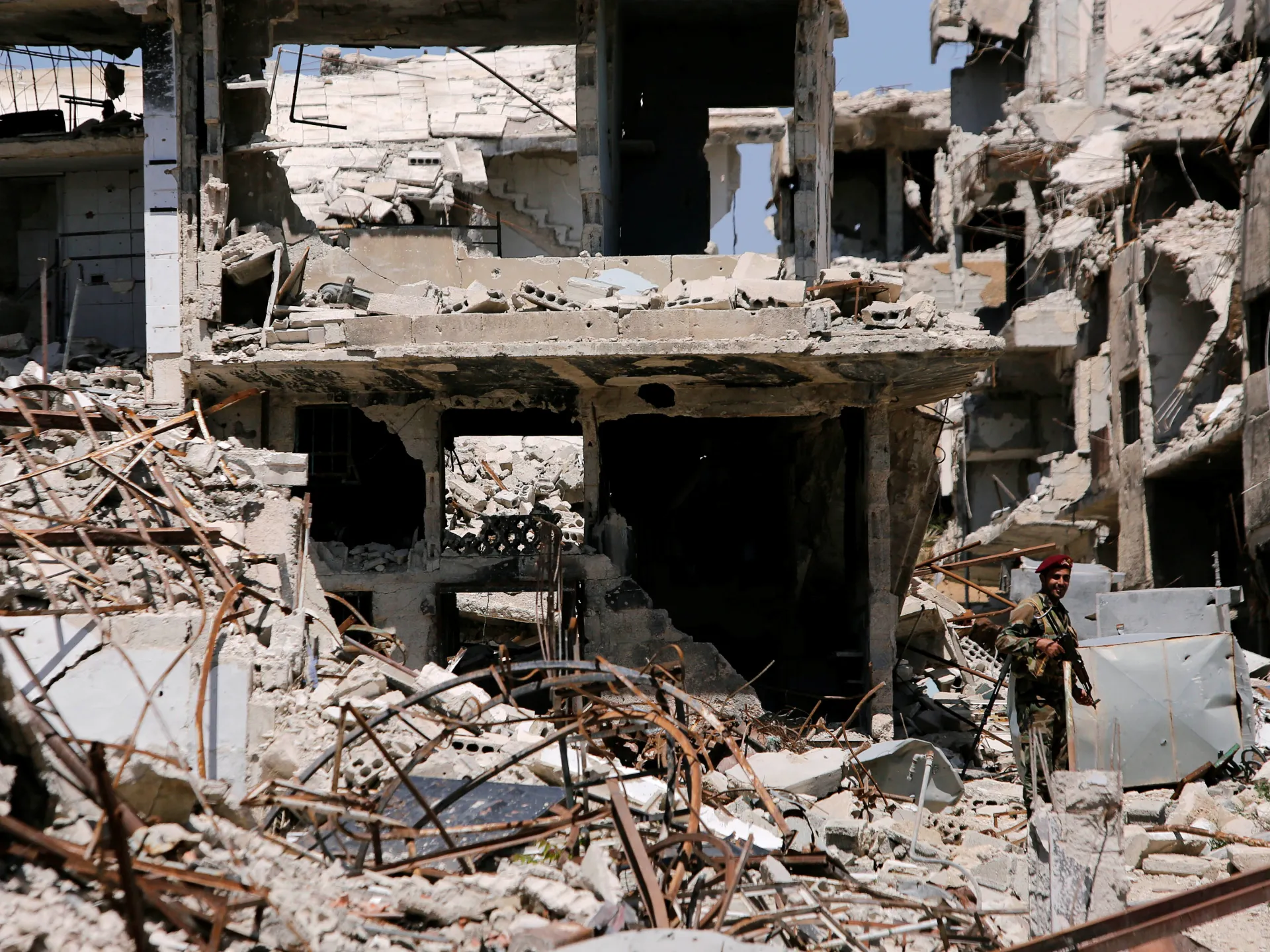
Jobar was held by rebels for much of Syria’s 13-year war, but was left destroyed by repeated government assaults.
Jobar, Syria – Ahmad, a Syrian man in his mid-30s, walks down an unpaved road in Jobar, in East Damascus, and points to a small home. It was damaged sometime during Syria’s 13-year war and is now dilapidated after years of neglect.
“That was my grandfather’s house,” Ahmad, who asked to use just his first name due to his sensitive position, told Al Jazeera. Nearby is his mother’s home and a small shop where she sold clothes.
Before Syria’s war broke out in 2011, following the violent suppression of anti-government protests, Jobar was a neighbourhood brimming with life. It was home to a historic mosque and synagogue but today stands as a ghost town after years of shelling, air strikes and chemical gas attacks.
Between 2012 and 2018, when much of Jobar was held by rebels, it became one of the frontlines of Syria’s war. It was repeatedly bombed and shelled by government forces, resulting in around 95 percent of buildings being destroyed. When the government recaptured the Damascus suburbs from the rebels in 2018, Jobar was emptied of most of its citizens.
Today, it stands as a major post-war problem for both Syria’s new government and its citizens, as they try to navigate reconstruction and the return of its former residents.
Opposition groups built a labyrinth of tunnels to avoid attacks by the regime and its allies, with daily air raids and shelling.
Locals said the tunnel network meant the area gained the nickname ‘the Bermuda Triangle’, because of how people would get lost there.
In 2018, the regime cut a deal with opposition groups – fighters, their families and other locals could leave the area. Most left for rebel-held Idlib and the regime banned any civilians from entering the area. Shortly after the rebels took Damascus in December 2024 and forced President Bashar al-Assad to flee to Russia, some of Jobar’s residents returned to visit their homes for the first time in eight years.
One former resident, Salem Sawan, 59, a former medic, also known as Abu Yehya, rents an apartment in a nearby suburb. He wants to return to his home but, like other locals, said residents have been blocked from rebuilding.
On a walk around a part of Jobar, Ahmad points to a large tunnel opening that was recently filled with dirt and rubble. “The government must have closed this recently,” he said.
Ahmad said some people had possibly got lost in the complex tunnel network. There have also been reports of buildings collapsing due to the hollowed-out ground below them. Between the tunnels, the lack of infrastructure and an ongoing mine clearance operation in the area, Jobar is a prime example of the struggle Syria faces in rebuilding.
One of the major issues for reconstruction has been finding financing. Assad left the country in ruins, materially but also economically, along with crippling international sanctions, which the new government has successfully worked to remove.
The World Bank estimated that the total cost of reconstruction in Syria is around $216bn, while almost 90 percent of the Syrian population lives below the poverty line.
“The need for reconstruction is really big and if a specific neighbourhood has no infrastructure at all [the question is] how to channel money into reconstruction,” Cao Yue, the author of a recent report on Syria’s reconstruction for ODI Global, a UK-based thinktank, told Al Jazeera. “We know the government has a limited public budget, so they have targeted international capital, and especially international private capital, and that’s why [there’s been an effort] to cut agreements with international investors, especially from neighbouring countries.”
On a tour of Jobar, Ahmad, the former fighter, points to a building with a missing facade. It was once a few storeys high, but the floors are missing because the iron rods that ran through them were stolen, he said.
A little over a decade earlier, Mohammad Hamsho, the former business partner of Bashar’s younger brother, Maher al-Assad, had come under US and EU sanctions for war profiteering and connections to the former regime. One of his companies has repeatedly been accused of extracting iron from destroyed areas for steel production. In January 2026, Hamsho allegedly came to a financial settlement with the new Syrian government, led by President Ahmed al-Sharaa.
Locals like Ahmad and Abu Yehya told Al Jazeera that officials told them they couldn’t rebuild their homes, even on their own initiative. When asked why, they were told there was a plan for the area, but they were not provided with any other information.
There are now reports that the government and private developers are looking to invest in areas like Jobar, and its geographic proximity to central Damascus means that land there is highly valuable.
Media reports say that local officials have proposed that a foreign-backed project for the area could finance a $21bn project that could create up to 200,000 jobs. But the project has a downside. It states that locals in the area will receive only 50 percent of their former homes and 30 percent of areas classified as “agricultural”. When that plan was presented to local councils and activists, it was met with anger.
This struggle between the government and locals is at the core of the struggle over Syria’s future.
“People need housing, but also need basic services like education, sanitation, water, electricity and governance,” Mauricio Vazquez, Head of Policy at ODI’s Global Risks and Resilience programme, and another of the report’s authors, told Al Jazeera. Vazquez added that the struggle is not only a “block of brick and mortar” but about finding ways to build back societies that are “better for Syria”.
As for people such as Abu Yehya, he said he is ready to start figuring out how to rebuild his home. During the war, he regularly had to pick up wounded people or bodies whilst fighting raged around him. He now has back problems, two slipped discs and can barely lift a kilo, let alone a body. “If a body is 70 kg (154 pounds) alive, it’s 140 (308) dead.”
“Anyone who doesn’t have a child outside [Syria] will die,” he said, sitting across from the local cemetery, filled with the bodies of his former neighbours and friends. Still, he wants to find a way to rebuild his home in Jobar.
Standing nearby was Mahmoud al-Ajouz, a 60-something-year-old gravedigger, who never left the area, even when his children were killed here and when the regime and its allies ordered all civilians out.
When asked about reconstruction, he was adamant that Jobar will thrive again. “We will rebuild with our own hands,” he said, “us and the state together”.
Source: https://www.aljazeera.com/features/2026/7/16/in-syrias-jobar-locals-struggle-to-rebuild-their-destroyed-homes?traffic_source=rss