Emily KeoghMay 20, 2026, 03:10 AM ETCloseBased in London, Emily Keogh is ESPN's women's soccer correspondent, specializing in the WSL and UWCL
Deanna Cooper was on a 20-minute Teams meeting while on holiday in Turkey at the end of the 2023-24 season when she and some of her Reading teammates were informed that their time at the club was over. Due to financial issues, the Reading women's team was taking voluntary relegation from the Women's Super League 2 to the fifth tier of English football and, with that, Cooper's four-year spell at the club was done, leaving her panicking about the future.
"I remember looking at my mum being like, 'I don't have a job for next year now'," she tells ESPN. "I remember it being an absolute whirlwind. We were like, 'Oh, we're finally going to find out what's going on for preseason, what's going on for contracts and stuff.' And it was literally like, 'No, by the way, we're self-relegating to tier five and there's not going to be a Reading women's team in the Championship anymore,' which was a bit of a shock."
For other players, it was even more abrupt, learning the news on social media. Several players had been at the club since the age of nine and weren't prepared to leave; others were still under contract and expected to return for preseason within weeks. Instead, they were left scrambling to find new teams with almost no warning.
"It was quite emotional," Cooper adds. "It was quite sad because it almost felt personal, like those four years had kind of just been and gone. It was almost like they'd taken away that meaning and that love for the club for me. I'll always have good memories of being there, it was a hard way to end it."
It just shows how fragile women's football can be, because it is still heavily reliant on the financial stability and success of the men's game that funds it. But this reality will now be weighing heavily on players at three WSL clubs.
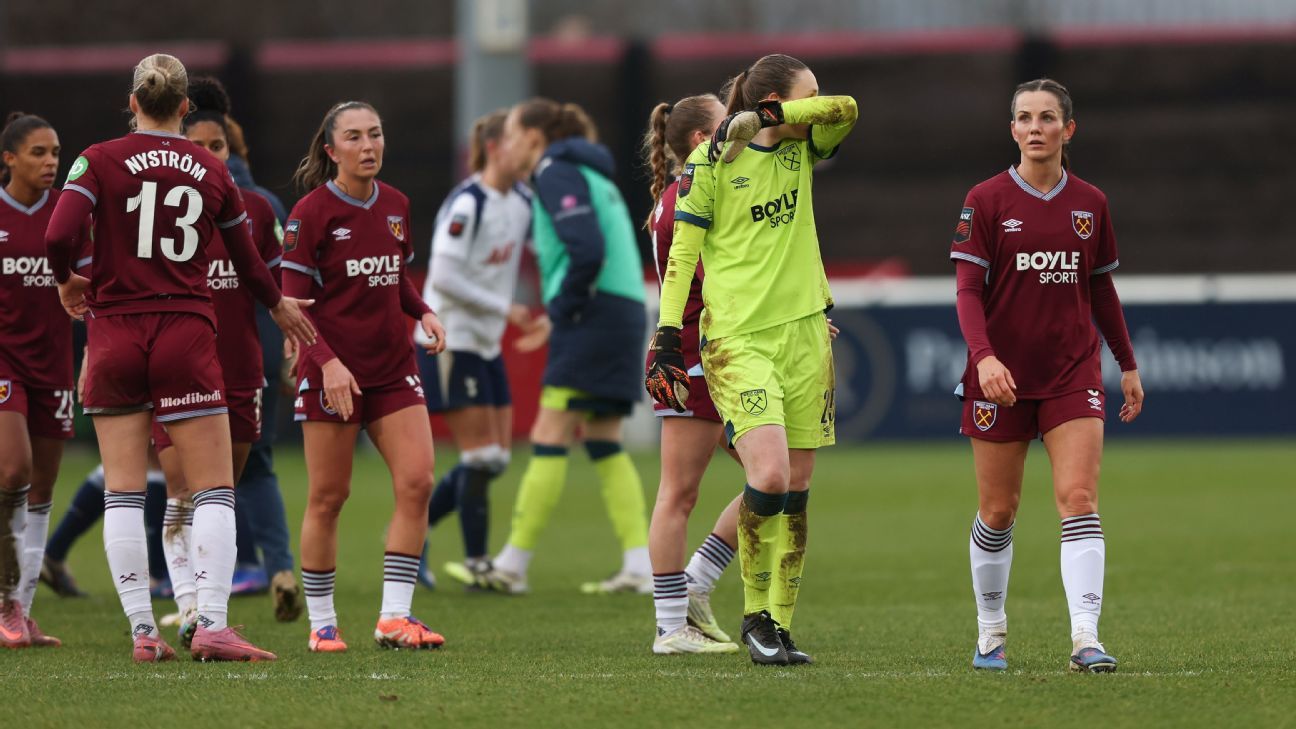
The men's teams of West Ham United and Tottenham Hotspur are locked in a battle to avoid relegation from the Premier League, with one certain to be playing Championship football next season. Meanwhile, Leicester City, whose men have already been relegated to League One amid fears of administration, are at even greater risk. Their women's side finished bottom of the WSL -- with a relegation playoff against Charlton Athletic to come -- and have suffered alongside the wider financial instability engulfing the club.
Yet the consequences of dropping out of the top flight could carry different implications for each women's team. Traditional financial models are proving increasingly unreliable at a time when the women's game demands greater investment, infrastructure and long-term security than ever before. Years of decline have intensified as turmoil at the boardroom level has filtered into the women's structure.
The future of women's teams that are attached to men's clubs feels increasingly uncertain.
Reading women were previously one of the founding teams of the WSL -- who had players like Fran Kirby, Fara Williams and Mary Earps wear the badge -- finishing as high as fourth in 2017-18 and maintaining steady mid-table finishes until they were relegated in 2022-23 -- with their final game coming in a 3-0 defeat against champions Chelsea. That same season, their men's team was relegated to League One and, within a year, the support for the women's team had disappeared altogether.
Reading's financial issues had predated the relegation -- the club faced significant EFL charges for breach of accounts from 2021-2023, after spending over the wage cap. As a result, the women's team moved to operating part-time in 2022-23 to absorb some of the financial strain of keeping the wider club running, but new financial regulations from WPPL (now WSL) meant that after one season, the women's team voluntarily withdrew to be placed as an amateur team in the fifth tier.
"We weren't told [about the financial issues]," Cooper says. "But I remember after Christmas there was some conversations within players being like, 'Well, have you been offered anything for next year?' as you do in many teams, people start chatting about the next season, what preseason plans are going to look like, what dates are we coming back, so there was a lot of chats like that and no one could give us really any answers.
"We were just a bit like 'something's going on.' Obviously, we knew there was some financial struggle with the men's because they'd obviously started laying off academy boys' coaches, which you know it's bad when the boys are being affected.
"I know that probably sounds bad because obviously everyone knows normally the women are the first to go and that's just the norm, which it shouldn't be, but it is. But when the boys are starting to get affected and the coaches are starting to get affected, you kind of know that there's something going on."
But how do you stop the Reading situation repeating itself?
There is a stark contrast between the support the Tottenham and West Ham women's team have received. Since entering the WSL in 2019, Spurs have benefited from consistent institutional backing, something that has only intensified with the appointment of former Arsenal CEO Vinai Venkatesham, a long-time advocate for the women's game.
But West Ham, despite being a founding member of the professional women's pyramid in England, have struggled to establish themselves as a competitive force and have spent consecutive seasons hovering near relegation while operating on a significantly smaller budget than many of their rivals. One ESPN source described the club's attitude towards the women's team as "lip service," claiming the ownership showed little genuine interest in its progress or ambitions.
Of course, West Ham are far from the only WSL club to be affected by detached ownership. At Manchester United, minority shareholder Sir Jim Ratcliffe has shown little engagement with the women's team since taking control of football operations -- he has yet to attend a match, including their 2024 FA Cup final victory -- and has repeatedly undermined the team through his public comments. If United Women were ever to face relegation, it is difficult to imagine Ratcliffe maintaining the same level of commitment, and the club have precedent: In 2005, United disbanded their women's team entirely to focus resources elsewhere, and only reformed the professional side in 2018.
In the modern WSL, backing from a Premier League men's club has become increasingly essential as the league grows more competitive and financially demanding. Yet there are emerging alternatives to that model.
London City Lionesses have positioned themselves as a disruptor to the established order through their multi-club ownership structure led by American billionaire Michele Kang, who also owns French giants OL Lyonnes and NWSL's Washington Spirit.
Kang has invested heavily in London City's rise to the WSL (they finished sixth this year) following their Championship-winning campaign last season, injecting approximately £22.4 million into the club. The scale of that investment is reflected in their latest financial accounts, in which the club reported operating losses of more than £10 million against revenues of just £902,000. Yet, their spending has continued.
Ahead of this season, London City enjoyed another ambitious transfer window -- with one ESPN source estimating the club spent close to £3 million on transfer fees alone -- and, unsurprisingly, that level of investment is expected to produce another significant loss in the next set of accounts.
While those figures are striking, the model is not entirely different from the losses routinely absorbed by Premier League clubs in support of their women's teams. The key difference is that London City's investment is being driven primarily by a single owner rather than being subsidized by a men's side.
That naturally raises doubts over London City's long-term sustainability and poses a question: What would happen if Kang was ever to withdraw her backing?
Kang is not new to this model. Having already accelerated the growth of both Lyonnes and the Spirit, she understands the long-term nature of investment in women's football and has repeatedly stated that profitability is a medium-term objective rather than an immediate expectation. Her approach does not guarantee success, but it does offer something increasingly valuable in the women's game: independence from the priorities and vulnerabilities of a men's club.
Tottenham's women still rely on funding from the men's side of the club -- similar to the structures at Arsenal, Chelsea and Manchester United -- but they are not viewed as wholly dependent on the success of the men's team.
That distinction matters in modern football finance. Most men's clubs operate at a loss, with spending routinely outstripping revenue in pursuit of success; women's football operates on a far smaller scale, but the same principle applies: revenues remain relatively modest while operating costs continue to rise. As a result, many women's teams depend on regular financial support to cover losses and sustain day-to-day operations.
But sources have told ESPN that Spurs keep the men's and women's budgets separate, with club officials assuring supporters during a recent fan forum that the women's side would not face financial repercussions if the men's team were relegated. Indeed, ESPN sources say the club have made clear that plans for an aggressive summer transfer window for the women's side would remain unchanged regardless of the men's league status.
The club have already moved quickly to secure head coach Martin Ho to a new contract less than a year into his current deal, while key players including Eveliina Summanen, Olivia Holdt, Matilda Vinberg and Olga Ahtinen, have all signed extensions.
At the other end of the spectrum, Leicester City represent a more precarious example. Sources close to the club describe the women's team as "heavily reliant" on the men's side, meaning the financial instability surrounding the wider club has become a growing concern for the future of the women's team.
Leicester were already facing significant financial pressure before the men's side suffered relegation from the Championship to League One -- a drop that has only intensified fears around their long-term stability -- and concerns about a potential sale, or even administration, are becoming increasingly real.
Multiple ESPN sources described Leicester women's budget as "shoestring," even before the latest relegation. The side have long struggled to financially compete with the league's established clubs, operating with only a fraction of the resources available to the WSL's elite and unable to consistently build or retain a competitive squad.
In recent seasons, Leicester have often survived relegation more through the failings of other clubs than through sustained progress of their own. This season has further exposed the widening gap between the Foxes and other low-budget WSL sides, as (after the controversial decision to sack Amandine Miquel only weeks before the start of the campaign) they finished 11th, eight points behind Liverpool, having won just two league games and scored only 11 goals all season under interim manager Rick Passmore.
The wider financial picture only deepens concerns. Leicester recorded losses of £71.1 million in their most recent accounts for the 2024-25 season. Football finance expert Kieran Maguire told TalkSPORT that the club's substantial wage bill, outstanding transfer payments, loan obligations, reduced revenues and continued stadium and training-ground operating costs are all likely to outweigh League One income.
Questions around the use of main stadiums are also a concern. Leicester's women have played all of their home games this season at the King Power stadium -- a 32,000 seater that has been their full-time home in 2021 after the club were promoted to the WSL -- and managed to balance the scheduling conflicts of a team in the Championship and WSL.
But despite plans to play more women's games at the Tottenham Hotspur Stadium, Spurs could face difficulty in scheduling due to the increase in games (38 to 46, plus playoffs). Of course, this is not an issue for West Ham at the London Stadium, as they are the only women's team to not have played at a main stadium yet due to the ownership rights of the ground.
Against that backdrop, maintaining investment in a women's team inevitably becomes more vulnerable.
For those involved with Reading women before the team's collapse in 2023-24, the scars still run deep.
"We came in for preseason, and it was a bit like we're in this new league in WSL 2," Cooper says. "We had no manager; we had hardly any staff and hardly any players either. I think for most of preseason, I think we had maybe 12 or 13 training, which was quite crazy.
"A lot of the kids come up and train with us, which was nice. It was that first initial period after getting relegated was a bit up in the air, shall we say." The team had been aware of some of the stories and rumors circulating in the media about the club's ownership and a possible takeover. Still, Cooper insists the team "didn't have any idea that what was actually going to happen" until that dreaded Teams meeting in June.
After Reading's relegation, the 32-year-old Cooper left for Newcastle United on a free transfer. But there was no communication with the club after that. Some players who were still under contract were in back-and-forth talks, but for many that was the last time many of the team spoke to anyone at the club.
ESPN has been told that all the staff and players from Reading's final WSL 2 season departed the club that summer, and the aftereffects of the women's team's demise sent a shockwave through women's football.
"I remember there being a lot of social media outrage by it, but there wasn't really anything that could be done because it wasn't like they got rid of the women's team, which obviously would've looked a lot worse," Cooper adds. "They just self-relegated, which kind of made it a little bit better, I suppose, or made them look a little bit better. But to us, it felt like they just got rid of the women's team."
At the heart of football's financial instability are the people; the players who had to find new clubs at short notice, the staff who went from employment to unemployment in a matter of hours, and the fans who went from supporting a team week in and week out to having little left to root for.
"We had some fans that would come to a lot of the games, and they were amazing. They were honestly incredible. And it was more for them. It felt like we were letting them down in a way," Cooper says.
"Obviously we had no choice of the matter, nothing we could have done. We could have won the league that year and it still would have been exactly the same situation. So it was more like we were letting them down and obviously we knew the hard work that each of us as players and all of the staff had put in over those four years that I'd been at, and even way before that."
Reading's story changed women's football. And even now it is a warning sign that more stability and financial support are needed as the game grows.
"It taught me to love what I do every day because you never know when it's going to end," Copper adds. "You have to separate yourself from that, but also remember that if someone's going to take it away, you have to enjoy it in the moment."
Source: https://www.espn.com/soccer/story/_/id/48815498/west-ham-spurs-leicester-beware-how-mens-relegation-impacts-wsl-team