Flooded tents and high prices leave Gaza families struggling to keep children warm as winter approaches.
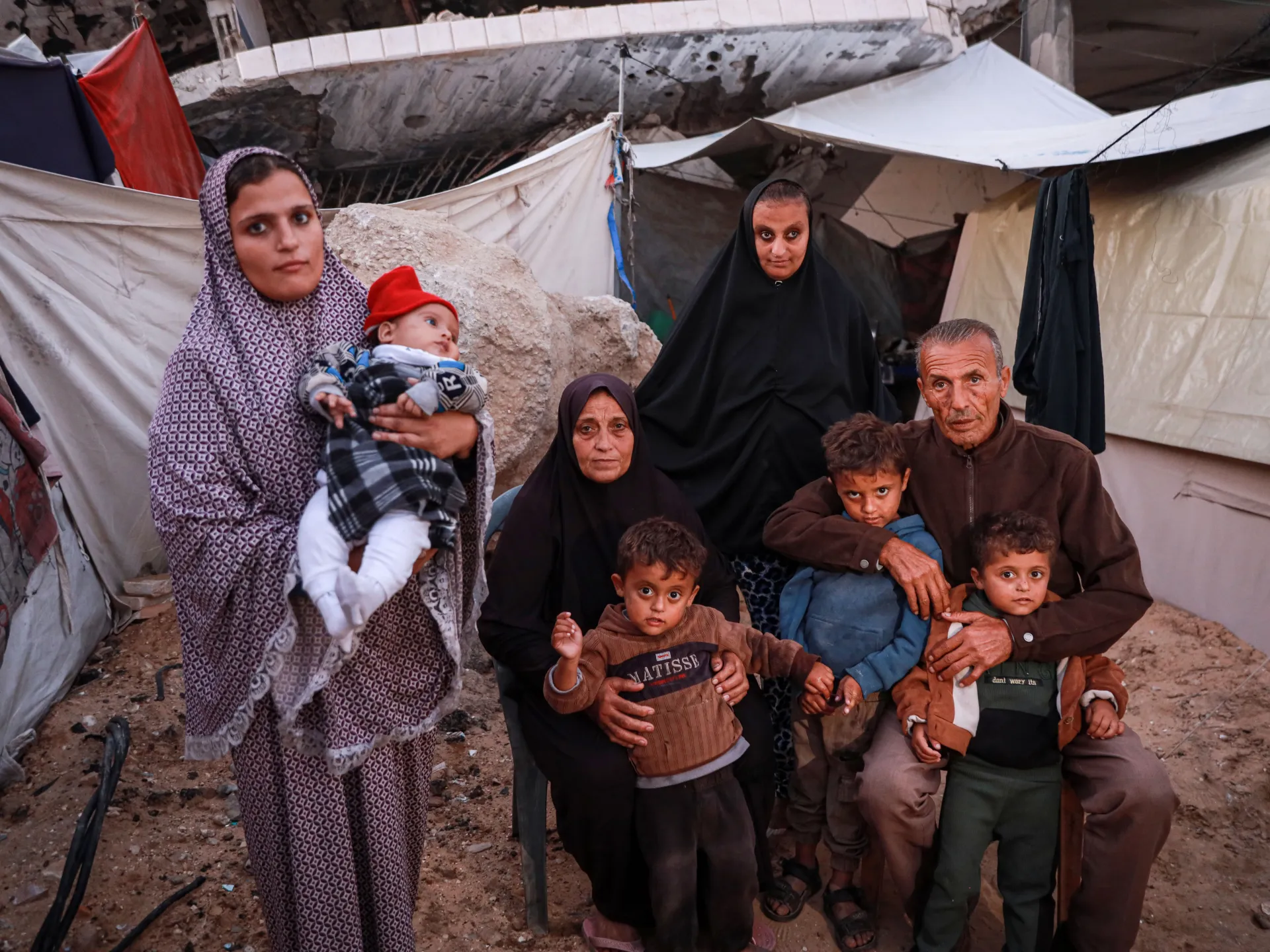
Gaza City, Gaza Strip – At night, as temperatures drop inside their makeshift shelter in Gaza City, Amira Saad struggles to keep her four-month-old baby, Mohammed, warm.
The baby mostly only has thin summer clothes. Unable to afford winter clothing, 27-year-old Amira has borrowed a warm garment from a neighbour, but remains worried about the cold during the night.
list 1 of 3‘Horrific crime’: Gaza doctor killed as Israel expands war on healthcare
list 2 of 3‘Greater Israel’: Christian Zionism’s role in US policy
list 3 of 3Israeli strike on Gaza’s Nasser Hospital kills surgeon, five others
She lives with 18 family members, including nine children, under a tarp offering little protection from the elements. Finding enough warm clothes and blankets for everyone has become increasingly difficult.
The family was displaced from Gaza City’s Shujayea neighbourhood earlier in Israel’s genocidal war on Gaza, and now lives in a makeshift camp west of the city.
Recent heavy rain has flooded their shelter, soaking mattresses, pillows, and blankets.
“We were flooded while we were sleeping. The water came inside and soaked our blankets, mattresses and pillows. Everything was wet,” Amira says.
The children mostly have old, torn summer clothes. Amira’s mother-in-law, 60-year-old Basima Saad, is also worried about her own 23-year-old daughter, who has a disability, and needs warm clothes and medication.
“Her hands become as cold as ice. I keep her beside me in bed to warm her, just as I would a small child,” Basima says. “I dress her before I dress myself. I have to make sure she is warm first.”
With no regular income, the family relies on community kitchens for food. Spare money for winter clothes and blankets simply is not available.
“My husband does not have a job. Two days ago, he went out to work breaking up rubble, but he broke his hand. The situation is very bad, and the cold is extremely severe,” Amira says.
The danger to the Palestinians living in these conditions, and particularly the very young, is not hypothetical.
On Thursday, a nine-month-old baby, Kinan Ahmed Raqiq, died of hypothermia. His father told AFP that he woke up in his tent to find that his son’s skin had turned blue.
Tragedies like that make Amal al-Maydana, a 46-year-old other of seven, fearful.
She’s raising her children alone – her husband Hamza was killed by an Israeli quadcopter in January 2025, and her eldest son Haitham was killed by a sniper in November of the same year, age 25 at the time.
She is originally from Gaza City’s Zeitoun neighbourhood and has been displaced six times during the war, fleeing Israeli attacks and losing the family’s home, land, and car.
Now living in a tent, Amal struggles to provide for her children. Her younger daughters, Rimas and Malak, are still wearing summer clothes despite the arrival of winter.
“Everything is expensive… children’s clothes, shoes, everything,” she says.
Amal tries to make do with what is available, but it is not enough to meet her daughters’ needs.
Rain also seeps through the damaged tarpaulins covering the family’s tent. With no heating equipment, they rely on blankets to keep warm.
“We have no means of heating ourselves; we just cover the children with blankets,” she says.
Amal fears another storm will bring more rain and cold. “We just pray that God makes this winter easier for the people living in tents,” she says.
The United Nations Office for the Coordination of Humanitarian Affairs (OCHA) says 94 percent of Gaza’s population urgently needs shelter assistance. Some 65 percent of households live in tents or makeshift shelters, while 650,000 children need winter aid, including warm clothing and blankets.
By September, aid agencies had secured enough winter clothing for just 9,000 households and bedding for 50,000 – far short of what was needed. OCHA said funding shortages were further hampering preparations for winter.
The UN Children’s Fund (UNICEF) has warned that winter conditions put children in Gaza at increased risk of hypothermia and respiratory infections – at least 11 children died from hypothermia last winter, according to the Gaza Ministry of Health. The agency is seeking $97.5m for its 2026-2027 winter response, which aims to support 540,000 children and their families across Gaza and the occupied West Bank.
Recent rains have worsened the crisis. UNICEF said on November 9 that flooding had affected more than 106,000 people, while some 950,000 displaced Palestinians were living in flood-prone areas.
More than three years into Israel’s genocidal war, which has killed more than 74,600 Palestinians and wounded over 176,000, homes and livelihoods across Gaza have been devastated. Nearly two million people have been displaced, many repeatedly, and hundreds of thousands remain in tents and damaged shelters.
As the war enters its fourth year, unemployment and rising prices have made basic necessities increasingly unaffordable, leaving families struggling to protect their children from the cold.
In Gaza City’s Rimal market, 25-year-old shop owner Mohammed Abu Shanar sees the same struggle among his customers. Many ask about winter clothing prices, but leave without buying anything.
“The prices are very high. They are not within everyone’s reach. People come in, ask how much something costs, and then leave because they cannot afford it,” he says.
Mohammed sells around four to six winter tracksuits a day. He says many children from nearby displacement camps still wear short-sleeved or lightweight clothes despite the cold.
He attributes the high prices to shortages of goods entering Gaza – the result of continued Israeli restrictions – and the cost of buying stock from wholesalers.
“First, there is a shortage of goods. The wholesalers hold on to their prices, and the merchandise is expensive for us, too. If these items were selling for 20 shekels ($6.25) or 25 shekels ($7.80) instead of 40 shekels ($12.60) or 50 shekels ($15.70), perhaps people would be able to buy them,” he says.
Mohammed says he has invested more than 20,000 shekels (about $6,265) in winter stock, but after three weeks of sales he has recovered less than 5,000 shekels (about $1,570).
People like Anas Hamad simply don’t have the money to buy from traders like Mohammed.
Anas and his family are displaced from Beit Hanoun in northern Gaza. Before the war, he ran a supermarket employing his four brothers. The war destroyed their homes and business, leaving all five university graduates without work.
With no income and unable to afford new clothes, Anas relies on second-hand markets and hand-me-downs to dress his three children.
He recalls how his five-year-old daughter, Jana, asked him for a new shirt. He could only point to the one she was wearing, which had belonged to her brother.
The family has lived in their badly torn tent for around two years. Despite his wife’s efforts to sew and patch it, rainwater enters from above and below. During the recent downpour, their bedding and belongings were soaked.
Anas says his three-year-old child was trembling from the cold, while the sound of rain hitting the tent frightened the children.
“I have to choose between buying food for my children, getting them warm clothes and blankets, or buying tarpaulins to protect our tent from the coming rain,” he says. “I don’t know what to prioritise or what to leave behind.”
Source: https://www.aljazeera.com/features/2026/11/12/her-hands-are-as-cold-as-ice-gaza-families-struggle-to-keep-warm?traffic_source=rss