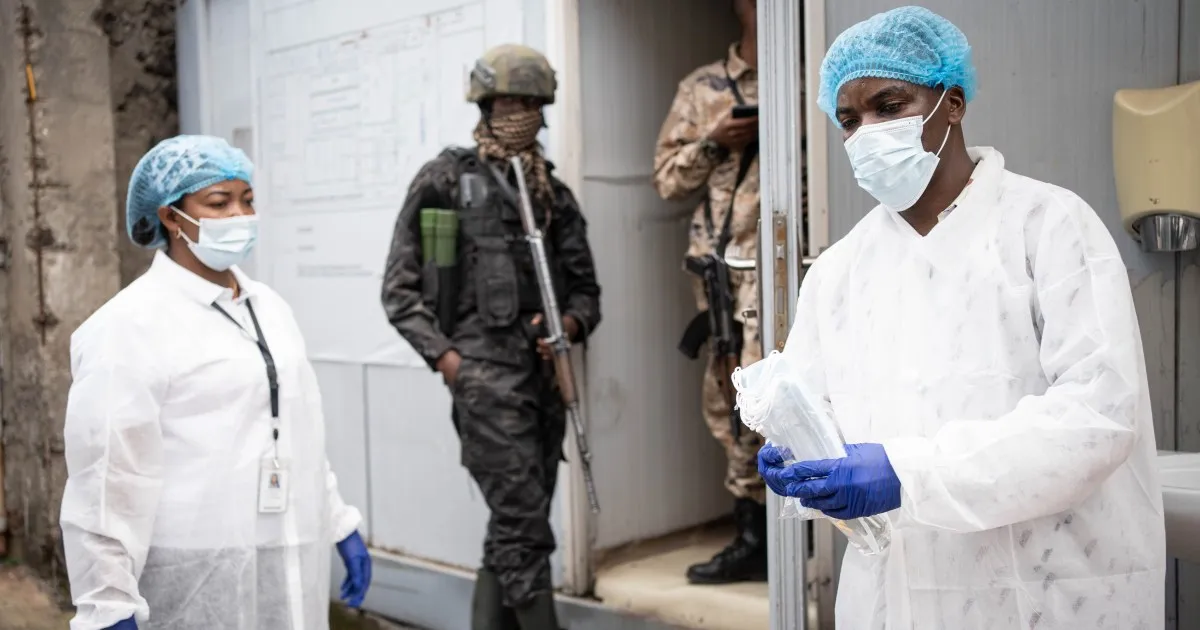
The Bundibugyo strain of Ebola has a fatality rate of up to 50 percent and no approved vaccine as yet.
The World Health Organization (WHO) has declared that the latest outbreak of a rare strain of the Ebola virus in Democratic Republic of the Congo (DRC) and Uganda is a “public health emergency of international concern”.
No vaccine or treatment exists for the new Bundibugyo strain of Ebola, a disease whose strains have killed more than 15,000 people in Africa in the past half-century. The previous Ebola outbreak in West Africa, which lasted between 2013 and 2016, killed at least 11,000 people, according to the National Library of Medicine.
list 1 of 3WHO chief ties funding cuts to Ebola, hantavirus outbreaks
list 2 of 3WHO responding to ‘complex, difficult’ Ebola outbreak in DR Congo
list 3 of 3WHO to hold emergency committee meeting as Ebola death toll rises to 131
So, how quickly can a vaccine be developed to contain the latest strain?
The epicentre of the latest outbreak is in DRC’s northeastern province of Ituri, close to the borders with Uganda and South Sudan, whose status as a gold-mining hub leads to people regularly crossing it.
The virus has also spread into neighbouring provinces of DRC, as far as 200km (125 miles) away from what has been identified as the epidemic’s “ground zero” as well as beyond the DRC’s borders.
The toll from the latest strain of the Ebola outbreak has risen to an estimated 131 deaths from 513 suspected cases, Health Minister Samuel Roger Kamba told the media on Tuesday. Over the past 24 hours, 26 more cases have been suspected.
In Uganda, according to the WHO, at least one person has died and two more people have been infected with the latest strain of the virus. Uganda government spokesperson Alan Kasujja told Al Jazeera’s Catherine Soi that more than 120 people are being quarantined and added that he is confident Uganda can control the spread of the virus.
Fear has, however, gripped both countries.
In the DRC, from Bukavu to Kinshasa, concern is spreading among residents and street vendors as Ebola cases rise. In cities hundreds of miles apart, people are wearing face masks and calling for stronger protections from the latest outbreak.
“I am afraid of bringing the disease home to my family because I spend the whole day transporting people. I am afraid of dying, that is what scares me so much,” a motorbike driver in the country told Al Jazeera.
“Last time [between 2013 and 2016], it killed a lot of people and we heard that it has reappeared, which makes us very afraid. Especially those of us who sell things in the street. We are in contact with people we do not know and that really frightens us,” Marie Evuto, a street vendor, said.
The WHO chief, Tedros Adhanom Ghebreyesus, said on Tuesday that he is “deeply concerned about the scale and speed of the epidemic”.
“Early on Sunday, I declared a public health emergency of international concern over an epidemic of Ebola disease in the Democratic Republic of the Congo and Uganda,” Tedros told the World Health Assembly in Geneva.
The Bundibugyo strain of Ebola is a distinct species within the Ebola virus family. It differs from the Zaire Ebola virus strain, which caused the large 2014-2016 West Africa outbreak, Krutika Kuppalli, associate professor at the Infectious Diseases and School of Public Health at UT Southwestern Medical Center in Dallas, Texas, told Al Jazeera.
“While Bundibugyo has caused fewer outbreaks historically, it is still a very serious pathogen. Prior outbreaks have had case fatality rates ranging from approximately 30-50 percent, and the current outbreak is particularly concerning because there are currently no licensed vaccines or specific therapeutics for Bundibugyo virus disease,” she said.
Kuppalli added that ongoing conflicts in the region, which have been accompanied by vast population displacement, weak surveillance systems and delayed detection, will make the latest outbreak more challenging to contain.
“Early cases may have been missed in part because many front-line diagnostic platforms were optimised for Zaire Ebola virus and do not reliably detect Bundibugyo virus,” she said.
“We are now seeing this strain of the virus spread into urban and cross-border settings, which raises concern about amplification if containment measures are not rapidly strengthened,” she warned.
There is currently no approved vaccine for this strain of the Ebola virus.
A vaccine named Ervebo, manufactured by Merck, which was used against the Zaire strain of Ebola, has been shown to provide some protection against Bundibugyo in animal studies.
Kuppalli from the UT Southwestern Medical Center explained that vaccine development timelines are difficult to predict.
“The scientific community is not starting from zero as there is already extensive knowledge from prior Ebola vaccine work, including viral vector and mRNA platforms that could potentially be adapted for Bundibugyo virus,” she said.
“However, moving from candidate design to clinical trials, manufacturing, regulatory review, and deployment still takes time, particularly during an active outbreak in resource-limited settings,” she added.
She noted that organisations such as CEPI (the Coalition for Epidemic Preparedness Innovations) have already recognised the need for broader “multivalent” filovirus vaccines that could protect against multiple Ebola species, including viruses that have not yet emerged widely in humans.
“CEPI has recently funded research specifically focused on broadly protective filovirus vaccines and rapid-response vaccine platforms. Their work reflects a growing recognition that relying on species-specific vaccines leaves the world vulnerable when a different Ebola species emerges,” she said.
Until a vaccine to prevent the latest strain is developed, a WHO official said on Tuesday that medical supplies, including personal protective equipment (PPE) to prevent Ebola, were due to arrive in the DRC.
“We have sent 12 tonnes of supply. An additional six are arriving today. These include personal protective equipment for front-line health workers [and] samples,” Anne Ancia, WHO representative in the Democratic Republic of the Congo’s Ituri province, told media.
Jean-Jacques Muyembe, a virus expert at the DRC’s National Institute of Biomedical Research, told reporters the country was also expecting shipments of an experimental vaccine for different types of Ebola from the United States and the United Kingdom.
Many countries have raised concerns about the latest Ebola virus outbreak and some, including Bahrain, have suspended the entry of foreign travellers arriving from South Sudan, the DRC and Uganda, for 30 days due to the outbreak.
Rwanda has also closed its borders with the DRC.
The US has implemented a 30-day temporary entry restriction for non-US citizens and non-permanent residents who have travelled to the DRC, Uganda or South Sudan within the prior 21 days.
Meanwhile, governments across Asia have begun introducing border screening and bolstering quarantine preparedness.
There is not the same urgency about developing a vaccine for Ebola as there was during the COVID-19 pandemic, Kuppalli said.
“COVID-19 vaccine development moved at unprecedented speed because the outbreak affected wealthy countries and rapidly disrupted the global economy,” she explained.
“African outbreaks have historically not generated the same urgency, financing, manufacturing investment or political attention despite causing devastating local consequences,” she said.
Kuppalli noted that Ebola vaccine development following the 2014 outbreak accelerated only after thousands of people had already died in West Africa.
“I do think there has been progress since 2014. Global partnerships involving WHO, CEPI, GAVI [the vaccine alliance], African scientists, regulators and research institutions are much stronger than they once were,” she said.
“The challenge now is ensuring sustained investment before crises become global threats, rather than only responding once outbreaks reach high-income countries. This outbreak underscores why equitable investment in epidemic preparedness and vaccine research matters not just for Africa, but for global health security overall,” she added.
Source: https://www.aljazeera.com/news/2026/5/21/ebola-outbreak-when-will-a-vaccine-be-developed-for-the-new-strain?traffic_source=rss