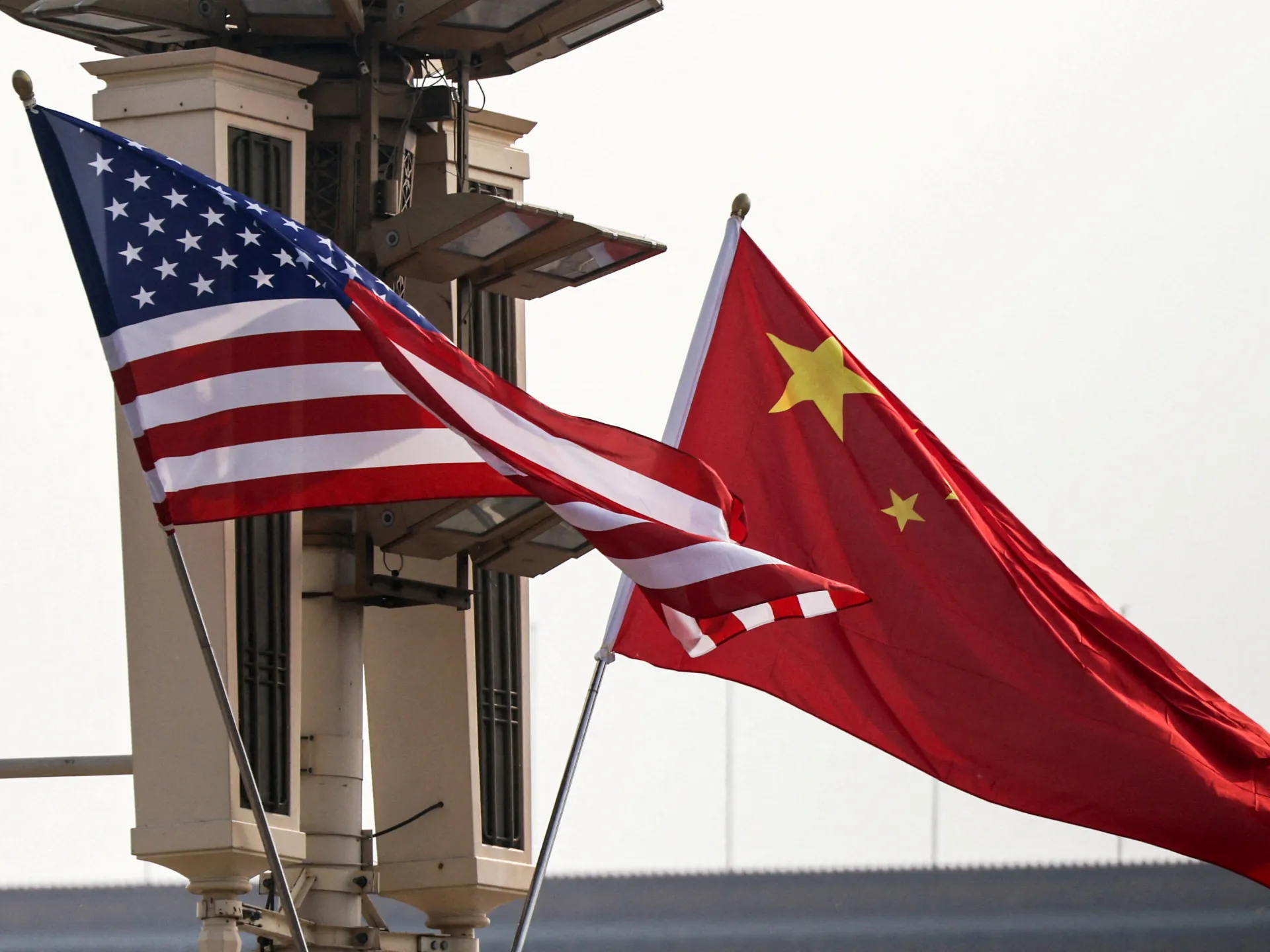
China, a key customer of Iranian oil, has advocated for a ceasefire, insisting US sanctions will not resolve the conflict.
China has said that it would safeguard its interests after Washington unveiled new measures while laying out plans for the “economic asphyxiation” of Beijing’s economic partner Iran.
Speaking at a regular news briefing in Beijing on Tuesday, Chinese Foreign Ministry spokesperson Lin Jian rejected Washington’s expanding pressure campaign, calling for an immediate end to unilateral measures.
list 1 of 3How US sanctions on Iran ripple through global markets and consumers
list 2 of 3The Iran war is bringing cyberwarfare into critical infrastructure
list 3 of 3Can Pakistani army chief make Iran’s military leaders restart US talks?
“Cooperation between China and Iran has always been conducted within the framework of international law and should not be interfered with or disrupted,” Lin said.
“China has already stated many times that it firmly opposes illegal unilateral sanctions … China will take all necessary measures to firmly safeguard its own rights and interests.”
The latest comments come nearly six months into the US-Israel war on Iran, as the United States rolls out new penalties on entities including several in China.
Washington also expanded secondary sanctions threats, urging governments worldwide to join its economic campaign.
Asked on Monday whether Chinese banks would be targeted by the new penalties, US Treasury Secretary Scott Bessent said, “No one is above the reach of US sanctions.”
China has advocated for a ceasefire, insisting US sanctions will not resolve the conflict.
Beijing remains a key customer for Iranian oil and is directly affected by the blockage of the Strait of Hormuz.
Iran has weathered sanctions for decades, using complex international financial networks to evade restrictions. Before the war, it continued to export millions of barrels of oil, mostly to China.
Amid the US’s latest move, some analysts say threats to sanction Chinese entities over trade with Iran are unlikely to materialise. This is due to a combination of diplomatic and legal obstacles, according to Trita Parsi, executive vice president of the Washington-based Quincy Institute for Responsible Statecraft.
“If the US now goes after the Chinese only weeks before [Chinese President] Xi [Jinping] is supposed to arrive in Washington, I find it unlikely,” Parsi told Al Jazeera, pointing out that Washington faces significant friction on both fronts.
Diplomatically, Parsi pointed out that Beijing helped avert a severe economic crisis during the height of the war by halting its oil purchases just as prices spiked, cratering demand and keeping crude under $100 per barrel for extended periods.
“They did this because the Chinese objective was to make sure this crisis would not bring about a global recession, which would be bad for China,” Parsi said, suggesting the move indirectly spared Washington from an energy shock that would have hurt the US economy.
Beyond that, Beijing is unlikely to accept US attacks on its companies or economic interests without pushback. “I suspect that we will see a lot of resistance from the Chinese if the US actually ends up going after Chinese companies,” Parsi said.
Separately, the president of the Iran-China Chamber of Commerce and Industries, Majidreza Hariri, also criticised US policies, warning that Washington has entered into an economic war with Tehran.
“What Trump has said makes it clear that he has entered into an economic war with us and considers it a new phase of military and security wars!” Hariri wrote in a post on X.
“With this same reasoning, all of America’s economic targets and its partners around the world, and especially in the region, are considered military targets of the enemy and are targetable!”
Source: https://www.aljazeera.com/economy/2026/8/25/china-says-will-safeguard-its-own-interests-as-us-expands-iran-sanctions?traffic_source=rss