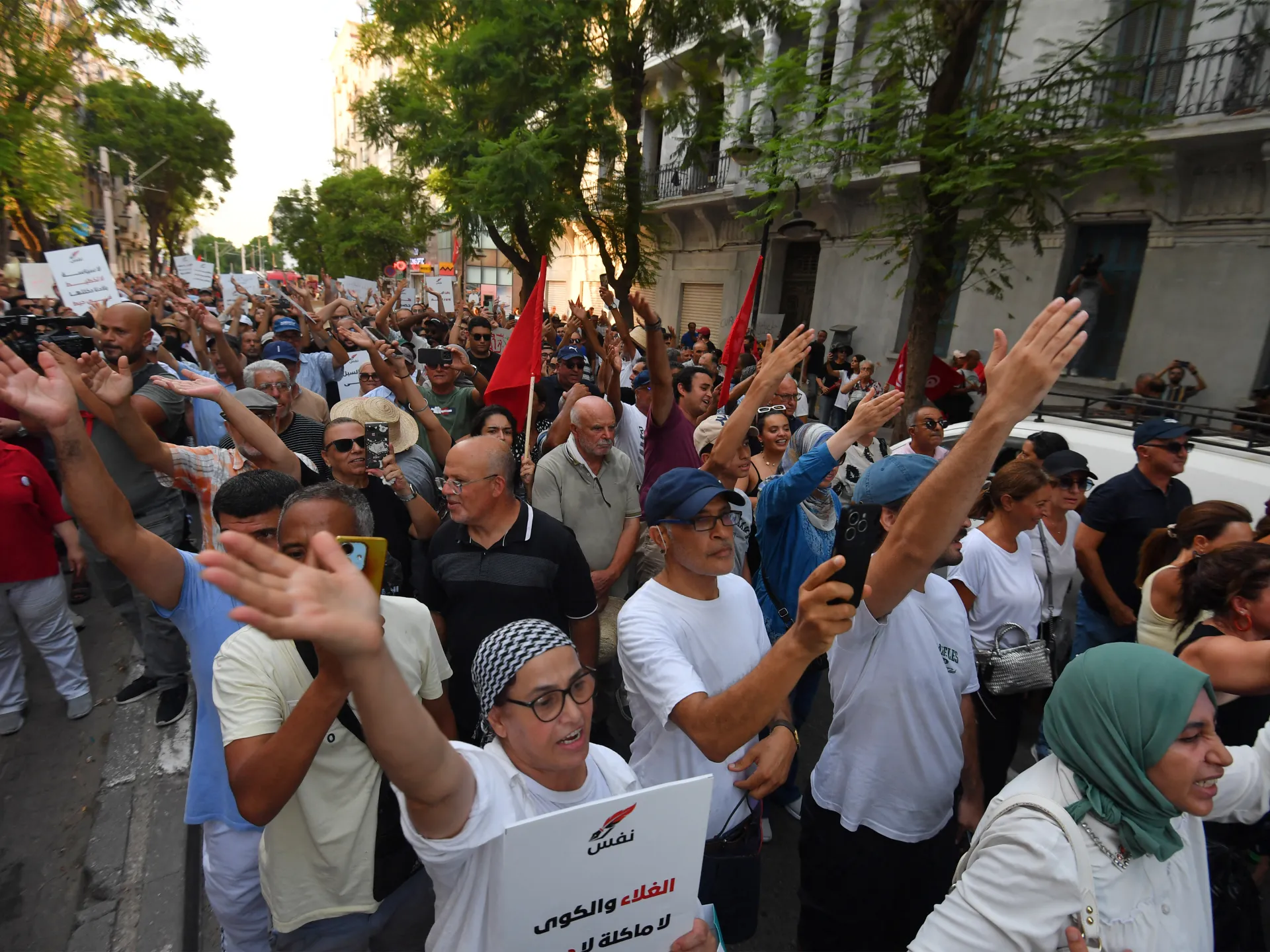
Tunisia has seen an uptick in protests as economic conditions in the country have deteriorated.
Hundreds of protesters have taken to the streets of Tunisia’s capital to call for the ousting of President Kais Saied and the restoration of democracy.
Protesters in Tunis said on Thursday that they reject “one-man rule” and “a slide towards dictatorship”, and urged the release of jailed opposition figures, activists and journalists.
list 1 of 3Tunisia’s body politic is in crisis
list 2 of 3Tunisian wildfires expose failing infrastructure, community vulnerabilities
list 3 of 3Beneath Tunisia’s silence, public anger simmers
Thursday’s protest follows a similar one on July 25, which was scheduled to coincide with the anniversary of President Saied’s 2021 dismissal of the government and suspension of parliament. He began ruling by decree later that year and dissolved parliament in 2022.
One demonstrator at Thursday’s march, activist Wissem Sghaier, said the country is “experiencing a complete collapse”, the Reuters news agency reported.
Tunisians are facing mounting economic and cost-of-living pressures, with deteriorating public services and shortages of some basic goods and medicines.
Tunisia’s inflation rate currently sits at 5.2 percent, according to the World Bank. Investment in the country has fallen precipitously, and Saied’s government has introduced a series of cost-saving measures, including halting public sector hiring and reducing imports.
Protests have broken out in several parts of the country in recent weeks over water and power cuts and environmental problems, suggesting that public anger is spreading beyond political disputes with Saied to the mounting hardships of everyday life. The country was also one of a number of North African countries to be hit by major wildfires this summer.
Rights groups, meanwhile, say that Saied has presided over a broad crackdown targeting opposition leaders, independent civil society groups, journalists and activists.
Saied, a 68-year-old independent politician and former constitutional lawyer, was elected in 2019 in a victory that he described at the time as “like a revolution”. His campaign refused to take money and instead relied on a diverse array of Tunisian volunteers, and its messaging focused heavily on tackling corruption.
Saied was one of the legal advisers who helped draft Tunisia’s 2014 democratic constitution, though he soon spoke out against elements of the document.
Since coming to power, Saied has drawn the ire of international rights groups for a series of measures perceived as anti-democratic. That includes reforms of the judiciary that gave Saied unprecedented control over Tunisia’s courts via the creation of a new governing body with him at the head, and mass trials of political opponents.
Source: https://www.aljazeera.com/news/2026/8/21/antigovernment-protesters-take-to-tunisias-streets-for-second-month?traffic_source=rss